
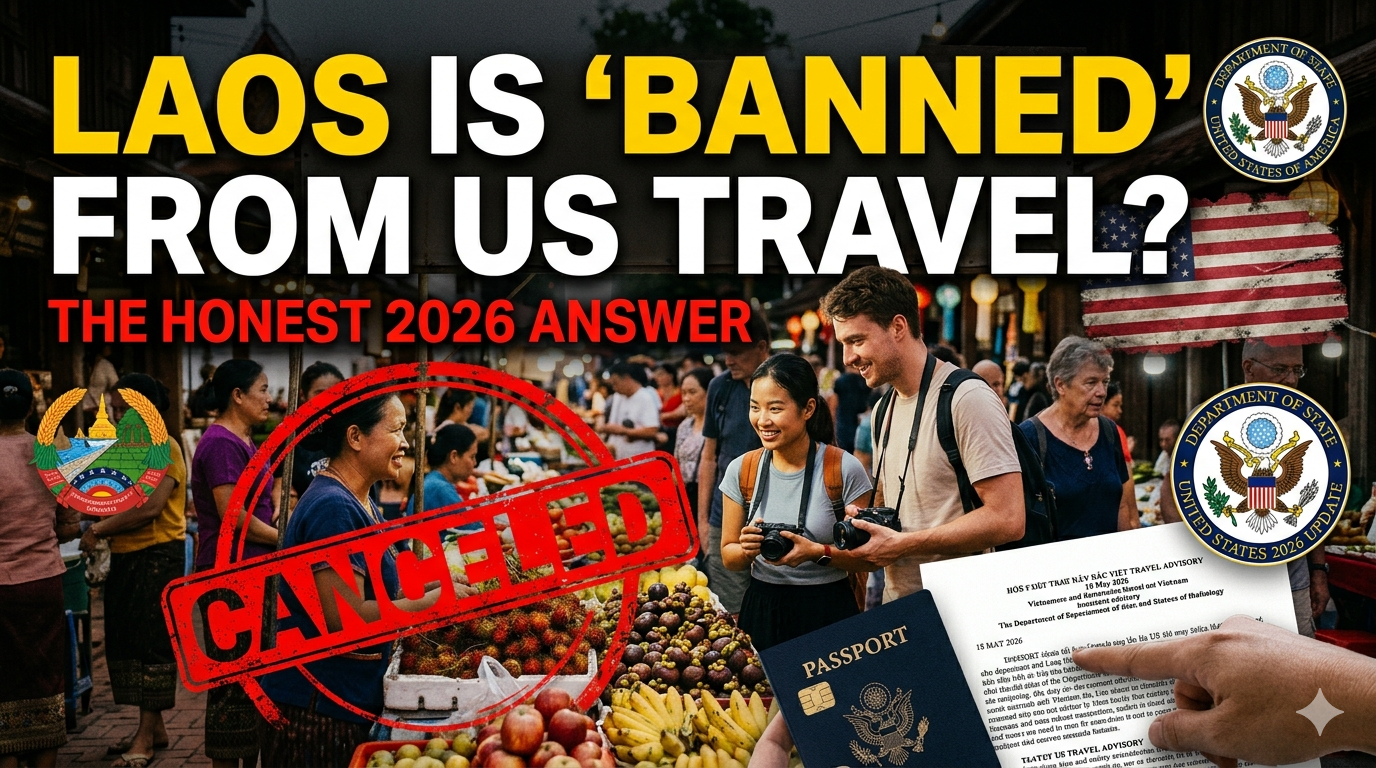
Why is Laos "banned" from US travel? The honest 2026 answer
Short version, because you came here for one: Laos is not banned. There is no US travel ban on Laos, no visa suspension, no Do-Not-Travel order on the country as a whole. The reason this question is trending in People-Also-Ask is that something real did happen — six tourists, including a 20-year-old American woman, died from methanol-poisoned alcohol in Vang Vieng in November 2024 — and the search algorithms have been chewing on that story ever since. People type "banned" because the headlines felt that big.
What they're actually asking is: is it still safe to go? So let's answer the real question.
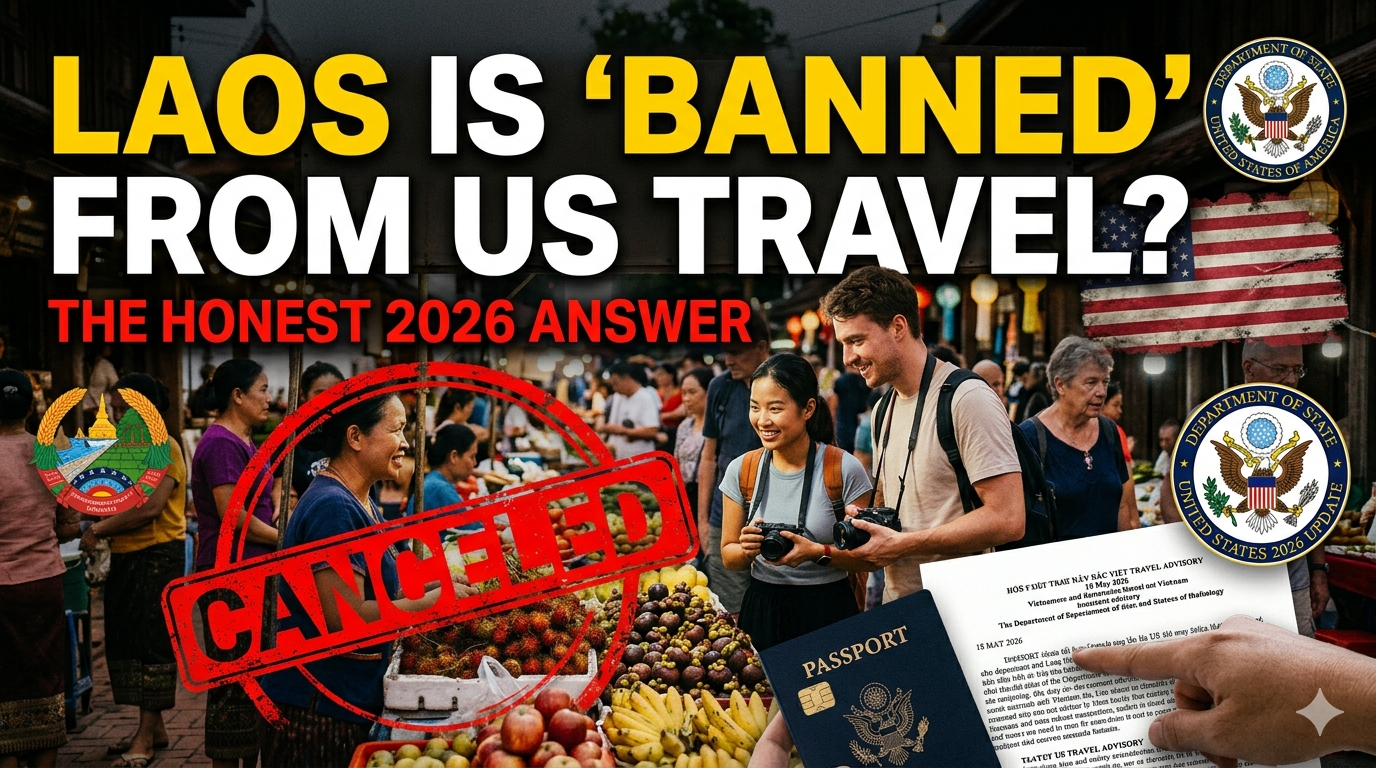
The honest answer
I'd go to Laos in 2026. I'd go with my eyes open about a specific, narrow risk — counterfeit spirits — and I'd structure my drinking accordingly. That's it. That's the headline.
The current US State Department advisory for Laos is Level 2: Exercise Increased Caution, last reissued November 21, 2024. Level 2 is the same level the State Department applies to France, Germany, Italy, and the UK. The advisory's main flags aren't even methanol — they're civil unrest in Xaisomboun Province (which is Level 3, Reconsider Travel, and which you have no tourist reason to visit anyway), unexploded ordnance off the beaten path in heavily bombed provinces, and border-area crime near Burma. Methanol isn't mentioned in the State Department text at all, though the US Embassy in Vientiane has issued separate health alerts on it.
The UK's Foreign, Commonwealth & Development Office (FCDO) is more direct: it expanded its methanol-specific warning for Laos in October 2025, and it names two products by name to avoid — Tiger Vodka and Tiger Whisky, both ordered off-sale by Lao authorities.
So the calibrated answer is: Laos is a Level 2 country with a specific, well-documented adulterated-alcohol problem in the backpacker drinking scene. The country is not dangerous to walk around in. The country is not dangerous to eat in. A subset of the cheap-spirits supply chain is genuinely dangerous, and you can route around it.
What to know before you go
Entry. Most Western passports (US, UK, EU, AU, NZ, Canada) can enter Laos either via eVisa through the official portal laoevisa.gov.la (about USD 50, processed in roughly three business days) or via visa on arrival at Wattay International (Vientiane), Luang Prabang International, and Pakse International, plus the major land crossings from Thailand. Both grant 30 days, extendable once for another 30 at immigration offices in the main cities. Your passport must have at least six months' validity remaining. There are no female-specific entry barriers, no proof-of-onward-travel theater I've personally been hassled about, and no vaccination requirements at entry beyond yellow fever if you're arriving from a yellow-fever country.
Vaccinations to talk to your travel clinic about: Hepatitis A and typhoid are the standard SEA recommendations. Japanese encephalitis if you're going rural for any length of time. Rabies pre-exposure if you're cycling or motorbiking — post-exposure treatment in rural Laos is patchy. Malaria risk is low in tourist zones but real along the borders.
Period-friendly logistics. Pads are easy to find in Vientiane, Luang Prabang, and Vang Vieng. Tampons are genuinely hard outside the capital — bring what you'll need, or switch to a menstrual cup before you fly. The bathroom infrastructure for cup-rinsing is fine in mid-range guesthouses; less so on overnight buses and slow boats. Plan accordingly.
Cash. Laos is more cash-dependent than its neighbors. ATMs work in cities but eat foreign cards regularly. Bring USD as a backup. Lao kip has been volatile against the dollar through 2024-25, so check rates the morning you change money.
Getting around safely
The genuine, non-alcohol safety risks in Laos are mostly transport.
Buses. Overnight VIP buses between Vientiane, Vang Vieng, and Luang Prabang have a poor accident record on mountain roads. If your schedule allows it, take the Laos-China Railway instead — the high-speed line opened in 2021 and is the single biggest practical change in Lao travel in a decade. Vientiane to Luang Prabang in under two hours, in a clean modern carriage, for around USD 25 in second class. Book a day or two ahead through your guesthouse or the LCR Ticket app; tickets sell out in high season.
Motorbikes in Vang Vieng and the Bolaven Plateau. Rentals come without insurance and often without functioning brakes. Helmet quality is bad. If you must ride, inspect the bike yourself, demand a real helmet, and stay off the Pakse-Bolaven loop at dusk when livestock are crossing. If you've never ridden, this is not the country to learn. Foreign embassy data consistently lists motorbike crashes as the leading cause of tourist hospitalizations in Laos.
Unexploded ordnance (UXO). Laos is the most-bombed country per capita in history — a legacy of the Secret War. The State Department flags this for a reason. The practical rule: stay on well-used roads, paths, and tracks, especially in Xieng Khouang (the Plain of Jars), Savannakhet, Salavan, and along old Ho Chi Minh Trail routes. Don't touch metal objects on the ground. Don't go off-trail to pee. This isn't paranoia; it's how locals live.
Night transport in cities. Vientiane and Luang Prabang both feel safe to walk in after dark in the tourist core. I've walked back to my guesthouse alone in both at 11 pm without incident. The thing to actually watch for is the tuk-tuk price gouge after a few drinks, not a safety threat. Agree on the fare before you get in.
Where to stay — and the methanol question
Here is where I'll be specific, because this is where the search query is coming from.
The November 2024 poisoning was traced to free welcome shots offered at Nana Backpacker Hostel in Vang Vieng. Eleven Nana staff were detained. A factory outside Vientiane producing counterfeit spirits was raided in December 2024 and the owner arrested, though the Lao government never formally confirmed the link in court. As of mid-2025, the same property was reported to be attempting to relist as "Vang Vieng Central Backpackers Hostel" — Tripadvisor has not confirmed a change of ownership and old Nana reviews remain attached to the new listing. If you're booking in Vang Vieng, cross-check the address against the old Nana location (it's a short walk west of the river, near the old airstrip).
Hostels with consistently clean post-incident track records, based on Hostelworld and Hostelgeeks reviews through early 2026:
Vang Vieng Freedom Backpackers — well-run, free breakfast, no free-shot welcome culture.
Mad Monkey Vang Vieng — the regional chain. Whatever you think of party hostels, Mad Monkey runs centralized procurement and has a public alcohol-sourcing policy across its SEA properties post-2024.
Vang Vieng Chill House — quieter, off the main drag, run by a local family.
In Luang Prabang, the picture is calmer because the drinking scene is calmer. Mad Monkey Luang Prabang, Downtown Backpackers, and a stack of boutique guesthouses on the peninsula (Villa Maly, Sanctuary Hotel, Villa Santi for splurges) are all reliable. In Vientiane, the Vayakorn Inn and Dhavara Boutique Hotel are long-trusted; for hostels, Barn1920s has held up well.
The drink-safe rules
This is the actionable bit. Print it out if you want.
No free shots. Ever. Whatever the bar, whatever the welcome ritual. The 2024 deaths happened because young travelers accepted free welcome shots at a hostel. A bar offering free spirits is either subsidizing them — which means cutting them — or losing money.
No bucket cocktails, no premixed jugs, no "house" spirits. This is the FCDO's specific guidance and it tracks with how methanol enters the supply chain: cheap counterfeit spirits get hidden inside mixed drinks where you can't smell or taste them. Methanol has no warning flavor.
No Tiger Vodka, no Tiger Whisky. Named by Lao authorities and the FCDO as banned-from-sale products. If you see them on a back-bar shelf, that's the bar.
Beer is fine. Beerlao is one of the great SEA lagers, brewed under tight quality control, and it's everywhere. If you want to drink in Laos and not think about any of this, drink Beerlao.
Wine and sealed imports are fine if the seal is intact when it reaches your table. Watch it get opened.
Lao-Lao (the local rice spirit) is where it gets nuanced. Village-distilled lao-lao at a homestay, served by the family that made it, is part of the cultural fabric and is generally safe — methanol contamination is a counterfeit-industrial problem, not a village-still problem. Lao-lao in a backpacker bar in Vang Vieng, poured from an unlabeled bottle: skip it.
Symptoms to know. Methanol poisoning mimics a bad hangover at first — nausea, vomiting, headache — and then 12 to 48 hours later you get blurred vision, confusion, difficulty breathing. If anyone in your group has vision changes after drinking, get to a hospital immediately and say the word "methanol" out loud. The antidote (ethanol or fomepizole) works, but only if treatment starts before the optic nerve is damaged. Vientiane has the best hospitals; Vang Vieng's clinic will stabilize and refer.
If something goes wrong
US Embassy Vientiane: Thadeua Road, KM 9, Vientiane. +856 21 487-000. After-hours emergencies: same number, follow the prompts.
UK Embassy Vientiane: Rue Yokkabath, Ban Wattay Yai. +856 30 770-0000.
Australian Embassy Vientiane: KM 4, Thadeua Road. +856 21 353-800.
Tourist Police, Vientiane: 1192.
Medical: For anything serious, the move is evacuation to Bangkok — Bumrungrad or Bangkok Hospital. Have travel insurance with medevac coverage. This is not negotiable for Laos. World Nomads, SafetyWing, and IMG Global all cover it.
Where your money goes
Laos has one of SEA's lowest GDP-per-capita figures, and tourism revenue leaks out fast when you book through international platforms. A few ways to keep more of it local:
Tour operators worth your money: Tiger Trail Travel (Luang Prabang-based, Responsible Tourism UK certified, runs the Fair Trek community program), Wander Laos (Lao-owned, Mr. Somsay's outfit in Luang Prabang, strong on textile and cooking experiences with master artisans), and Nakarath Travel for multi-day itineraries that route profits back to village partners.
Skip the "ethical" elephant rides. There is no such thing as a riding-elephant sanctuary. The MandaLao elephant conservation project outside Luang Prabang is the one I'd send a friend to: no riding, observation and walking only, rehoming program for retired logging elephants.
Women-run textile cooperatives. Ock Pop Tok in Luang Prabang trains women weavers, pays above-market wages, and runs day classes you can take. The shop is on the river road; the Living Crafts Centre is two km out. Houey Hong Vocational Training Centre in Vientiane does similar work and runs natural-dye workshops.
Stay in family-run guesthouses, not chains. The price gap is small; the revenue distribution is night and day.
The bottom line
I'd go to Laos in 2026. I'd take the high-speed train. I'd stay on Beerlao. I'd skip Vang Vieng's free-shots scene entirely and probably spend my Vang Vieng days on the river and in the caves rather than at the hostel bar. I'd give my evenings to Luang Prabang — sunset on the Mekong, the morning alms procession watched quietly from across the street, a slow dinner at a Lao-owned place on the peninsula.
The methanol story is real and it killed people, and Laos has done a worse job of public accountability than its neighbors would have. Both of those things are true. But the country isn't banned, isn't dangerous to walk through, and isn't going to be off your itinerary if you can follow one rule: don't drink mystery spirits offered for free or cheap. That's the whole risk model.
Go. Be specific. Have a great trip.
Solo female traveler from Bangalore. Safety advocate, responsible tourism, women-run cooperatives — empowering, never alarmist.
✦ More from Priya Sharma


✦ Keep reading
More from this region


More in Destinations
✦ Discussion
Start the discussion
No replies yet — yours could be the first.