
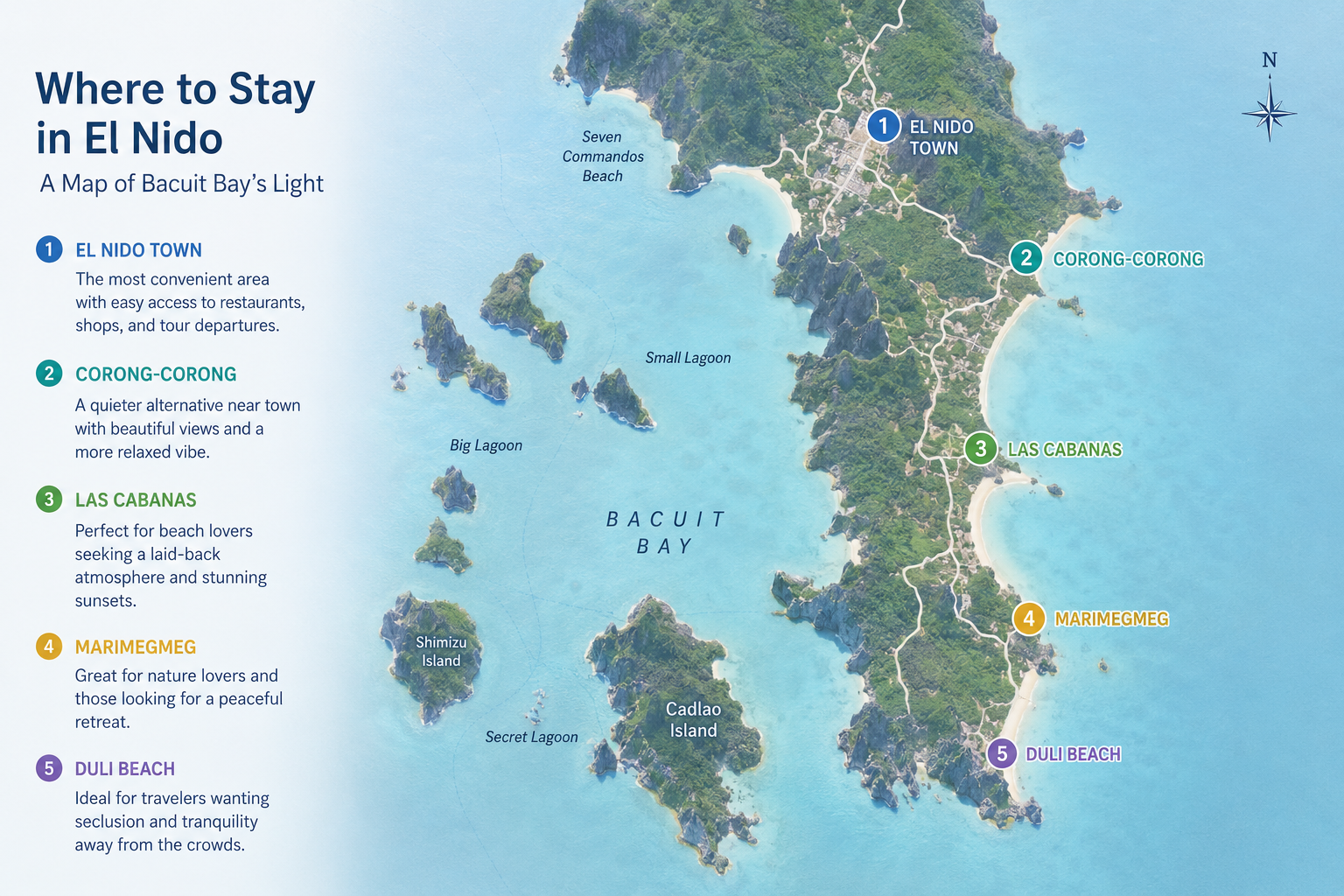
Where to Stay in El Nido: A Map of Bacuit Bay's Light
There is a moment, somewhere around 5:20 in the afternoon in March, when the western light leaves the open water of Bacuit Bay and begins to climb the eastern faces of the karst islands. The limestone, which has held the high midday sun as a uniform white-grey for six hours, goes briefly the colour of unripe apricots — a warm, ochre flush that lasts perhaps ten minutes — and then the towers turn back into silhouettes against a sky going pink and then bruise and then, very quickly, dark. The water in front of you, depending on the angle and the day, is somewhere on a scale between celadon and the green of oxidised copper. A single outrigger bangka drifts across the foreground. This is the photograph people come to El Nido for, and the place you choose to sleep determines whether you are the one standing on the right beach at 5:18.
El Nido is not one place. It is four — possibly five — and they offer wildly different versions of the same bay. Choose the wrong one and you will spend the trip in a tricycle, missing light. Choose the right one and the picture is at the end of your bed.
El Nido is not one place. It is four — possibly five — and they offer wildly different versions of the same bay.
What you're actually choosing between
The administrative town of El Nido sits at the north-western tip of Palawan, facing into Bacuit Bay — a roughly twelve-kilometre crescent of water studded with around forty-five limestone karst islands, the geological signature of the place. Almost everything called "El Nido" is one of the following:
El Nido Town itself: a dense, low-rise grid of guesthouses and beachfront bars, pressed up against a working bangka harbour. Cheap, lively, noisy, central. The tours all launch from here. Best for travellers who want to walk to dinner and out for a drink.
Corong-Corong: the next bay south, about ten to fifteen minutes by tricycle. Quieter, set back from the harbour, west-facing — which means sunsets directly off your beach rather than around a headland. Increasingly the savvy traveller's choice.
Lio Beach and the Lio Tourism Estate: a master-planned development by Ayala Land about five minutes from El Nido's small airport, sixteen kilometres north-east of town. Clean, almost suspiciously curated. Includes Seda Lio, a children's playground, and a row of restaurants in low whitewashed buildings.
Nacpan Beach: a four-kilometre stretch of sand about forty-five minutes by van north of El Nido Town. Wild, mostly empty, the wrong direction for Bacuit Bay tours but spectacular for anyone who has come to photograph long beaches at low light.
The offshore island resorts: Miniloc, Lagen, and Pangulasian (all El Nido Resorts properties, operated by Ayala), plus the more remote Apulit Island over on the eastern side of Palawan in Taytay Bay. These are the all-inclusive, fly-in, world-class properties. Different country, different budget, different trip.
Each of these chooses something different for you. What you see when you open the curtain. What you hear at 6:30am. How long you sit in a tricycle before you get to a boat.
El Nido Town: where the trip is happening
If your reason for coming to El Nido is the social rhythm — meeting other travellers, eating at a different street-corner grill every night, drinking a San Miguel at a low table while the bangkas come in — stay in town. Specifically, stay in the strip of streets between Calle Hama, Calle Real, and the beachfront. The walking is excellent; everything you need is inside a four-block radius.
The honest take on El Nido Town for a photographer is mixed. The beach itself, in front of town, is a working harbour: bangkas pulled up to the sand in rows, a constant low-grade tangle of boatmen, fuel cans, plastic chairs. It is not the postcard. You will not photograph it like the brochures. But it has its own picture — a frame of late-afternoon light raking across the painted hulls of the boats, fishermen mending nets, the karst rising in the background like a slightly improbable theatre flat. Treat it as a working port that happens to be beautiful, not as a beach. The 2025 noise ordinance has tamed the worst of the late-night music — outdoor bars must close their amplifiers by midnight — but the streets still have a constant background of generators, scooters, and morning roosters. Sleep on the eastern side of the grid if you mean to get up for tours; the bangkas blow their horns from about 6:30am.
For accommodation in town, the mid-range options change faster than I can name them in print. The general principle: pick a guesthouse that explicitly markets quiet, has an interior courtyard, and is not on Calle Hama itself. Hostels here run $15–$25 a night. Mid-range guesthouses $50–$120.
Corong-Corong: the photographer's compromise
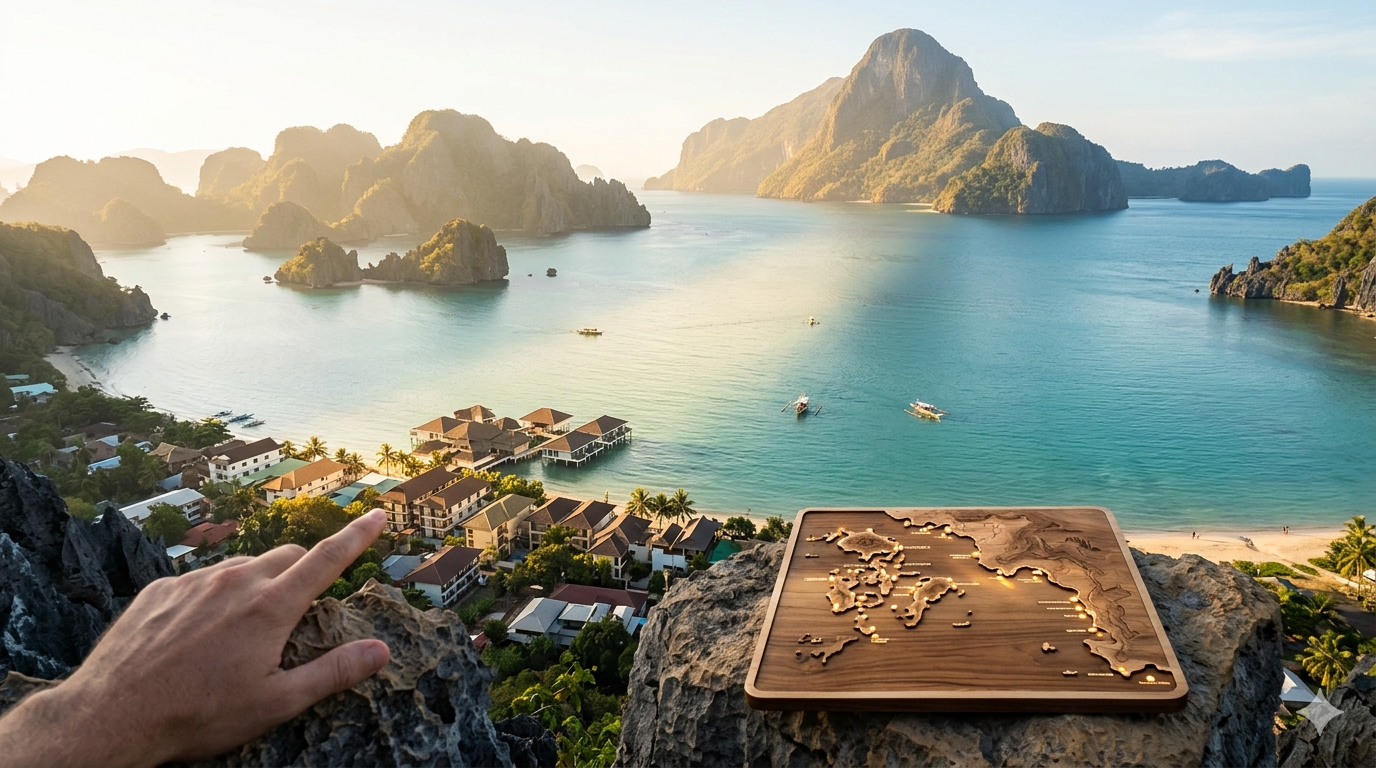
Of all the choices on this list, the one I most reliably recommend to readers who want to photograph the bay is Corong-Corong. It is the next bay south of town — close enough that a tricycle to the El Nido tour piers is ten to fifteen minutes (PHP 150–200, around three dollars), far enough that you fall asleep to the sound of water on sand rather than karaoke.
Corong-Corong faces directly west into Bacuit Bay, which is the geometric fact that makes the entire piece. From the beach in front of your guesthouse you have, every single dry-season evening, a clean line of sight to a sun setting through the karst silhouettes. You do not have to go anywhere. You do not have to negotiate with a tricycle driver at 5:10. You walk down twelve steps from your room and the picture is already composing itself.
The development along Corong-Corong's beachfront is a mix: some long-running guesthouses, some recently-opened mid-range resorts, a handful of small boutique stays in the $100–$200 range that have crept in over the last few years. Two pieces of advice. First, stay on the beachfront itself, not on the highway side — the two are separated by a single road, but the difference is the difference between the photograph and not. Second, walk the southern end of the strip. Properties at the south end are quieter, with longer uninterrupted views.
The trade-off you are accepting in Corong-Corong is the walk to dinner. Most travellers tricycle back into El Nido Town for the night's eating, then tricycle home. It is not a huge thing — fifteen minutes, three dollars — but it adds up over five evenings.
You do not have to go anywhere. You do not have to negotiate with a tricycle driver at 5:10. You walk down twelve steps from your room and the picture is already composing itself.
Lio Beach: the planned alternative
About sixteen kilometres north-east of El Nido Town, on the way to (and including) the airport, sits the Lio Tourism Estate — a planned development by Ayala Land that wears its planning quite openly. Low whitewashed buildings, broad clean boulevards, a row of restaurants in matching architecture along a single avenue called Kalye Artisano. The beach itself is long, gently curved, and faces north-west, so the sunsets are around the headland rather than directly off the sand.
The flagship hotel here is Seda Lio, a 153-room beachfront property operated by Ayala's Seda Hotels brand. Three interconnected pools, a poolside bar, three minutes' walk to Lio Airport, and free shuttle service to El Nido Town for those who want the night-market side of the trip. The architecture is competent and the staff are excellent. What it is not, for a photographer, is gritty or specific. You are staying in a brand-new resort estate that could in some lights be on Java, in others on the Yucatán. The beach is clean and quiet, the food is reliable, the wifi works. Some travellers want exactly this. Some find it strange to come this far for it.
Lio's argument is convenience: if your flight lands at five and you want to be in a swimming pool by six, the estate is hard to beat. Its argument against itself is that you are forty-five minutes from where the boats launch, and you will spend a meaningful slice of every day getting back and forth.
Nacpan Beach: for the long-beach landscape shooter
About forty-five minutes by van north of El Nido Town — call it twenty-two kilometres up a dirt road that has improved markedly in the last five years — is Nacpan Beach, a four-kilometre crescent of pale sand and the kind of unbroken horizon Bacuit Bay does not give you. Nacpan is not karst country. It is open ocean and long sand and palms, and for a particular kind of landscape photographer it is the most rewarding stretch of coast in northern Palawan.
A small number of resorts now operate directly on the beach — Nacpan Beach Resort, Nacpan Beach Villas, a handful of smaller bungalow operations — with rates in the $80–$200 range. The trade-off is severe: if you stay on Nacpan, the day-tour scene of Bacuit Bay becomes a major logistical undertaking, with most boats launching from El Nido Town an hour away. Conversely, if you have come specifically for the long beach at dawn, with a horizon of carabao silhouettes and a five-minute walk to the next photograph, this is the only place to be.
My honest recommendation: stay one or two nights in Nacpan as a deliberate split, not as your base. Most travellers do best with three nights in Corong-Corong or town, then a night out at Nacpan, then back to town for the flight.
The island resorts: a different argument
The four El Nido Resorts properties — Miniloc, Lagen, Pangulasian, and the more remote Apulit — are a different conversation. These are full-board, fly-in, $700–$2,500 a night experiences run by a single Ayala-affiliated operator with decades of experience in the bay. They are also among the few places in the Philippines where the trip from your bed to a kayak is genuinely measured in metres.
Pangulasian Island is the photographer's choice among the three Bacuit Bay properties. The island sits roughly in the centre of the bay, with a 750-metre white-sand beach facing west toward the karst horizon — which means sunsets directly off the front of the resort — and an eastward exposure on the back of the island where the morning light comes up over the open water. The marketing nickname is "Island of the Sun", which is unusually accurate. The architecture is wood-and-glass beach villas with private terraces, an infinity pool that catches the western light at six in the evening, and a relatively small footprint (forty-two villas total). The thing Pangulasian gives you that the other two don't is genuinely good light at both ends of the day from the same property.
Lagen Island is the more isolated and upscale of the older two properties. It sits in a sheltered cove on the northern edge of Bacuit Bay, surrounded by tropical forest, with a freshwater pool that Miniloc does not have. Lagen is quieter, more enclosed, and slightly further from the centre of the bay's snorkelling sites. Pick Lagen if your priority is privacy and afternoon swimming in something other than salt water.
Miniloc Island is the original El Nido Resort, built in 1982, and the architecture leans into a more rustic Filipino vernacular — bamboo, nipa thatch, native-style cottages set directly on the water. Miniloc is also positioned closer to the central snorkelling sites of the bay, which means a shorter boat ride to the day's destinations. For divers and snorkellers, this matters. The aesthetic, however, is more rough-cut than the other two — some travellers love that, some don't.
Apulit Island, off in Taytay Bay on the opposite (eastern) coast of Palawan, is a separate trip — ninety minutes by van from El Nido airport, then an hour by boat from Taytay Town Port. The bay is different (no karst on the same scale, but spectacular reef and turquoise water), the resort is more remote, and you will need to commit at least two nights. Pick Apulit if you have already done El Nido proper.
The honest framing for all four: if your budget allows it and your trip is photography-first, Pangulasian for three nights produces more of the postcard than anywhere else in Bacuit Bay. The trade-off is that you are inside a single resort the entire time, on a private island, with no access to the small slow texture of town. Some readers want exactly that. Others, after two nights, miss the noise.
The tour geography, and what it means for where you sleep
The two iconic day tours of Bacuit Bay are Tour A (Big Lagoon, Small Lagoon, Secret Lagoon, Shimizu Island, Seven Commandos Beach) and Tour C (Helicopter Island, Hidden Beach, Secret Beach, Talisay Beach, Matinloc Shrine). Both launch from El Nido Town's beachfront pier between 8:30 and 9:30am. Both return between 4:00 and 5:00pm.
For a photographer, Tour A is the lagoon tour — the karst-cathedral interiors, the jade water, the kayak shots between cliff walls. Big Lagoon is no longer accessible by motorboat (a 2018 ruling, environmental protection); you kayak in or swim. The light inside the lagoon is best in the morning, before the sun rises too high; aim for the first tour group out, which means staying within fifteen minutes of the pier.
Tour C is the outer-bay tour — Hidden Beach (entered through a narrow cleft in the limestone), Secret Beach (swimmable through a small opening only at certain tides), the wider seascapes. The light here is less time-sensitive, but the boat ride is longer.
If you mean to do both — and most readers should — your accommodation needs to be within twenty minutes of the El Nido Town beachfront. That rules in town itself, Corong-Corong, and Lio (with a shuttle); rules out Nacpan as a daily base; and rules out the offshore resorts (which run their own private boat tours rather than the public Tour A/C network).
Sunrise versus sunset: a quick directional note
A point of orientation, because it matters more in El Nido than it does in most places:
Sunrise in Bacuit Bay comes up behind the karst islands when viewed from town and Corong-Corong, which is to say it lights the eastern faces of the islands beautifully but does not give you the sun-on-the-water shot. For that, you need to be on Nacpan (north-facing, open ocean), on the eastern beach of Pangulasian, or out on a private dawn boat.
Sunset is universally the bigger event. Las Cabanas Beach (a ten-minute tricycle south of town, geographically the northern end of Corong-Corong), the Corong-Corong beachfront proper, and the western beach of Pangulasian are the three best sunset positions in the bay.
If you are a sunset photographer, stay Corong-Corong. If you are a sunrise photographer, stay Nacpan or Pangulasian.
The closing argument
For most readers who write in asking where to stay in El Nido — three to five nights, photography-leaning, a real interest in the place — the answer is Corong-Corong, in a small mid-range guesthouse on the southern half of the beachfront, with the budget allowing for one boat tour a day and a tricycle into town for dinner. You wake to the sound of water on sand. You walk twelve steps to your sunset. You are fifteen minutes from the pier when the tour launches at 8:45.
The alternative readings: town if you want the social rhythm, Lio if you want clean and easy, Nacpan if you have come specifically for the long beach at first light, Pangulasian if your budget is genuinely no object and you want to be in the picture from the moment you wake up.
What I would not do: stay anywhere that requires a forty-minute drive every morning to be where the boats are. Bacuit Bay is small. The light is short. Sleep close to the water.
Italian travel photographer-writer. Architecture, landscape, the light. Slow, deliberate, image-led essays.
✦ More from Marco Rossi


✦ Keep reading
More from this region


More in Destinations
✦ Discussion
Start the discussion
No replies yet — yours could be the first.