
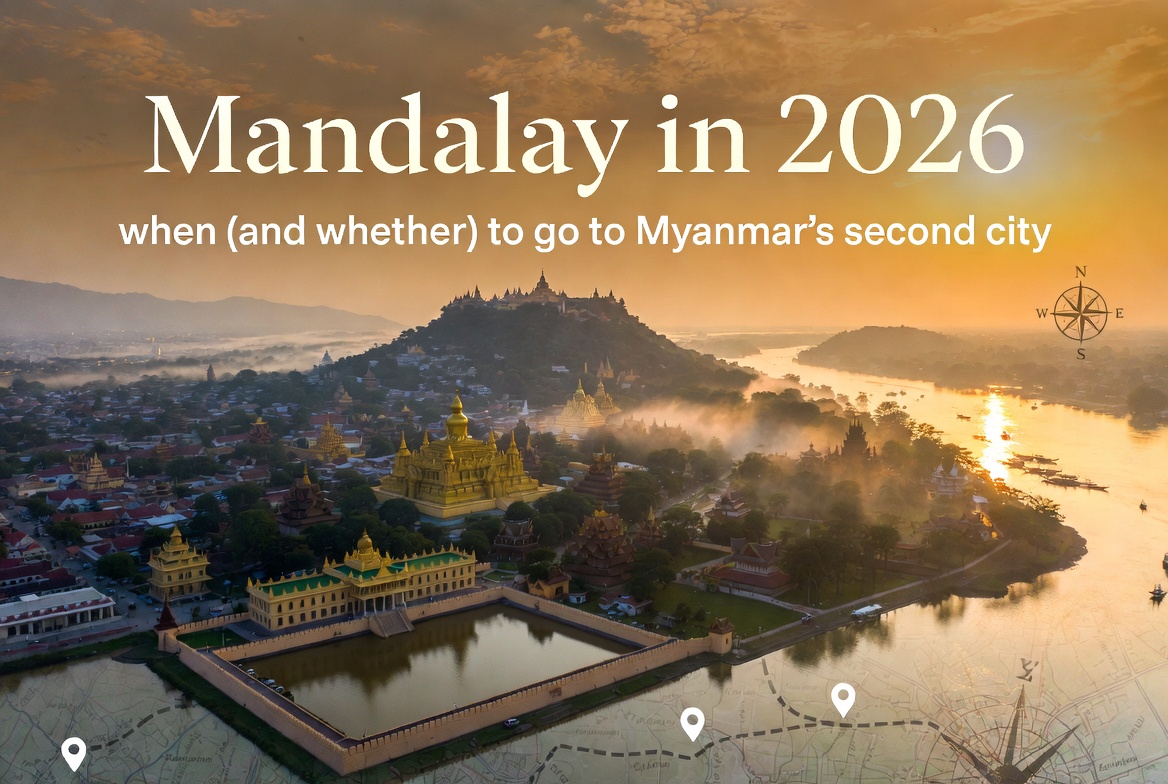
Mandalay in 2026: when (and whether) to go to Myanmar's second city
The query that brought you here is "when is the best time to visit Mandalay, Myanmar." The weather answer is straightforward and three sentences long. The honest answer is longer, because Myanmar in 2026 is not a country you can responsibly book on weather alone. It has been in active civil war since the February 2021 coup. In March 2025 a magnitude 7.7 earthquake levelled large parts of Mandalay itself. Most Western governments — the US, UK, Australia, Canada, the EU — currently advise against all travel. And yet around 90,000 foreign tourists entered Myanmar in the first three months of 2026, according to the junta's own tourism ministry, which means a lot of people are going anyway.
So let's do this properly: the weather, then the bigger question, then the practicalities for those who decide they're going.
The honest answer
If you're going, late November to mid-February is the window. Daytime temperatures hover around 25–30°C, nights drop to around 15°C, rain is minimal. March to May is brutally hot — Mandalay regularly hits 38–40°C in April, and the dust and haze from agricultural burning make the city unpleasant. May through October is the monsoon and shoulder seasons; not impossible, but humid, hot, and occasionally flooded.
Whether you go at all is a separate question, and I'm not going to answer it for you. I'll lay out what's actually true in 2026 and let you make the call. I have not been to Mandalay since 2019. What I'm writing here is built on government advisories, on Reuters and AFP reporting from March 2025 through April 2026, on the World Bank's May 2025 damage assessment, and on conversations with two women — one Burmese, one a Yangon-based long-term expat — who I've kept in touch with through the crisis. Where I'm uncertain I'll say so.
The bottom line on safety: tourists in the Yangon–Mandalay–Bagan–Inle Lake corridor — what the Myanmar tourism trade calls "the tourist kite" — have largely not been targets of the civil war. Tens of thousands have visited since 2022 without incident. That is not the same as "safe." The wider context is one of arbitrary detention, sudden military checkpoints, an unpredictable junta, conscription roundups, ethnic-armed-organisation clashes within striking distance of major roads, landmines in border states, and a healthcare system that is functionally broken outside the largest cities. Travel insurance from most major Western insurers will not cover you here because of the Level 4 advisories. If something goes wrong, your government cannot reliably help you. That's the deal.
What you're walking into
The political situation. The State Administration Council (SAC, the junta) controls the major cities and most of the central dry zone, including Mandalay. The National Unity Government (NUG, the elected-government-in-exile) and a constellation of ethnic armed organisations (the KIA in Kachin, the AA in Rakhine, the TNLA and MNDAA in northern Shan, the KNLA in Karen) control varying amounts of the periphery and contested territory. Front lines shift. As of May 2026, the NUG and allied forces hold a striking amount of rural Sagaing and parts of Magway — the regions surrounding Mandalay — though Mandalay city itself remains under SAC control.
Conscription. In February 2024 the junta activated a long-dormant 2010 law requiring military service from men 18–35 and women 18–27. Enforcement has been most aggressive in the central dry zone, including Mandalay. Tourists are not subject to this, but the effect on the city is visible: fewer young men around, families hiding sons, an undercurrent of fear in conversations you'd never read about in a guidebook. About 45,000 men had been drafted in nine batches in the first year. Tourists are not at risk of being conscripted, but the people you'll be talking to in restaurants and at temple gates are living inside this reality.
The 2025 earthquake. On 28 March 2025 a magnitude 7.7 earthquake struck near Sagaing, just west of Mandalay. The shallow depth made it devastating. Around 3,800 people died in Myanmar, more than 5,000 were injured. Mandalay bore the worst of it: roughly 65,000 buildings damaged across the affected zone, the World Bank put structural losses at around US$11 billion (14% of GDP), and reconstruction is expected to cost two to three times that figure. What this means for visitors in 2026, per AFP reporting in March 2026: most flattened residential buildings have been cleared. The Mandalay palace moat towers have been brought back upright. The Ava Bridge over the Irrawaddy is still partially collapsed — only some spans have been removed. Mingun lost the Hsinbyume Pagoda in significant measure, and 20 people were killed by a collapsing military bunker there. Reconstruction is patchy and slow, hampered by sanctions, by the civil war diverting resources, and by the junta's reluctance to allow some international aid in.
Sanctions and money. Myanmar is under US, UK, EU, Canadian, and Australian sanctions targeting the junta, military-owned conglomerates (MEC, MEHL), and key individuals. The financial sector is largely cut off from international banking. Practical effect on you: your cards won't work. There are essentially no functioning international ATMs for foreign cards inside the country. You bring cash, in crisp US dollars, no folds, no marks, no tears, ideally new-series notes. Banks and money changers refuse anything damaged. The kyat trades at roughly 2,800 per USD in 2026 (compared to 1,300 pre-coup), and the official exchange rate diverges from the street rate — use licensed but informal exchange in Yangon or Mandalay, not the airport counters.
Is it ethical to go?
This is the question that comes up in every post-coup Myanmar piece, and I've found the binary unhelpful. Here's what's actually true:
Tourism revenue partly funds the junta. All formal businesses pay junta taxes. Domestic flights (Myanmar National Airlines, Air KBZ, Mann Yadanarpon) have varying degrees of military entanglement. Hotels above a certain size often have a military partner. Entrance fees at major sites (Bagan archaeological zone, Mandalay Palace, Inle Lake zone fee) go to the government. You cannot fully avoid funding the junta if you visit.
Tourism revenue also keeps ordinary Burmese afloat. Family-run guesthouses, freelance guides (many of whom lost work in 2021 and again after the earthquake), local restaurants, artisan workshops, trishaw drivers, market vendors. The NUG itself, notably, has not called for a blanket tourism boycott in 2026 — its position has shifted from the early-coup boycott era. It asks tourists to avoid military-linked businesses, hire local independent guides, and use the visit to bear witness.
The Burmese people I've asked all say a version of the same thing: come if you come with eyes open, spend small and local, don't post photos that could identify resistance sympathisers, listen more than you talk, and don't romanticise.
If that ethics calculus doesn't sit right with you — go to Laos or northern Thailand instead. There is no obligation to make this trip. Anyone who tells you otherwise is selling something.
What to know before you go
Visa. The eVisa system at evisa.moip.gov.mm is functional in 2026. Tourist eVisa is valid 90 days from issue, allowing a stay of 28 days. Processing takes around 3 working days (up to three weeks in busy periods). Visa-on-arrival is suspended. Apply with a clean passport-page photo, hotel booking, and return flight.
Flights. International routes into Yangon operate from Bangkok (Thai Airways, Bangkok Airways, Myanmar Airways International), Singapore, and Kuala Lumpur, with reduced frequency vs. pre-2021. Mandalay International Airport handles a small number of regional flights and frequent domestic services. Practical route in 2026: fly Bangkok → Yangon, then domestic Yangon → Mandalay, around 70 minutes.
Insurance. This is the hard one. Most standard travel policies (World Nomads, SafetyWing, IMG, AXA) exclude Myanmar entirely under their conflict / FCDO-advisory clauses. The specialist options that do cover it — Battleface, High Risk Voyager, some Lloyd's syndicate-backed policies — are expensive (often US$15–25/day) and require declaring the destination. Do not travel uninsured here. Medical evacuation from Myanmar to Bangkok is a real possibility and runs five figures USD.
Connectivity. Local SIM cards work but speeds are throttled. VPNs are partially blocked but most function via paid services (Proton VPN, Mullvad have been reliable through 2026). Facebook is blocked but most Burmese still use it via VPN. Telegram and Signal work. Assume your communications are monitored.
Photography. Do not photograph: military personnel, checkpoints, government buildings, monks at political-feeling gatherings, anyone protesting. Tourist photography of temples, markets, and landscapes is fine.
Mandalay specifically: what's open, what isn't
Functioning and worth your time:
Mandalay Hill — climb at sunset for views over the city. The 1,700-step covered stairway is intact.
Kuthodaw Pagoda — "the world's largest book," 729 marble slabs of Buddhist scripture. Largely intact.
Shwenandaw Monastery — the elaborate teak monastery that survived WWII bombing. Earthquake damage was minor.
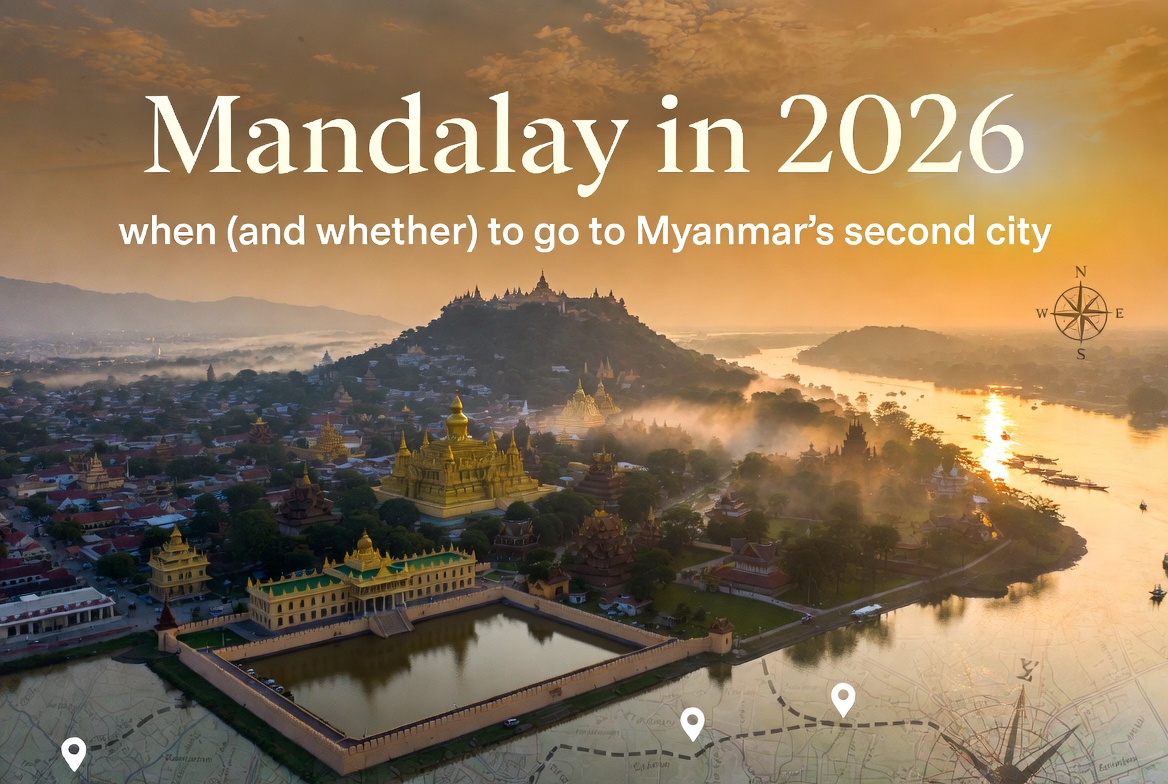
Mandalay Palace and the restored moat towers — the towers were toppled in the earthquake and have been brought back upright as of early 2026.
U Bein Bridge in Amarapura — the 1.2km teak footbridge over Taungthaman Lake. Per March 2026 AFP reporting it remains a functioning tourist site. Sunset is the iconic time. Go with a local guide who knows which sections were repaired.
Mahagandayon Monastery in Amarapura — the famous mass alms-round of monks at 10:30am. Be respectful, don't crowd the line, ask before photographing faces.
Inwa (Ava) — the old capital across the river. Horse-cart tours of the brick monasteries remain a thing. The Ava Bridge itself is still partially collapsed, so you go by the newer Yadanabon Bridge.
Functioning but with caveats:
Mingun — accessible by Irrawaddy boat from Mandalay. The Mingun Pahtodawgyi (the giant unfinished stupa) is significantly cracked but standing. The Hsinbyume Pagoda was largely destroyed in the 2025 earthquake — what remains is a partial reconstruction site. Go for the boat trip and the scale of Mingun itself, not for Hsinbyume in its old form.
Sagaing Hill — across the river, monasteries and nunneries on a hillside. Open. Some structural damage from the earthquake.
Not open / not advisable:
Overland travel from Mandalay anywhere except down the central highway to Yangon or up to Bagan should be very carefully considered. Foreigners are largely confined by the SAC to fly-between-tourist-cities movement, with overland routes through contested Sagaing, Magway, and northern Shan officially restricted and practically dangerous.
Pyin Oo Lwin / Maymyo and the road to Hsipaw — historically a beautiful trip. Currently in or adjacent to active conflict zones. Skip.
Shan State beyond Inle Lake — same.
Bagan overland is restricted; fly it instead (45 minutes Mandalay → Nyaung U).
Getting around safely
Within Mandalay city, Grab does not operate. Use the local oway.com.mm ride app, or hire a trishaw or taxi for the day. A full-day taxi with English-speaking driver runs around US$40–50 in 2026 — by far the most useful arrangement, because the driver becomes your route advisor, your checkpoint-handler, and your cultural translator.
Hire a local independent guide for at least one day — not a government-affiliated tour. Sample reputable independent operators that have been recommended by Burmese contacts and verifiable on Responsible Travel's vetted list: Khiri Travel (regional but with Myanmar operations), Sampan Travel (independent, run by long-term expats with deep local networks), Pro-Niti Travel (Yangon-based, smaller). I cannot personally vouch for any specific operator in 2026 — confirm via recent reviews and ask them directly how they handle the SAC vs. local payments split.
Avoid:
Anything booked through a "government-approved tour" website that takes your money via a state-linked bank — the price differential is small, the ethical differential is not.
Domestic flights on the airline associated with MEC (Myanmar Economic Corporation). Air KBZ and Mann Yadanarpon are generally considered less military-entangled than Myanmar National Airlines.
The big package hotels owned by junta-connected conglomerates. Family-run guesthouses in the old quarter are both better and ethically cleaner.
Where to stay
I'd stay in a small family-run hotel in the centre of Mandalay rather than a big-chain or junta-linked hotel near the airport. Specific places that have been operating through 2025 and into 2026 and are recommended by trusted contacts: Hotel by the Red Canal (boutique, well-managed, on the canal east of the palace) and Hotel Yadanarbon (mid-range, family-managed). For budget: small guesthouses around 25th–27th Streets.
I'm being deliberately cautious about naming budget guesthouses because ownership changes fast under sanctions and I cannot verify any given small operator in real time. Confirm via the Sampan Travel team or a recent independent review before booking.
If something goes wrong
Your embassy is in Yangon, not Mandalay. The realistic emergency play is:
Medical: Mandalay General Hospital and the private Pacific Medical Centre handle most things. For anything serious, you fly to Bangkok (Bumrungrad, BNH). This is what your specialist insurance is for.
Detention or political trouble: call your embassy in Yangon immediately. UK +95 1 370865, US +95 1 753 6509, Australia +95 1 251 810. Save these offline.
Earthquake or other natural emergency: follow local guidance, the SAC has a poor record of letting in foreign aid quickly. Have at least US$500 cash on you at all times for an unplanned exit.
There is no dedicated tourist police hotline that functions reliably in Myanmar in the way Thailand or Vietnam has one. Your independent guide and your embassy are your real safety net.
Where your money goes
If you're going, the difference between an ethical trip and an extractive one is where the money lands. The pattern I'd follow:
Stay in family-run guesthouses.
Eat at small local restaurants, not hotel restaurants.
Hire a local independent guide for most days, paid in cash USD or kyat directly.
Shop for textiles and lacquerware directly at artisan workshops in Amarapura and around Mahamuni Pagoda. Pay the asking price; don't bargain hard. They've had a brutal five years.
Avoid entrance-fee-heavy paid attractions where you can, since those fees go to the central government. Mandalay Hill is free; the palace charges a foreigner fee.
Tip generously. US$5 to a guide is meaningful money in 2026 Myanmar.
If you want to give beyond your travel spend: the Mutual Aid Myanmar network and the Spring Revolution support networks operate through diaspora channels. Be very careful here — vetting matters, and direct donations need to land via verified routes, not random GoFundMes.
The bottom line
Most years I'd say: go in November, stay two weeks, take the boat down the Irrawaddy from Mandalay to Bagan, eat too much tea-leaf salad. In 2026 I'd say: only go if you've thought about it seriously and you can afford the insurance, you can afford to lose the bookings if things change at short notice, and you can travel with a posture of bearing witness rather than collecting experiences. If you can, the people you meet will be grateful you came, the historical sites are extraordinary, and Mandalay even in its post-earthquake state retains a quiet that has nothing to do with the rest of Southeast Asia.
If that "if" stack feels heavy — and it should — go to Laos or Vietnam this year. Myanmar will still be there. Whether it'll be a different country by the time it's stable again is a question none of us can answer right now.
Sources verified May 2026 against UK FCDO advisory, US State Department Level 4 designation (active through April 2026), AFP reporting from Mandalay March 2026, World Bank Myanmar Earthquake Damage Assessment May 2025, Myanmar Ministry of Hotels and Tourism Q1 2026 arrivals data, Amnesty International reporting on conscription Feb 2025, and conversations with two contacts inside Myanmar in April 2026 whom I've kept anonymous for their safety. If you go, please come back and write to us with what you found.
Solo female traveler from Bangalore. Safety advocate, responsible tourism, women-run cooperatives — empowering, never alarmist.
✦ More from Priya Sharma


✦ Keep reading
More from this region


More in Destinations
✦ Discussion
Start the discussion
No replies yet — yours could be the first.