
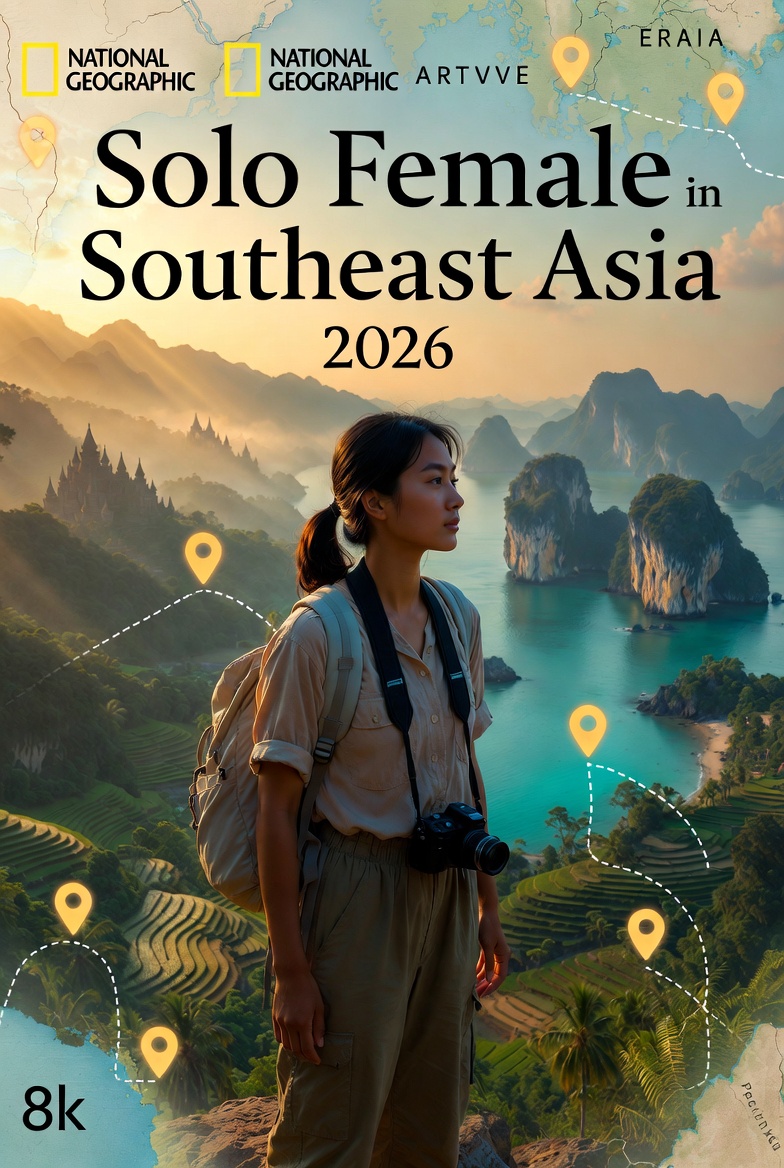
Solo female in Southeast Asia 2026: a country-by-country honest guide
I get a version of this email twice a week. "I want to do SEA solo, my mum is freaking out, what do I tell her?" The answer my mum got (because I sent it to mine too) is the same one I'll give you: Southeast Asia is, on the whole, one of the easier regions of the world for a woman to travel alone. Easier than India. Easier than most of Europe at 2 a.m. Easier than where I'm writing this from. That doesn't mean uniformly safe. It means legibly unsafe in ways you can prepare for, which is the only kind of safety information that matters.
What this piece is: six SEA countries, rated, with the actual harassment and scam patterns, the named places I send friends, the dress code that's real vs. the dress code Pinterest invented, and what to actually pack and memorise. I've travelled all six in the last four years, three of them in the last twelve months. Where I'm working from second-hand reporting I'll say so.
The honest answer
SEA in 2026 ranges from Very Safe (Malaysia, Vietnam, Laos) to Safe-with-Care (Thailand, Indonesia outside the trouble pockets, Cambodia outside Sihanoukville). No country on this list is Caution or Avoid in 2026 for a tourist following sensible routes — Myanmar is the regional exception and gets its own piece. Violent crime against foreign women is rare across the region. The realistic risks are: scams (every country, especially in tourist hubs), bag-snatching from motorbikes (Vietnam most, Cambodia second), drink spiking (Thailand's party islands, occasionally Bali nightlife), road accidents on rented scooters (Bali leads the ER stats, by a wide margin), and the everyday pattern of being mildly hassled by touts and dodgy taxi drivers when you look new.
Race and class change this. South and East Asian women travelling alone are often read as local and get less of the "tourist" hassle but more of the local-women-shouldn't-be-here pattern in conservative areas. Black women travelling in SEA report more staring than harassment, but the staring is exhausting and worth knowing about. Trans and visibly queer women have the easiest time in Bangkok, Bali, and Bangkok-adjacent Thailand; can be more cautious in Brunei and rural Malaysian and Indonesian conservative areas. None of this is showstopping — it's calibration.
What to know before you go
Visas. Most Western passports get visa-exempt entry to Thailand (60 days, as of mid-2025), Malaysia (90), Indonesia (visa-on-arrival, 30 days, extendable once), Vietnam (45 days visa-exempt for many EU/UK passports; e-visa 90 days for everyone else), Laos (visa-on-arrival, 30 days), Cambodia (e-visa or visa-on-arrival, 30 days). Indian, African, and several other passports have stricter regimes — check your specific case on the destination embassy site, not third-party blogs.
Vaccinations. Routine boosters plus typhoid and Hepatitis A are the baseline. Japanese encephalitis if you're doing long rural stays. Rabies pre-exposure series if you're planning to ride motorbikes through villages (dog bites are real). Malaria prophylaxis is not needed for most tourist routes anymore — confirm with a travel clinic, ideally one that consults fitfortravel.nhs.uk or the CDC Yellow Book, not Reddit.
The female-specific stuff people don't tell you:
Tampons are hard to find outside major cities. Confirmed in 2025 reporting: rural districts of Cambodia, Laos, and Myanmar mostly don't stock them at all. Bangkok, KL, Singapore, Saigon, Hanoi, Bali — yes, in the bigger supermarkets, at a markup. Bring a menstrual cup. If you can't get on with one, bring a 3-month supply of tampons. This is not a "rough it" situation; it's a "the supply chain isn't there" situation.
Pharmacies sell most things over the counter. Including emergency contraception (in Thailand, Vietnam, the Philippines, and Indonesia easily; harder in Brunei and Muslim-majority parts of Malaysia, where ask for "Postinor" at a 24-hour clinic instead). Antibiotics, antifungal creams, anti-diarrhoeals, codeine in some places, all over the counter.
Period stigma is mostly absent in temples — you do not need to skip them on your period, despite what one travel blogger circuit keeps repeating. The "don't enter temples on your period" rule exists in some Balinese Hindu contexts; in practice no one's checking, and no one cares.
Country-by-country: the actual landscape
Thailand — Safe-with-Care
The default starter destination, and rightly so. Bangkok at 11pm in Sukhumvit or Silom is fine. Chiang Mai is one of the most relaxed cities for a solo woman in Asia. Krabi, Pai, the north generally — very low harassment.
Where the risk concentrates:
Drink spiking on Koh Phangan around Full Moon Party, and in Phuket's Bangla Road. Specific, well-documented pattern: women drinking from buckets they didn't watch get poured. Solution: buy bottled, watch it open, hold it. Don't accept poured drinks from new acquaintances. Don't go home alone with someone you met two hours ago unless a friend has photos of him and the address.
The "tuktuk to the gem shop / tailor shop" classic in Bangkok. A friendly local says the Grand Palace is closed today, offers to take you "somewhere better." It's a commission scam, not dangerous, just annoying.
Jet ski scams in Phuket and Pattaya. They'll claim you damaged the ski and demand thousands of baht. Photograph the ski thoroughly before you get on. Better: don't rent one.
Where to stay:
Bangkok: Lub d Silom or Lub d Siam (well-run, female dorms available, secure key cards). My Home 22 Female Hostel in Bangkok is genuinely female-only and cheap. Mad Monkey Bangkok has a solid female dorm if you want the social/party hostel energy without sketch.
Chiang Mai: Stamps Backpackers, Hug Hostel Roastery. Both safe, both female-friendly, both have clean female dorms.
The islands: stay in Haad Salad or Haad Yao on Koh Phangan, not Haad Rin, unless you specifically want the Full Moon scene.
Dress code: Bangkok dresses like London in July. The "cover your shoulders" rule is for temples specifically (Wat Pho, Wat Arun, the Grand Palace — they enforce it, and sarongs are usually available to borrow). Otherwise wear what you want. The conservative-dress advice for "everywhere in Thailand" is overblown.
Transport: Grab everywhere. The BTS and MRT in Bangkok are immaculate and have signage in English. Overnight trains (especially the Bangkok-Chiang Mai sleeper) have female-only carriages on most departures — book a lower berth, lock your luggage to the seat frame.
Vietnam — Very Safe (for violence), Safe-with-Care (for scams)
Vietnam is the country I most often recommend for a first solo SEA trip, with a single asterisk: the scams are creative and persistent in HCMC and Hanoi old town, and the bag-snatch problem is real.
The patterns:
Motorbike bag-snatch in District 1 (HCMC), especially around Ben Thanh Market and Bui Vien. Riders pull up beside you, grab the bag off your shoulder, gone. They can drag you if you don't let go. Rule: if it happens, let go. Wear cross-body bags with the strap over both shoulders or worn under a jacket. Don't walk along the kerb with your phone out.
Hanoi Old Quarter pickpockets working in pairs around the night market.
Taxi meter scams at airports — use Grab or Be (the Vietnamese ride app, often cheaper) instead of grabbing one at the kerb. From Tan Son Nhat use the official taxi queue inside the terminal if you can't get data working.
The fruit-seller-hat-photo scam in Hanoi where the woman insists you carry her pole, then demands money for the photo. Just smile and decline.
Harassment level: very low. Hanoi and Saigon both rank consistently well among solo women I've talked to. You'll get more "hello!" calls than catcalls, and they're not threatening.
Where to stay:
Hanoi: Nexy Hostel and Old Quarter View Hanoi both have well-run female dorms with curtained pods and lockers.
Saigon: The Hideout Hostel (District 1) has a female dorm and is well-known for its solo travel community. Vintage Hostel in District 1 is the quieter alternative.
Hoi An: Tribee Bana or Tribee Kinh — both have separate female dorms and free bike rental.
Dress code: Casual everywhere. Cover shoulders for pagodas. Otherwise no expectations. The Vietnamese themselves dress fashionably and aren't fazed by tourist outfits.
Transport: Don't rent a motorbike unless you have a license and experience. The traffic is its own learnable skill but the bottom of the learning curve is dangerous. Grab Bike (where you ride pillion on someone else's motorbike) is cheap, fast, and women drivers are now common in HCMC.
Malaysia — Very Safe
The dark horse. Multicultural, modern, the easiest English in the region, and the lowest harassment rate I've personally experienced anywhere in SEA. KL Sentral at midnight: I'd walk it alone without thinking. So would most women I know who've been.
The asterisks:
East Malaysia (Sabah, Sarawak) is different from Peninsular Malaysia — generally even safer, with the exception of the east coast of Sabah (Lahad Datu, Semporna, the Sulu Sea islands), where there's a credible kidnapping risk from cross-border groups. Western governments advise against the eastern coast specifically. Mainland Sabah (Kota Kinabalu, Mount Kinabalu) is fine. If you're doing Sipadan diving, fly into Tawau and use a reputable operator that controls the route.
Dress code in religious sites (Putra Mosque, Batu Caves) — shoulders and knees covered, and they'll lend you a robe. Outside religious sites, regular clothes are fine in KL, Penang, Melaka. In the conservative east coast states (Kelantan, Terengganu) dress somewhat more covered — long sleeves are not required, but vest tops on the street will draw stares.
Where to stay:
KL: Mingle Hostel KL Sentral, BackHome KL, or for a private female space, Sunshine Bedz KL has a female dorm with very good reviews.
Penang (Georgetown): Reggae Penang, Tipsy Tiger — both have female options. Georgetown is small and walkable.
Transport: This is where Malaysia quietly outpaces the region. KTM Komuter has a pink women-only coach in the middle of every train in the Klang Valley — coaches C and D for six-car trains, B for three-car. Grab Malaysia rolled out women-only rides in beta in 2026 — visible only to women passengers, matched only to verified women drivers. Use it on late-night airport runs.
Indonesia — Safe-with-Care
A country of 17,000 islands cannot be one safety rating. Practically: Bali, Lombok, the Gilis, Yogyakarta, central Java are easy and well-trodden. Jakarta is fine in business districts and tourist zones; not somewhere you wander randomly at night. Sumatra, Sulawesi, Papua are more variable and reward more research and a guide.
Bali patterns:
The biggest threat by a wide margin is the scooter. ER admissions for foreign women in Bali are dominated by scooter falls. If you've never ridden in heavy traffic at home, don't start in Canggu.
Drink spiking exists but is uncommon — Kuta and Seminyak nightlife is where to be more careful.
The Bali "monkey scam" at Uluwatu and Ubud's Monkey Forest: they steal your sunglasses/phone, the local handler offers to "trade" it back for money. Just don't bring loose stuff.
Conservative dress isn't really a thing in Bali, which is Hindu and tourist-soaked. Sarong at temples (provided at the gate), regular clothes elsewhere.
Yogyakarta: lower harassment than Bali, Javanese culture more reserved, modest dress appreciated but not enforced — long shorts and t-shirts are fine. Borobudur and Prambanan both require shoulders-and-knees covered for the temple grounds.
Jakarta: dress more conservatively in residential areas and on public transit. TransJakarta has women-only sections at the front of buses, marked in pink.
Where to stay:
Canggu/Ubud (Bali): Puri Garden Hotel & Retreat (Ubud) — pool, social, well-managed. The Farm Hostel (Canggu) has a women's dorm.
Yogyakarta: Greenhost Boutique Hotel for a step up from hostel; Wonderloft for budget female dorms.
Jakarta: Six Degrees Hostel or stay in Kemang/Senopati at a small hotel.
Transport: Gojek and Grab are the only sensible options for getting around cities. Bluebird taxis are reliable if you can't get data working. Inter-island flights via Lion Air, AirAsia, Garuda — book directly, not via aggregator hard-sells.
Cambodia — Safe-with-Care
Tourist Cambodia (Siem Reap, Angkor, Phnom Penh, Battambang, Kampot) is genuinely safe for solo women. The country has one large flashing red flag: Sihanoukville.
Sihanoukville is not a normal scam zone — it's a documented hub of cyber-scam compounds linked to forced labour and human trafficking. Amnesty, the UN, and the US Treasury have all reported on it through 2025. The scam compounds themselves are mostly internal — they're holding trafficked workers (often other Asians who came thinking they had IT jobs), not snatching tourists off beaches. But the city has become a strange place: half-abandoned construction, a different vibe, and a lot of fishy stuff in the periphery. Skip it. Go to Koh Rong or Koh Rong Samloem via Sihanoukville port if you want the beach, but don't linger in the city.
Elsewhere in Cambodia:
Pub Street, Siem Reap: pickpocket gangs work the crowd at peak hours. Wear minimal jewellery, cross-body bag zipped and forward.
Tuktuk overcharging is universal — agree fares before getting in, or use PassApp / Grab in Phnom Penh and Siem Reap.
Begging children at Angkor is genuinely a sad situation; the consensus from local NGOs (and what the Cambodian government itself asks tourists to do) is don't give cash directly. Support a vetted local organisation like ConCERT Cambodia, which helps direct tourist money to actual schooling rather than perpetuating begging networks.
Where to stay:
Siem Reap: Onederz Siem Reap has a female dorm with a rooftop pool and a security-conscious team. Mad Monkey Siem Reap if you want social.
Phnom Penh: Mad Monkey Phnom Penh again, or Velkommen Guesthouse for quieter family-run vibes.
Dress: Cover shoulders and knees at Angkor Wat — they will turn you away at the upper levels of the central tower if you're not covered. Elsewhere, normal warm-weather clothes.
Transport: Tuktuks via PassApp in cities. For Phnom Penh–Siem Reap, the Giant Ibis bus is the standard — clean, safe, on-time, female solo travellers I trust use it routinely.
Laos — Very Safe
Laos is the quiet star. Low harassment, slow pace, genuine warmth. Luang Prabang specifically is one of the most peaceful places I've spent time as a solo traveller anywhere.
The scams are minor and rare. Tuktuk overcharging in Vientiane, occasional bag-snatch in Vang Vieng on busy nights. The bigger practical concerns are road safety on the buses through the mountains (minivans go fast on bad roads — sit in the back, avoid overnight services) and adventure-activity oversight in Vang Vieng (it's better than the lawless tubing era of 2012, but still — wear the life jacket they give you, even if no one else is).
Where to stay:
Luang Prabang: Mad Monkey Luang Prabang has a female dorm. Khammany Inn II for a peaceful guesthouse with a great owner.
Vientiane: Vientiane Backpackers Garden Hostel for budget; small boutiques in Chao Anouvong area for a step up.
Vang Vieng: Nana Backpackers (party) or Riverside Boutique Resort (quiet).
Dress: Cover shoulders and knees at temples. Otherwise relaxed. Lao women dress modestly — wearing very short shorts in markets reads as oddly tourist-y rather than offensive.
If something goes wrong
Memorise (or save offline) these:
Thailand: Tourist Police +66 1155 (English-speaking, 24/7). Embassy contact for your country in Bangkok.
Vietnam: Tourist Hotline 1800 1014 (English). Police 113.
Malaysia: Tourist Police 03-2149-6590 (KL). Talian Kasih 15999 for women in distress (24/7).
Indonesia: Tourist Police 110 (Bali specifically has English-speaking units at Kuta and Ubud stations).
Cambodia: Tourist Police 097 778 0002 (Siem Reap). The General Department of Tourism hotline 012 942 222.
Laos: Tourist Police 1191. Vientiane main station +856 21 251 128.
For a sexual assault in any of these countries: call your embassy first if you can — they will direct you to a vetted medical and reporting pathway. Local police can be variable in their handling of these cases, but embassy intervention raises the bar. Keep your embassy's after-hours line saved offline.
Where your money goes
A few specifics worth supporting:
Cambodia: Women's Resource Center (Siem Reap) runs cooking classes and language exchanges led by Khmer women; it's also a working drop-in centre.
Laos: Ock Pop Tok in Luang Prabang is a long-established women-run weaving collective with a fair-trade model that's been independently audited.
Vietnam: Sapa O'Chau in Sapa is a Hmong-women-founded social enterprise running treks and homestays where the money lands in the village, not a Hanoi office.
Bali: Threads of Life in Ubud works with women weavers across Indonesia using natural dyes — pricier than the market, but the price-to-weaver ratio is real.
Thailand: Hilltribe Organics and the Akha Ama coffee project both employ women from hill tribe communities with documented benefit flows.
What to pack and memorise before you fly
Pack:
Menstrual cup (and a backup, or 3 months of tampons)
Doorstop wedge for hotel doors (US$3, fits any door, more useful than the chain lock)
Cross-body bag with zipper-toward-body, ideally slash-proof
Photocopy of passport + visa + insurance, both paper and a photo in your phone
A modest scarf/sarong (1m × 2m) — covers shoulders for temples, doubles as beach wrap and aircraft blanket
A small padlock for hostel lockers (don't trust the hostel-provided ones)
Spare SIM-free phone if you can afford it — or an eSIM (Airalo, Holafly) you can activate before the plane lands
Memorise:
Your hotel address in the local script (screenshot it on your phone)
Your embassy's emergency number
One trusted person back home who has your full itinerary
The local emergency number (above)
How to say "police" and "help" in the local language
The bottom line
I'd go. I'd plan two weeks across two countries rather than five countries in a month, because the joy of solo SEA is the unhurriedness of it. I'd start in Vietnam or Malaysia if it's your first solo trip — easier scams to navigate, lower harassment. I'd add Thailand or Bali if you want the social-hostel scene. I'd save Cambodia and Laos for trip two, because they reward more time and more attention. And I'd absolutely tell anyone who'd listen that the people who think solo female SEA is dangerous have either never done it or did it badly. The risks are real. They're also legible, prepareable, and — with the alternatives in this piece — almost entirely manageable.
The internet's solo-female-travel discourse oscillates between "it's so empowering, just go" and "you'll be murdered." The truth, as usual, is more useful: do your homework, pick your battles, and back yourself. SEA will meet you halfway.
Sources cross-checked May 2026 against UK FCDO and Australian Smartraveller advisories, Grab Malaysia 2026 IWD press release, KTMB Komuter operations notice (Feb 2025), Amnesty International's June 2025 Cambodia report, and conversations with women travellers across the region in April 2026. If a named hostel changes hands or a number changes — they do — please let us know at the editorial desk.
Solo female traveler from Bangalore. Safety advocate, responsible tourism, women-run cooperatives — empowering, never alarmist.
✦ More from Priya Sharma


✦ Keep reading
More from this region


More in Activities
✦ Discussion
Start the discussion
No replies yet — yours could be the first.