


Bali Cultural Etiquette in 2026: The Honest Visitor's Guide
If you've been on the internet in the last four months, you've probably seen at least three breathless takes on Bali: the new criminal code is going to land you in jail for sharing a room with your boyfriend; the temple police will arrest you for a bikini photo; you'll be cursed by the Queen of the Southern Sea for wearing green. The reality, after talking to friends who live there, to a Balinese guide I've worked with since 2019, and to the people running the actual enforcement task force, is calmer and more specific. Here's what genuinely matters.
The honest answer
Bali in 2026 is one of the easier places in Southeast Asia to visit without offending anyone, if you do three things: cover up at temples (sarong and sash, every time), don't step on the little flower offerings on the sidewalk, and skip the "naked at the sacred tree" Instagram trend that has gotten a string of tourists deported. The new KUHP (criminal code) is real, the cohabitation provisions exist, and they are almost certainly not going to affect you. The double-pricing, the photographing of locals without asking, the assumption that "Bali is just a beach" — those are the gaps where Western tourists keep getting in their own way.
The 2026 picture: what actually changed under the new criminal code

Indonesia's revised KUHP came into force on January 2, 2026, replacing the colonial-era Dutch code that had been in place since 1918. It's a big legal shift — banning the spread of Marxist-Leninist ideology, expanding blasphemy provisions, introducing the cohabitation and extramarital sex articles that got most of the international press — and it applies nationally, including in Bali.
The two clauses that have generated the most reader email to me are Article 411 (sex outside marriage, up to one year) and Article 412 (cohabitation by unmarried couples, up to six months). Both are real. Both are also classified as complaint-based offenses — meaning the police cannot initiate a case on their own. A prosecution can only begin if a complaint is filed by a very narrow set of people: a spouse, a parent, or a child of one of the people involved. Random hotel staff, an angry neighbor, a Satpol PP officer who saw you holding hands — none of them have legal standing to trigger Article 411 or 412.
Between January and mid-April 2026, Bali's Dharma Dewata immigration task force ran 165 deportations and 62 administrative detentions across the island. The dominant categories were visa overstays, working on a tourist visa, and the longstanding sacred-site offences — climbing the trees, naked photography at temples, the usual. As of my most recent check (May 2026) I have not seen a single reported Article 411 or 412 case brought against a foreign tourist anywhere in Indonesia. Verify this for yourself before you go — these laws are new and case law builds month by month.
The cohabitation law and your hotel
Here's the practical reading: you can share a room with your girlfriend, your boyfriend, or your same-sex partner in Bali in 2026. Bali Governor Wayan Koster issued a public statement before the law took effect specifically reassuring tourists that the Bali Provincial Government would not conduct marital-status checks at tourist accommodations and would protect guest data confidentiality. Hotels, villas, and guesthouses have not been deputized to verify marriages. There are no raids. There is no morality police walking the corridors of Ubud villas.
What you can't rely on:
If you are sleeping with a Balinese local and that person is married, or is a minor's child whose parents object, you have moved from "private matter" to "complainant has legal standing." This is the failure mode worth knowing about. A bad breakup, a money dispute, a family that disapproves — any of these can in theory now be escalated under Article 411. Treat romantic involvement with locals with the awareness that the legal environment around it has changed.
Smaller Muslim-majority areas of Indonesia outside Bali (Java, Sumatra, Lombok in parts) may have local custom that lands earlier than the national law. Some homestays in conservative regions will ask for a marriage certificate at check-in; that's pre-KUHP practice, not new policy. If you're booking a homestay anywhere outside Bali, the room description usually tells you.
Same-sex couples: there is no specific anti-LGBT provision in the new code, but the cohabitation article is gender-neutral and the broader Indonesian legal environment for queer travelers is not warm. Affection in public is best kept low-key — the same advice I'd give for any moderately conservative country.
The temple rule book: sarong, sash, no climbing, no menstruating
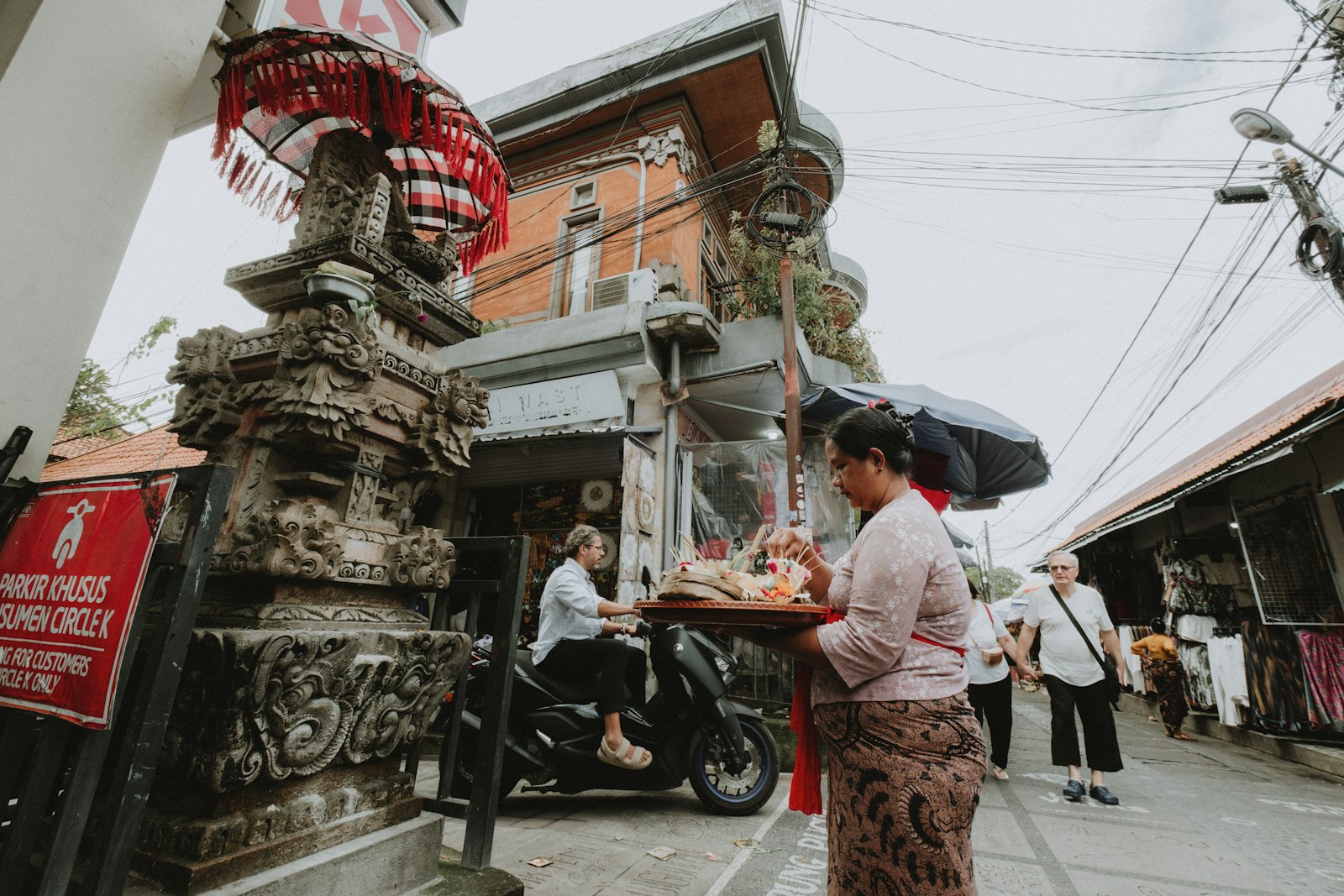
The Balinese take temple etiquette seriously, and the Provincial Government codified the rules in Circular Letter No. 4 of 2023 (later updated as SE No. 7 of 2025). The rules are simple, and they apply to every temple regardless of how touristed it is.
At any temple, inside the gate:
Sarong around the waist, covering knees, every visitor. Rentals are available at every major temple for IDR 10,000–20,000 (under USD 1.50). Bring or buy one of your own if you plan to visit several — the rental ones get damp.
Sash (selendang) tied over the sarong at the waist. Symbolically separates the sacred upper body from the worldly lower body.
Shoulders covered. A T-shirt is fine. A swim coverup, a strappy top, or anything sheer is not.
No climbing on shrines, no posing on the gates, no straddling the statues. This is the one that gets people deported. I'm not exaggerating: a Russian influencer was deported in 2023 for posing nude on a sacred tree at Mount Agung; a German tourist was prosecuted in 2025 for a topless Instagram post at Pura Besakih. The Civil Service Police (Satpol PP) has a public WhatsApp hotline (+62 812-8759-0999) that locals genuinely use.
No entry while menstruating. This is the rule that startles a lot of Western women. It's a doctrinal rule across Balinese Hinduism — bodily blood is considered ritually impure in the temple's inner sanctum — and the signs at every temple state it plainly. There's no menstruation check at the gate; the rule is enforced on the honor system. If you're on your period, walk the outer courtyards, photograph the architecture, skip the inner sanctuary. It's not personal; the same restriction applies to Balinese women.
Tanah Lot specifically: as of 2026, the temple itself is closed to non-worshippers — only Balinese Hindus performing ceremonies enter the temple proper, so the sarong/sash rules don't strictly apply on the cliff path. You're still expected to dress respectfully (shoulders and knees covered), and the site opens around 7:00 AM and stays accessible until well past sunset. The IDR 75,000 foreigner entrance fee includes parking.
Besakih (Pura Besakih) is Bali's mother temple and the strictest site for dress code. Wear sarong + sash from the entrance; you'll be turned around if you don't.
Dress code beyond temples: where the bikini is fine and where it isn't

This is the area where Western media gets Bali most wrong. The default coverage rule in Bali — outside temples and government buildings — is less strict than people expect, especially compared to Aceh or West Sumatra.
Beach, beach club, pool: bikinis, swim trunks, board shorts are fine. Seminyak, Canggu, Kuta, Nusa Dua, Uluwatu all work.
Shopping streets, cafés, warungs: shorts and a tank top are everywhere. Locals won't blink.
Walking to and from the beach: cover up the swimsuit with a sarong or coverup. Don't walk into a 7-Eleven in just a bikini — it reads as exactly as oblivious as it sounds.
Temples, of course: sarong and sash, shoulders covered.
Government offices, immigration, banks: closed-toe shoes if you can; long pants or a skirt; covered shoulders.
If you're going further into Indonesia — Java, particularly Yogyakarta or Solo, and certainly Aceh — the calibration tightens. I've written a longer regional dress-code piece that covers the country-by-country logic; for the headline version, treat Bali as the loosest end of the spectrum and Aceh as the tightest, with Lombok and Java sitting in the middle.
Canang sari: don't step on the flowers
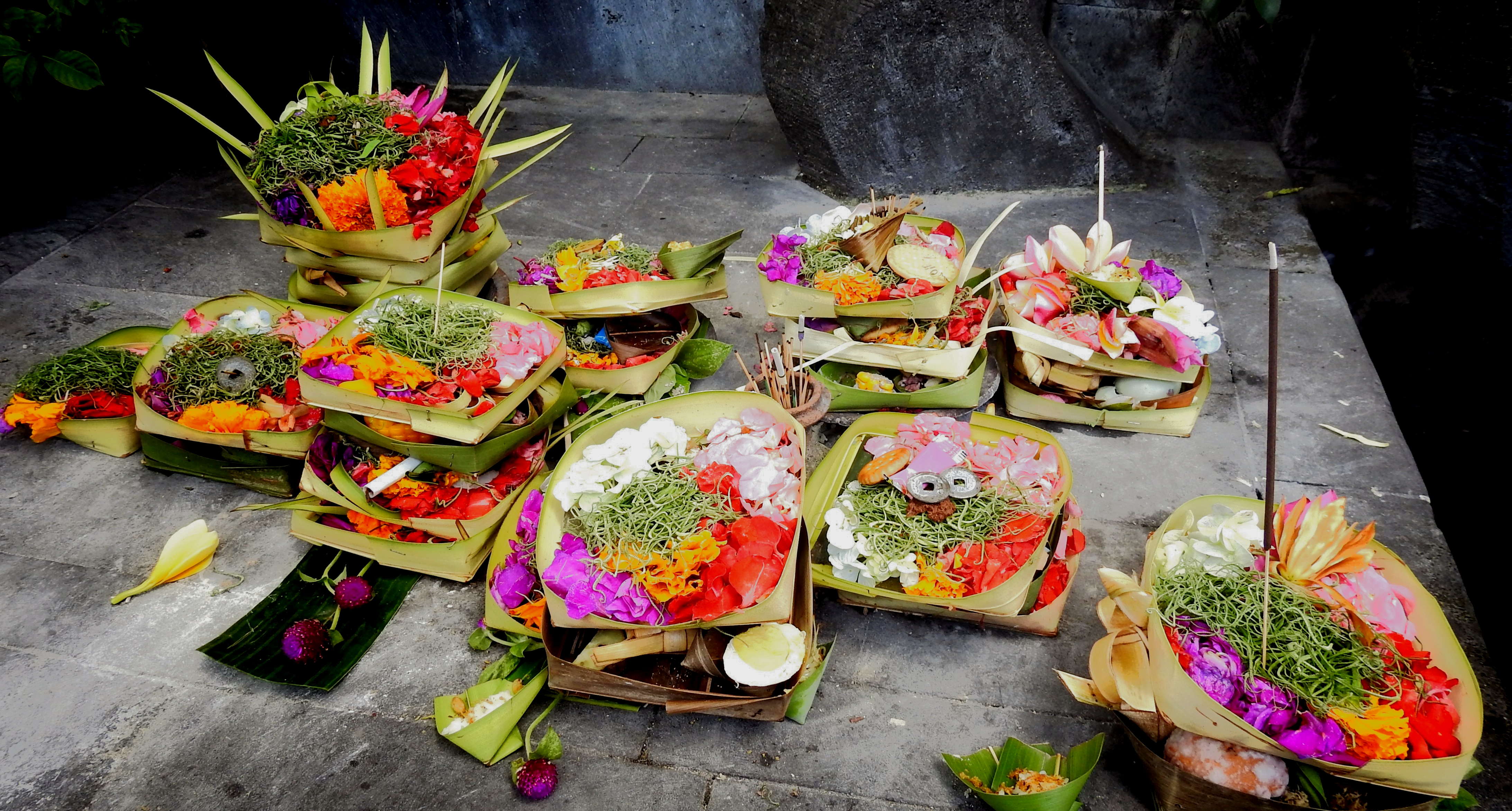
The small palm-leaf trays you'll see on sidewalks, doorways, dashboards, and roadside shrines — flowers, a few grains of rice, a stick of incense, sometimes a small piece of candy — are called canang sari. Balinese women place them every morning as offerings to the gods and to placate the lower spirits. They are not litter. They are not décor.
The etiquette is simpler than it sounds:
Walk around them, not over them. This is the only rule that matters.
If you step on one accidentally, just step off and move on. There's no formal apology. Balinese people are kind about tourist mistakes; the offense is in stepping deliberately or in arguing about it.
Don't pick them up to look at them. Once placed, they're considered sacred.
Don't kick them aside even if they're blocking a doorway. Wait, walk around, or step over with deliberate respect if there's truly no path.
Photographing them is fine if no one is actively praying. If a woman is mid-ritual, give her space — observe quietly from a distance, don't lean in with a phone.
The Nyi Roro Kidul story: why locals ask you not to wear green at the south coast
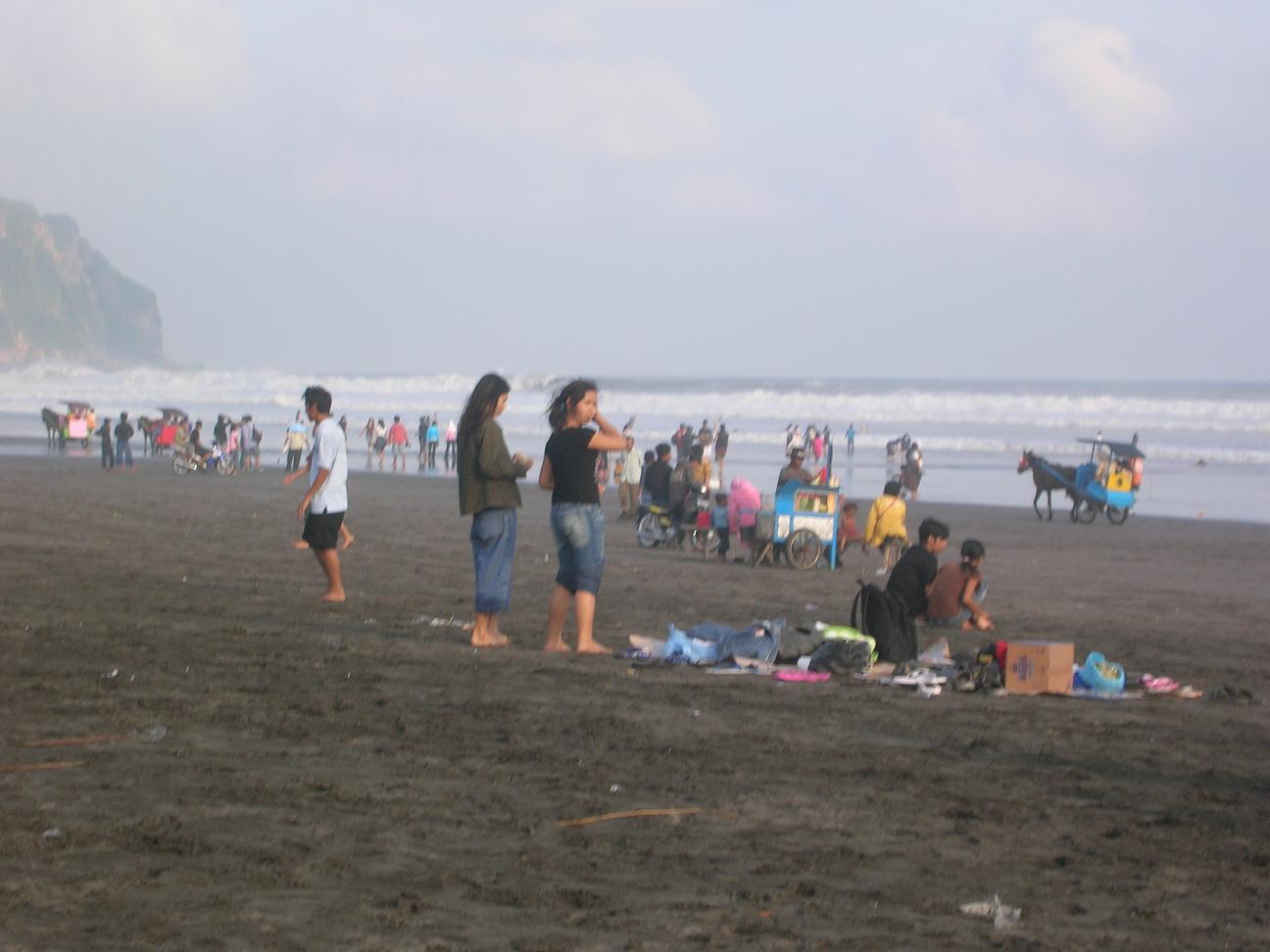
You'll encounter this most strongly not in Bali itself but on the south coast of Java — Parangtritis Beach near Yogyakarta is the classical site — and you'll hear softer versions from Balinese guides at the southern beaches.
The legend: Nyi Roro Kidul (also spelled Nyai Roro Kidul) is the Queen of the Southern Sea, who reigns over the Indian Ocean off Java's south coast. She wears green. The story has it that anyone wearing green at her shores risks being claimed by her and drowned. Local hoteliers along the south coast keep a room reserved for her — the Grand Bali Beach Hotel famously holds Room 327 for her, and at the Queen of the South Resort in Parangtritis you'll see signs asking guests not to wear green into the water.
The folkloric source is the Javanese court tradition: the Sultans of Yogyakarta claim a mystical marriage with her that legitimizes their rule, and the annual labuhan ceremony at Parangtritis maintains the relationship. There's also a hard-nosed reading that the green-clothing taboo is partly a safety device: the Southern Sea has notoriously brutal rip currents, and green clothing makes a body harder to spot in the water.
My take, traveling there: I don't wear green at Parangtritis or at the southern Java beaches. Not because I believe a sea queen will drag me under, but because the local fishermen and the families on the beach genuinely hold this belief, and being the foreign woman who shows up in a green swimsuit reads as the tourist who couldn't be bothered to ask. In Bali proper, the taboo is much weaker — green is fine in Ubud, fine in Seminyak, fine almost everywhere. It's a south-Java thing more than a Bali thing.
Tipping, photographing locals, and the tarif bule
Three smaller things that come up constantly:
Tipping. Bali does not have a deep tipping culture, but tourism has changed expectations. Many restaurants now add a 10% service charge to the bill — read the small print before tipping again. For drivers, guides, and spa therapists: IDR 20,000–50,000 (USD 1.30–3.30) per service is generous and appreciated. Round up taxi fares to the nearest 10,000.
Photographing locals. Ask before you photograph anyone, especially anyone in ceremonial dress or in the act of making offerings. "Boleh foto?" ("Can I take a photo?") is enough. A nod or a smile is consent. A turned shoulder is a no. Children — ask the parent. This is the etiquette I'd want for myself if a stranger pointed a lens at me in my own neighborhood.
Tarif bule — literally "foreigner price" — is the practice of charging foreigners more than locals for the same thing. It's real, it's everywhere, and it's not a scam: it's a normalized pricing tier. Attraction entrance fees are openly tiered (IDR 75,000 for foreigners vs. IDR 25,000 for Indonesians at Tanah Lot, for example), and that's published. Where it gets fuzzy is taxis with the meter switched off, restaurants without printed menus, and street market vendors. Use Grab or Gojek for transport (metered, app-priced), eat at warungs that have printed price lists, and politely ask the price before you order or accept a service. Negotiate without rancor. The 20% extra you pay is, in the wider scheme, a working tourism economy.
Bali vs. wider Indonesia: calibrate as you go

The mistake first-time visitors make is treating "Indonesia" as a single cultural context. It isn't. Bali is a Hindu-majority island with a tourism-shaped economy and an unusually relaxed dress and behavior code for the country. Other parts of Indonesia are not Bali.
Java (Yogyakarta, Solo, Jakarta) is Muslim-majority and more conservative. Shoulders and knees covered in public is the default; bikinis are pool/beach only.
Lombok sits between Bali and Java in feel — a Muslim-majority island with a developed tourist coast (Senggigi, Kuta Lombok, the Gili Islands). Gili Trawangan is essentially Bali-relaxed; the inland villages are conservative.
Aceh in northern Sumatra applies a regional version of Islamic law. Cover up, full stop. This is the only province where it genuinely matters in the way Western media keeps suggesting it does everywhere.
Sulawesi, Flores, Sumba, the Mollucas vary wildly. The eastern islands are predominantly Christian and culturally more relaxed than central Java; the rule of thumb is to follow what local women wear in any given place.
The 5 things that will actually get you in trouble (vs. the 5 that won't)
Will get you in trouble, fast:
Climbing or posing on sacred temple structures. Tree, shrine, gate, statue, doesn't matter. Deportation is on the table.
Naked or topless photography at any temple or sacred site. Same outcome. The Satpol PP hotline gets used.
Working on a tourist visa. Selling things at markets, teaching yoga for cash, running a side-hustle from your villa. The Dharma Dewata task force is built specifically to find this.
Driving a scooter without an International Driving Permit (IDP) and a helmet. Bali traffic police stop foreigners for this routinely. The fine is small; the insurance implications of an uninsured accident are not.
Bringing in even a small amount of drugs. Indonesia's drug penalties are among the harshest in Asia. The Bali Nine and subsequent cases established the seriousness. Don't.
Will not get you in trouble, despite the internet:
Sharing a hotel room with an unmarried partner. Article 412 is complaint-based; no hotel checks.
Wearing a bikini on the beach or at the pool. Bali is fine with this.
Wearing green anywhere in Bali. The Nyi Roro Kidul taboo is a south-Java thing; in Bali it's a soft cultural reference at most.
Drinking alcohol. Bali licenses bars and restaurants; legal drinking age is 21. Public drunkenness is the issue, not consumption.
Showing affection in public (hand-holding, a quick kiss). Modest physical affection is unremarkable in Bali. Anything more performative reads poorly anywhere in Asia.
The bottom line
Go. Bali in 2026 is more regulated than it was five years ago, more crowded than it was ten years ago, and substantially more interesting than the Eat Pray Love version still imprinted on most Western travelers. The new criminal code doesn't change the practical advice: dress for the room you're in, sarong up at temples, walk around the flowers, and treat the place as a culture you're a guest in rather than a backdrop you're entitled to. The Balinese are among the most patient hosts in Asia. Repay it.
If you want to put your money where it lands well: book through community-based tour operators in Sidemen or Pemuteran rather than the big Kuta chains, eat at warungs run by local families, hire a Balinese guide for at least one full day, and pay the IDR 150,000 tourist levy without arguing — it funds the cultural preservation that makes the island worth visiting.
Solo female traveler from Bangalore. Safety advocate, responsible tourism, women-run cooperatives — empowering, never alarmist.
✦ More from Priya Sharma


✦ Keep reading
More from this region


More in Destinations
Where this happens

✦ Discussion
Start the discussion
No replies yet — yours could be the first.