
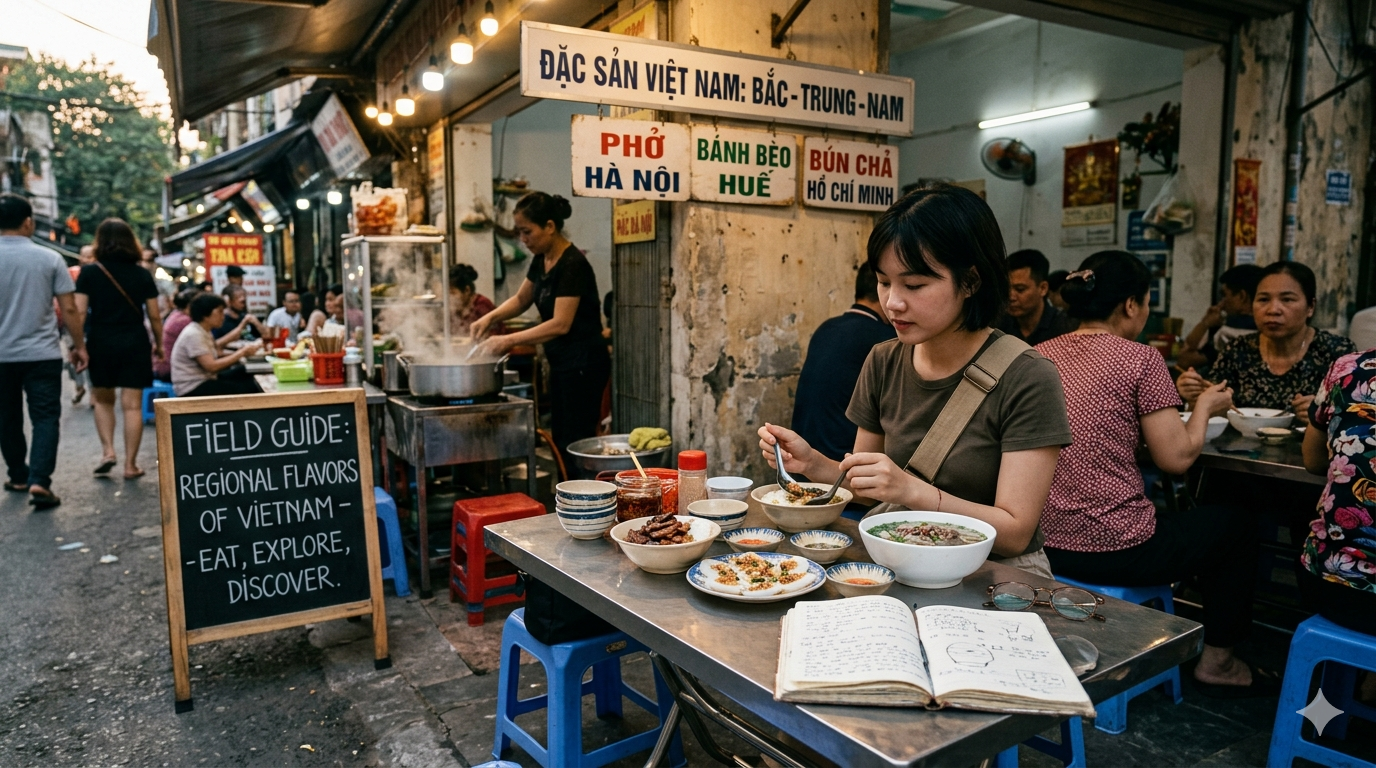
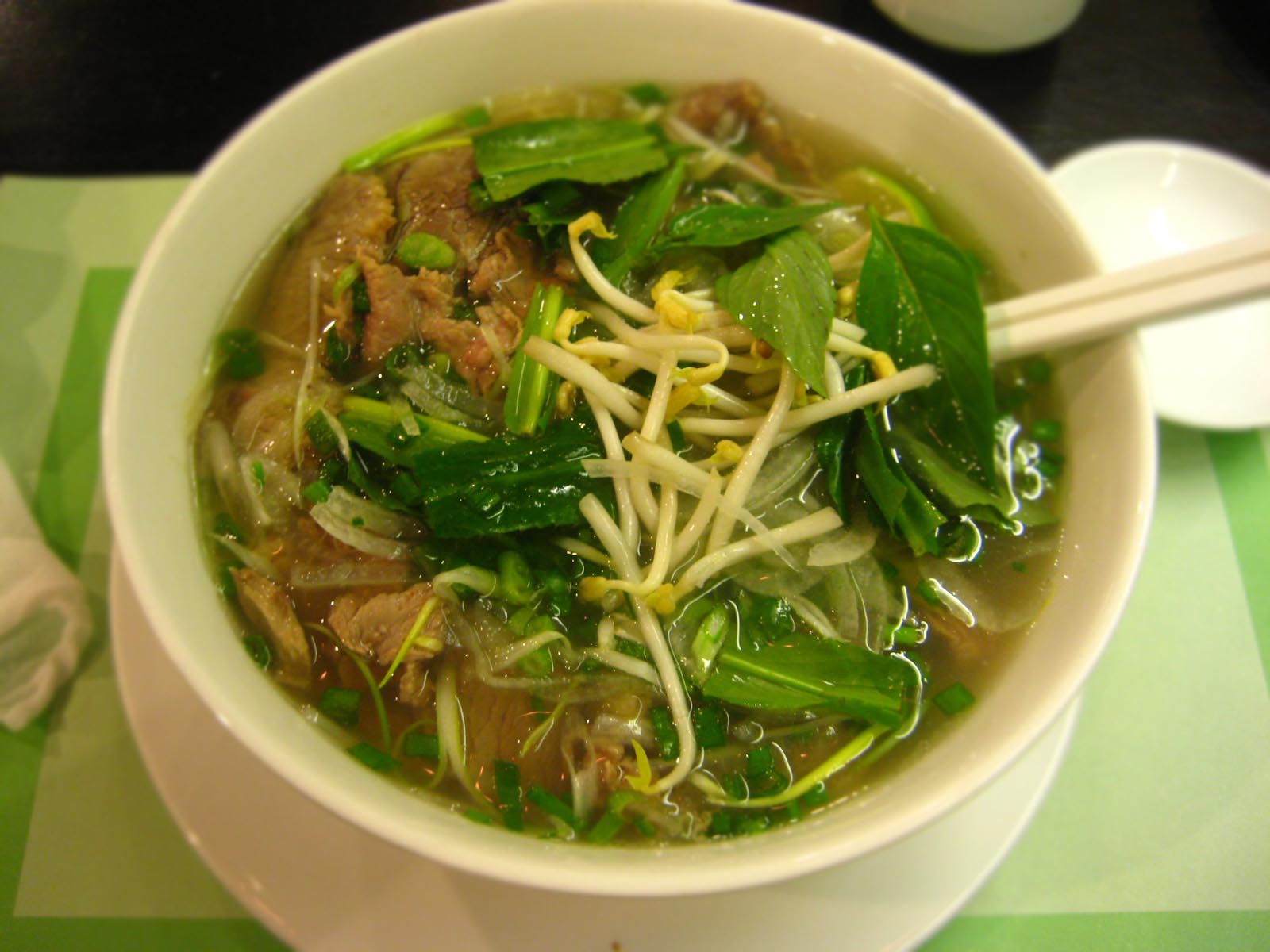
What to Eat in Vietnam: A Region-by-Region Field Guide
The first thing I order in any Vietnamese city is breakfast, and the bowl tells me where I am before the street signs do. In Hanoi it arrives clear — a beef broth so pale you can read the pattern on the bowl's bottom through it. In Huế the same idea comes back stained brick-red, slicked with chili oil, sharp with lemongrass. By Saigon the broth has gone sweet, the herb plate has tripled in size, and there's a saucer of sugar on the table in case you disagree with the cook. Vietnam is one country, three appetites. Get the geography right and you eat better; get it wrong and you spend a meal wondering why the phở tastes off when it's just not from here.
This is a guide to eating Vietnam region by region — what to order, where it belongs, and why. The question underneath it, the one most travelers actually want answered, is whether you can do all this without wrecking your stomach. You can. Vietnam is, in my experience across roughly a dozen trips since 2016, the easiest country in Southeast Asia to eat well and stay well — because so much of its food is cooked to order, served scalding, and assembled in front of you. The safety thread runs through this piece, but it isn't the spine. The spine is the food.
The North: clarity, restraint, and the original phở
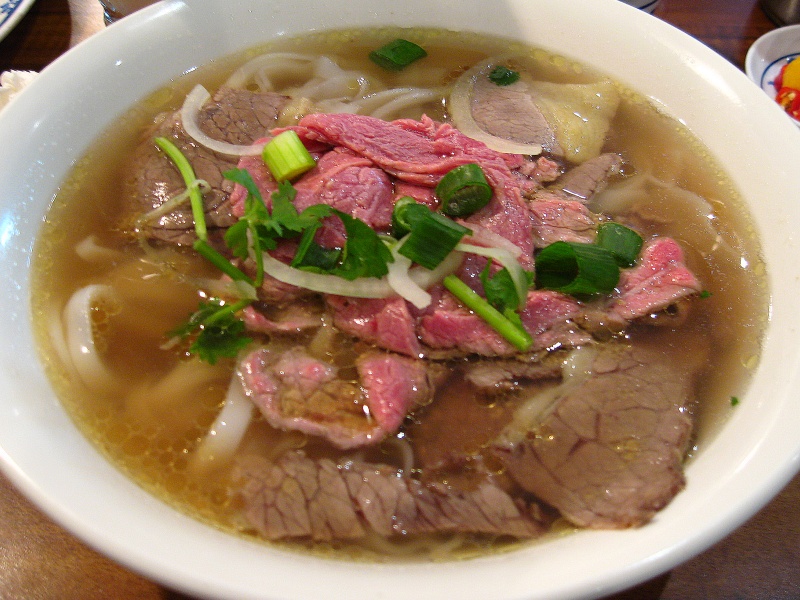
Hanoi cooks like a city that thinks garnish is a confession of weakness. Northern Vietnamese food is the most restrained in the country — less sugar, less chili, fewer herbs piled on, more faith in the base ingredient. This is phở's home, and Hanoi phở (phở) is a different animal from the version that conquered the West via Saigon and the diaspora. The broth is the whole argument: beef bones, charred ginger, charred onion, star anise and cassia bark simmered for hours and then skimmed — relentlessly — until it runs clear and clean. No hoisin. No sriracha. No bean sprouts, no Thai basil, no lime wedge the size of your thumb. A Hanoi phở cook would consider that plate of southern accompaniments an insult to the broth. You get the bowl, maybe a wedge of lime, some chili if you ask, and that's the deal. Expect to pay 40,000–60,000 VND, roughly $1.60–$2.40.
Order phở bò (beef) first. If you want the cook's real opinion of their own broth, order phở chín — fully cooked brisket — rather than the rare slices, because rare beef forgives a thin broth and brisket does not. A famous outlier worth knowing: Phở Thìn on Lò Đúc, where the beef is flash-fried with garlic before it hits the bowl, giving the broth a faint wok-smoke edge. It's not classic and the place trades hard on its fame, but the technique is real and the bowl, at around 60,000–80,000 VND, still earns it.
Then there's bún chả (bún chả), which is Hanoi's true home cooking and, for my money, the dish to build a Hanoi day around. Pork — both fatty belly slices and seasoned patties — grilled hard over charcoal until the edges char, then dropped into a bowl of warm, diluted fish-sauce dressing cut with vinegar, sugar, and slivers of green papaya and carrot. You get a cold tangle of rice vermicelli and a basket of herbs on the side. You dunk, you wrap, you eat. The smoke is the point: a bún chả made over gas instead of charcoal is a different, sadder dish. Around 40,000–60,000 VND. The Obama-and-Bourdain table at Bún Chả Hương Liên is now a tourist set-piece — the bún chả is fine, but you'll eat better and cheaper at a stall where the charcoal smoke is hanging in the alley before you even find the address.
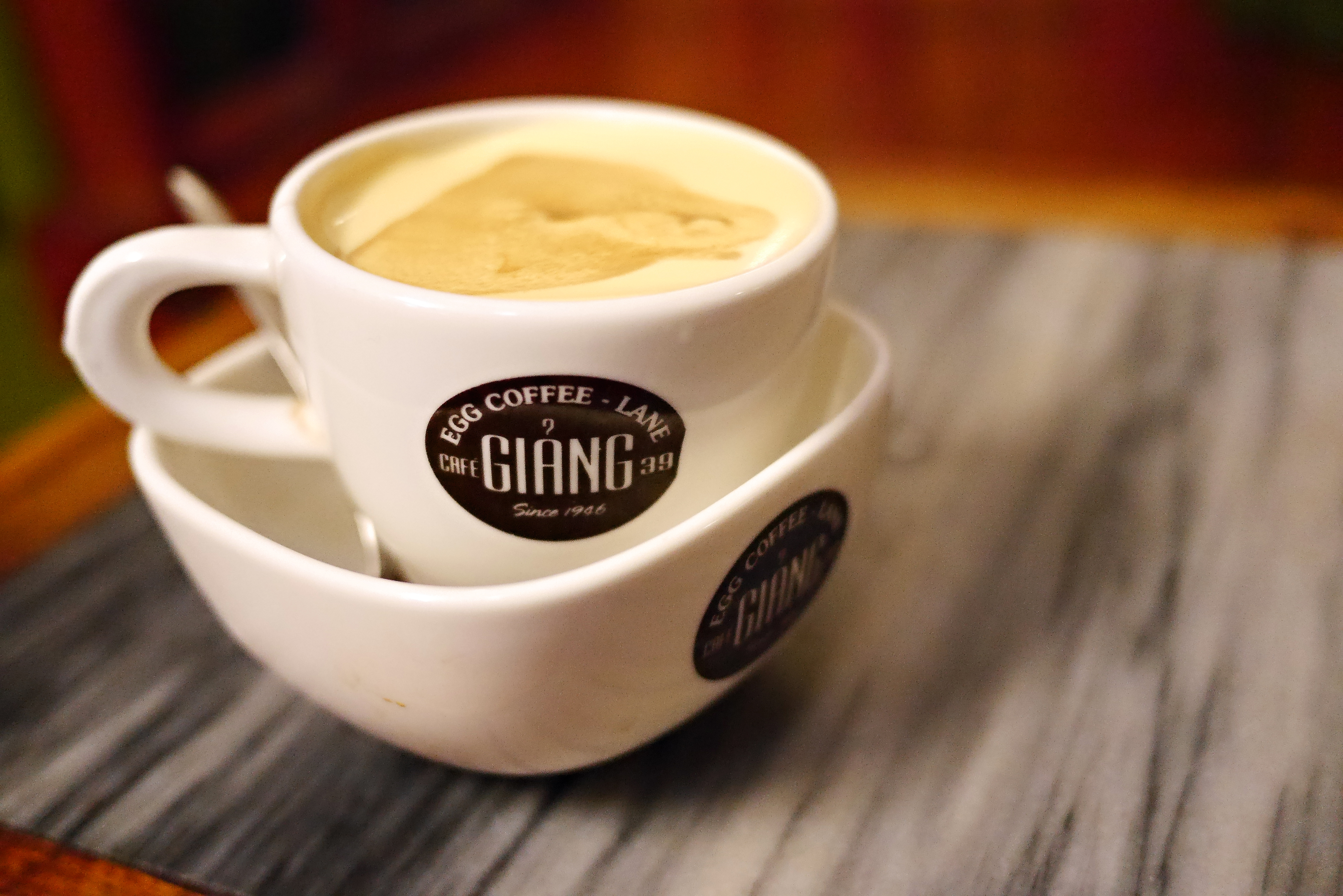
Two more northern things. Chả cá — turmeric-and-dill grilled fish, finished tableside in a pan over a flame, eaten with vermicelli, peanuts and shrimp paste — is a genuine Hanoi institution; the dish is so tied to one restaurant that a whole street, Chả Cá, is named for it. And egg coffee (cà phê trứng), invented at Café Giảng in 1946 when a Metropole hotel barista named Nguyễn Văn Giảng whipped egg yolk and condensed milk to stand in for scarce fresh milk. It is, correctly, more dessert than drink — a warm glass of strong robusta under a thick, almost zabaglione-like cap of sweet egg foam. Café Giảng still runs, down an alley at 39 Nguyễn Hữu Huân. Drink one. Then drink a normal cà phê sữa đá — iced coffee with condensed milk — every morning after, because that's the actual habit of the country.
The Centre: Huế royal cooking and the Hội An kitchen
Central Vietnam is where the food gets ambitious. Huế was the imperial capital, and Huế cooking still carries that court inheritance — many small, precise, intensely seasoned dishes, a cuisine built to fill a banquet table rather than a single bowl. It is also the spiciest regional cooking in Vietnam, and unapologetic about it.
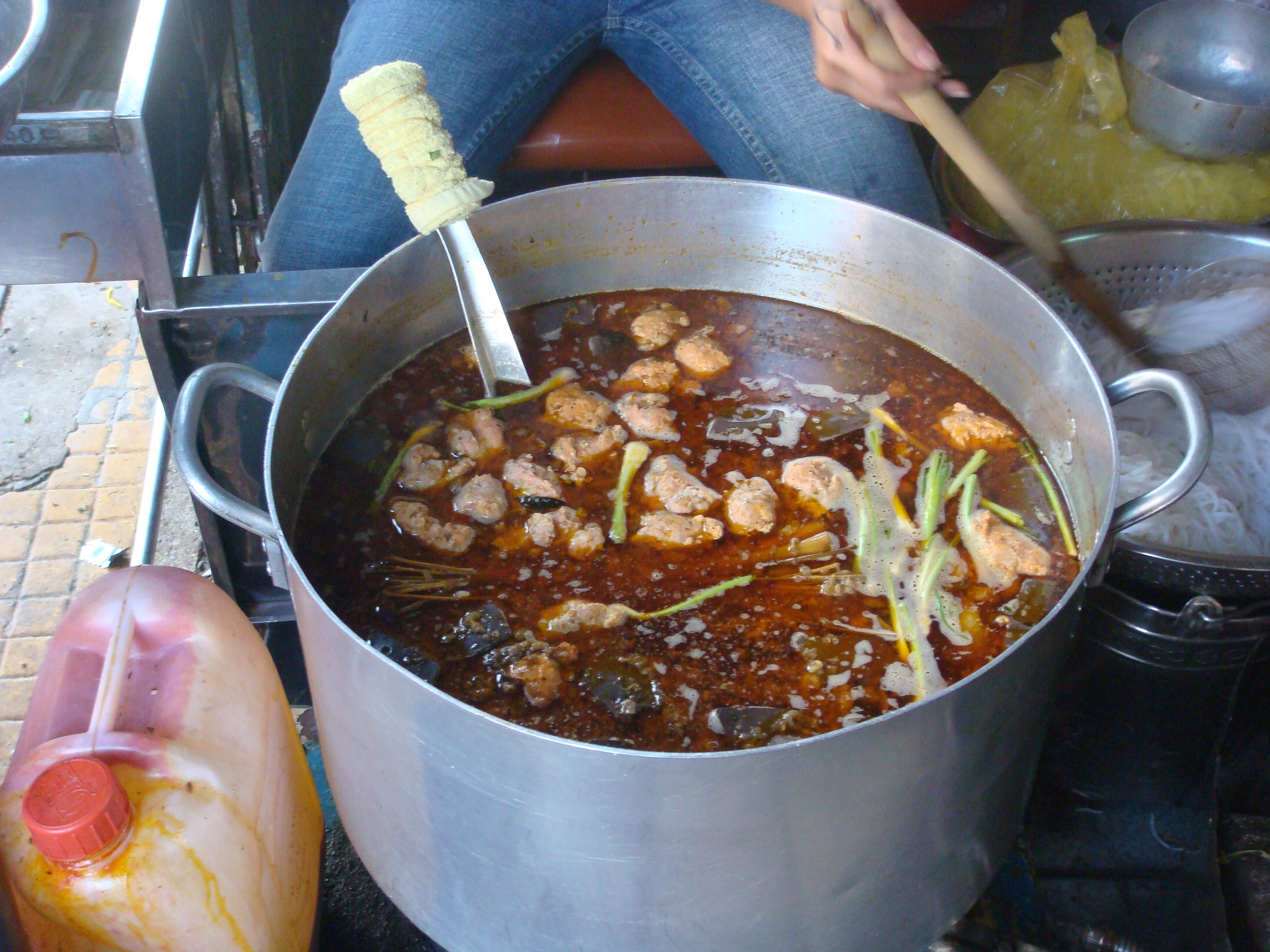
The dish to chase is bún bò Huế (bún bò Huế), and travelers who only know phở are routinely unprepared for it. Where Hanoi phở is about clarity, bún bò Huế is about depth and aggression: a broth of beef bones and pork knuckle simmered with whole stalks of bruised lemongrass and finished with mắm ruốc, fermented shrimp paste, which gives it a funky, savory undertow that phở never reaches for. It's stained red-orange with chili and annatto oil, the noodles are thick round rice vermicelli with real chew, and the bowl carries beef shank, pork knuckle, and often a slab of congealed pork blood. It is one of the great noodle soups of Asia, full stop, and Huế is the place to meet it on home ground — around 40,000–55,000 VND.
Down the coast in Hội An, the cooking turns into a port-town story. Cao lầu (cao lầu) is the one dish you genuinely cannot get right anywhere else, and the reason is water. The thick, chewy, faintly smoky noodles are traditionally made with lye water from a specific local source and well water from the Bá Lễ well in the old town — a closed-loop terroir that links the noodle to a few square kilometers of Hội An. The bowl is dry-ish: noodles, slices of barbecued pork, a few crisp croutons cut from the same dough, herbs, and just enough savory liquid to bind it. The genetic mix is visible in the bowl — a Japanese-influenced noodle, Chinese-style roast pork, Vietnamese herbs — which is exactly what you'd expect from a town that spent centuries as a trading port. Eat it where it's made; a "cao lầu" in Hanoi or Saigon is a tribute act.
Hội An also gave the world a famous bánh mì — and here I'll be the food journalist rather than the cheerleader. Bánh Mì Phượng is the shop Anthony Bourdain anointed, and it makes a genuinely good sandwich: a shatter-crisp Vietnamese baguette (lighter and airier than a French one, because of the rice flour in the dough), pâté, cold cuts, pickled daikon and carrot, cilantro, chili, a slick of house sauce. But in September 2023 the shop was at the center of a mass food-poisoning outbreak — around 150 people hospitalized — and was suspended and fined. It has since operated again. I'd still eat a bánh mì in Hội An; I would not treat any single famous shop as a pilgrimage that overrides the basic rule of the next section. A bánh mì made fresh in front of you at a busy cart is, for reasons I'll get to, one of the safest things you can eat in Vietnam.
One more central bowl: mì Quảng (mì Quảng), from Quảng Nam province just outside Hội An and Đà Nẵng. Wide turmeric-yellow rice noodles, only a shallow pool of intense broth — not a soup, not dry, somewhere deliberate in between — topped with shrimp, pork, a quail egg, peanuts and a shard of toasted rice cracker you crush over the top. It is the central coast on a plate and most travelers walk straight past it. Don't.
The South: sugar, herbs, and the Mekong's generosity
Cross into the south and the cooking relaxes. Saigon and the Mekong Delta sit on some of the most fertile land in Asia, and southern food spends that abundance freely — it's sweeter, brighter, more generous with herbs, fruit and coconut. A southern cook will sugar a dish that a Hanoi cook would leave alone, and they're not wrong to; it's a different palate, built on different ground.
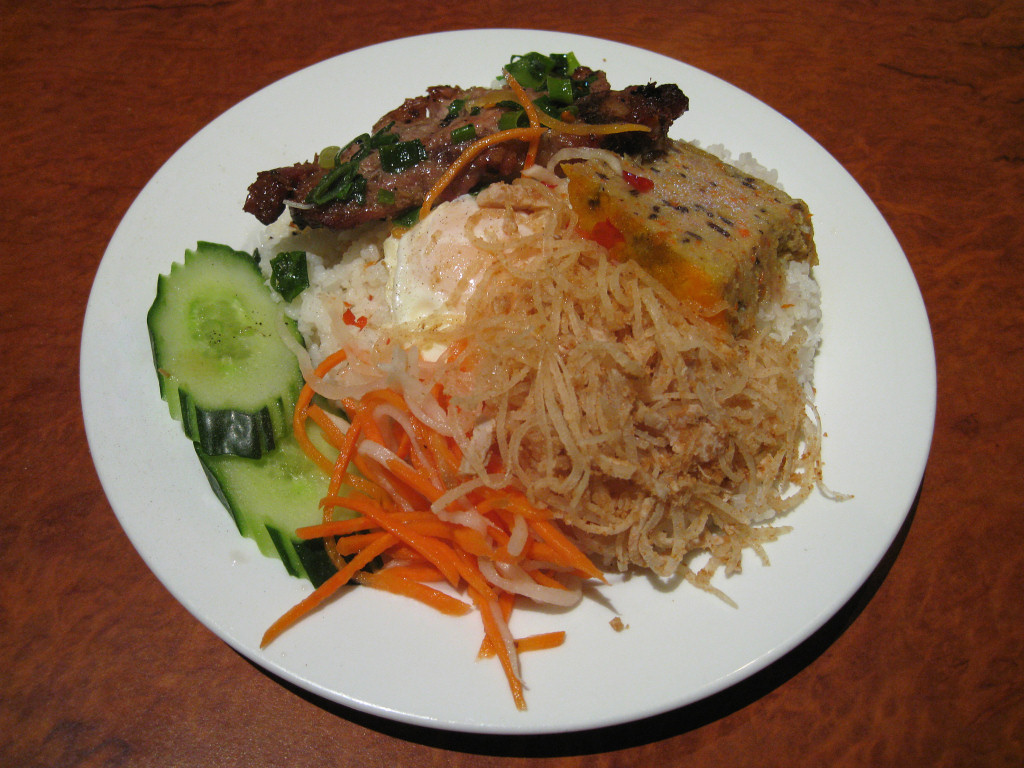
The breakfast-and-anytime king here is cơm tấm (cơm tấm) — "broken rice." The grains are the fractured bits left from milling, once sold cheap because they were considered seconds; now the dish is a point of southern pride. The standard plate: broken rice, a fat grilled pork chop marinated in lemongrass and sugar and caramelized hard over coals, often a square of chả trứng (steamed pork-and-egg meatloaf), a fried egg, pickles, a brush of scallion oil, and a small bowl of nước chấm to pour over the whole thing. The broken grains drink that sauce in a way intact rice never does — the dish only works because the rice is "lesser." Around 50,000–65,000 VND for a loaded plate.
Bánh xèo (bánh xèo) is the south's great communal dish — a large, thin, turmeric-yellow crepe, crisp at the edges, made batter-on-griddle with pork, shrimp and bean sprouts folded inside. You don't eat it with cutlery. You tear off a piece, wrap it in lettuce or mustard greens with a fistful of herbs, and dunk it in nước chấm. The southern version is big and crackly; central versions (you'll see them in Huế and Đà Nẵng too) run smaller and thicker. The eating ritual — the wrapping, the herbs, the dip — is half the dish.
And hủ tiếu (hủ tiếu), which is the southern noodle bowl phở-obsessed travelers keep missing. Its roots are Chinese-Cambodian — hủ tiếu Nam Vang, "Phnom Penh style," is the benchmark — and it shows the Mekong's reach: the broth is clear and faintly sweet, built from pork bones and dried seafood, the noodles are usually a chewier rice or tapioca strand, and the bowl can carry pork, shrimp, quail egg, liver and minced pork all at once. Crucially you can order it khô (dry) — noodles tossed in sauce with the broth served alongside — which is the move most travelers don't know to make. Chợ Lớn, Saigon's Chinatown in District 5, is the place; bowls run around 45,000–55,000 VND. Lighter than phở, more various, and a window straight into how Chinese, Khmer and Vietnamese cooking braided together in the delta.
How to eat well and not get sick
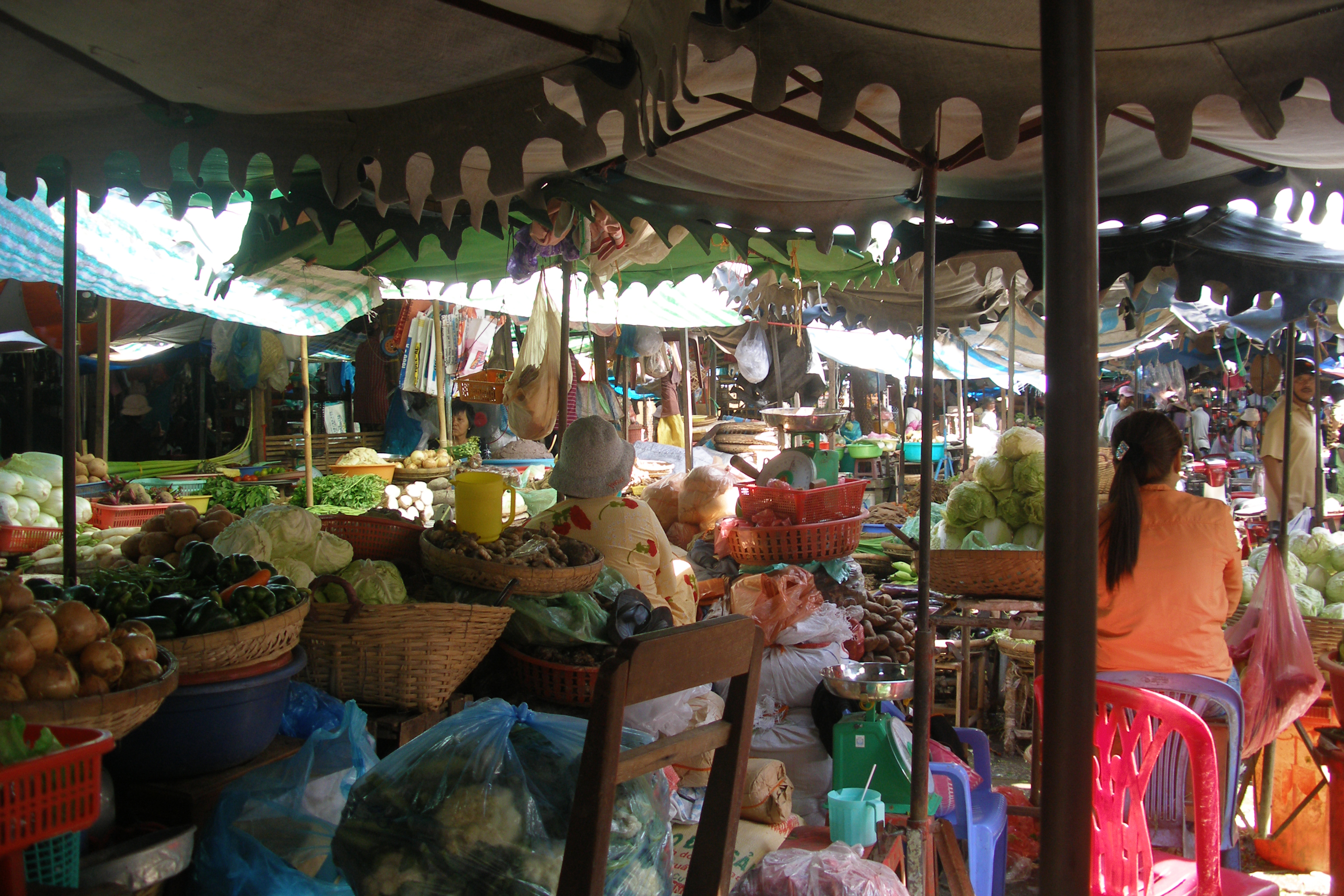
Here's the part you came in worried about, and here's the honest version: Vietnam is easier than its reputation. The structure of the food does most of the safety work for you. Phở, bún bò Huế, hủ tiếu — these arrive at a rolling boil. Bún chả and cơm tấm come straight off live charcoal. Bánh mì is assembled in front of you with no shared serving vessel and no standing water. The cuisine is, by its own logic, mostly cooked-to-order and served hot. That is the single best food-safety system there is.
What actually matters is learning to read a stall, and it takes about a day:
Follow the crowd, specifically the local crowd. A stall with a queue of Vietnamese office workers turns its ingredients over fast — nothing sits. High turnover is freshness. An empty stall with a faded laminated menu in four languages is the warning sign.
Watch the cooking happen. You want to see the flame, see the bowl filled to order, see steam. Food that's cooked in front of you and handed over hot has had its bacteria dealt with.
Be a little careful with the cool stuff, early on. The raw herb plate is rinsed in tap water; so are the bean sprouts. Most travelers are fine with both, but if your stomach is cautious, give the herbs a few days before you pile them on, and favor herbs you dunk into boiling broth. Cold pre-cut buffet items sitting out unrefrigerated are the genuine risk — far more than anything off a hot wok.
Water and ice. Don't drink the tap water; bottled water is everywhere and costs around 10,000 VND. Ice is mostly fine and mostly fine to stop worrying about — commercial ice in Vietnam is typically the cylindrical cubes with a hole through the middle, factory-made from filtered water. In a busy city café or restaurant, drink the iced coffee. In a remote rural stop, it's reasonable to skip ice. Hot tea and hot coffee are always safe — they've been boiled.
Peel-it-yourself fruit is your friend. Mango, mangosteen, rambutan, pomelo, banana — anything you peel yourself bypasses the rinse-water question entirely. Pre-cut fruit on a cart in the sun is the thing to skip.
None of this should make you timid. The food poisoning stories that travel — the Hội An bánh mì outbreak included — are real but rare, and they tend to involve scale: large pre-made batches held too long, not the cook grilling your pork chop to order. The corner stall with the queue and the open flame is, statistically and structurally, where you want to be eating.
A day of eating, and how to order it
You don't need a reservation or a plan in Vietnam. You need a rhythm. A good eating day, anywhere in the country, looks roughly like this:
Breakfast is a noodle soup or a bánh mì, eaten early at a stall. Phở in Hanoi, bún bò Huế in Huế, hủ tiếu or cơm tấm in Saigon. The Vietnamese eat their biggest, most serious bowl at breakfast, and the stalls are at their freshest before 9am.
Mid-morning is coffee — a cà phê sữa đá at a plastic-stool café, watching the street. This is not optional; it's how the country paces its day.
Lunch is rice or a "dry" noodle dish — cơm tấm, a bún bowl, cao lầu in Hội An, mì Quảng on the central coast.
Late afternoon is a snack — bánh xèo to share, or bánh mì, or a glass of sugarcane juice (nước mía).
Dinner is the relaxed, social meal — often grilled food, often beer (try bia hơi, the cheap fresh draft, in Hanoi), often a table of small plates rather than one big dish.
Two practical ordering notes. First, point and watch — you rarely need much language; gesture at the pot, at someone else's bowl, at the grill. Second, learn the words that change your meal: khô (dry, noodles without the soup), nước (with broth), không cay (not spicy), thêm (more), and ngon (delicious — say it to the cook; it's true and they'll like hearing it).
The verdict
Eat your way south. Start in Hanoi with the clear, disciplined broths and the charcoal smoke of bún chả; pick up chili, lemongrass and the imperial ambition of Huế through the centre, with a mandatory bowl of cao lầu in Hội An; finish in Saigon and the Mekong, where the sugar comes out and the herb plate takes over the table. Order what the local queue is ordering, eat it hot and cooked-to-order, peel your own fruit, and don't lose sleep over ice in a busy city café. Vietnam rewards the curious eater and punishes almost no one. The biggest risk on this trip isn't your stomach — it's running out of mornings before you've had every breakfast bowl the country makes.
If you can only do one thing
Sit down at a charcoal-smoked bún chả stall in Hanoi's Old Quarter at lunchtime — one with a Vietnamese queue and smoke already in the alley — and order one serving with a side of nem (fried spring rolls). It is the single most complete argument for Vietnamese food: live fire, fish sauce, fresh herbs, cheap, fast, and impossible to do better anywhere outside this city. About $2.50, and you'll think about it for a year.
Food journalist based in Seoul. Restaurant criticism, regional cuisines, comparative analysis. Hawker stalls and tasting menus, same standards.
✦ More from David Park


✦ Keep reading
More from this region


More in Destinations
✦ Discussion
Start the discussion
No replies yet — yours could be the first.