
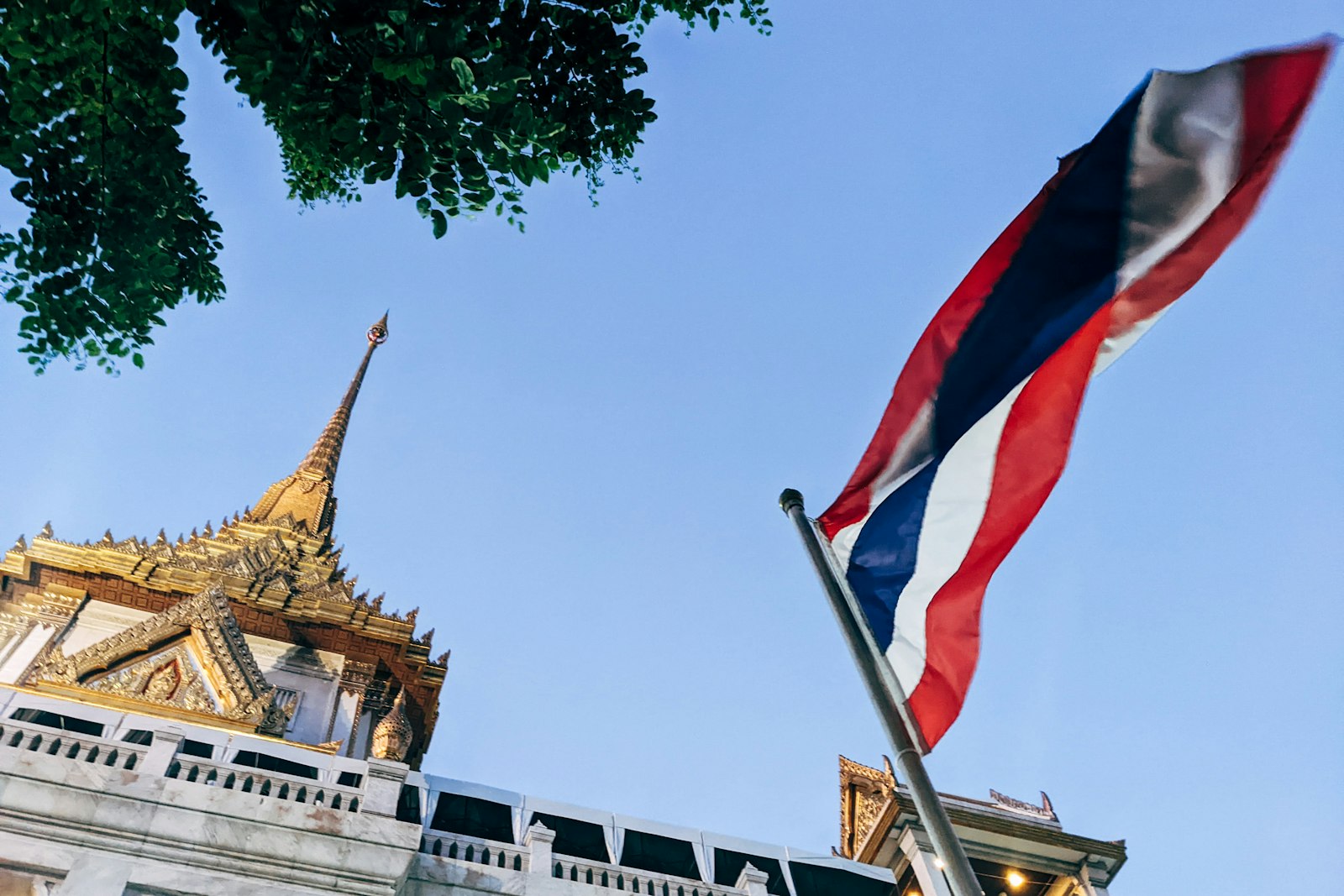
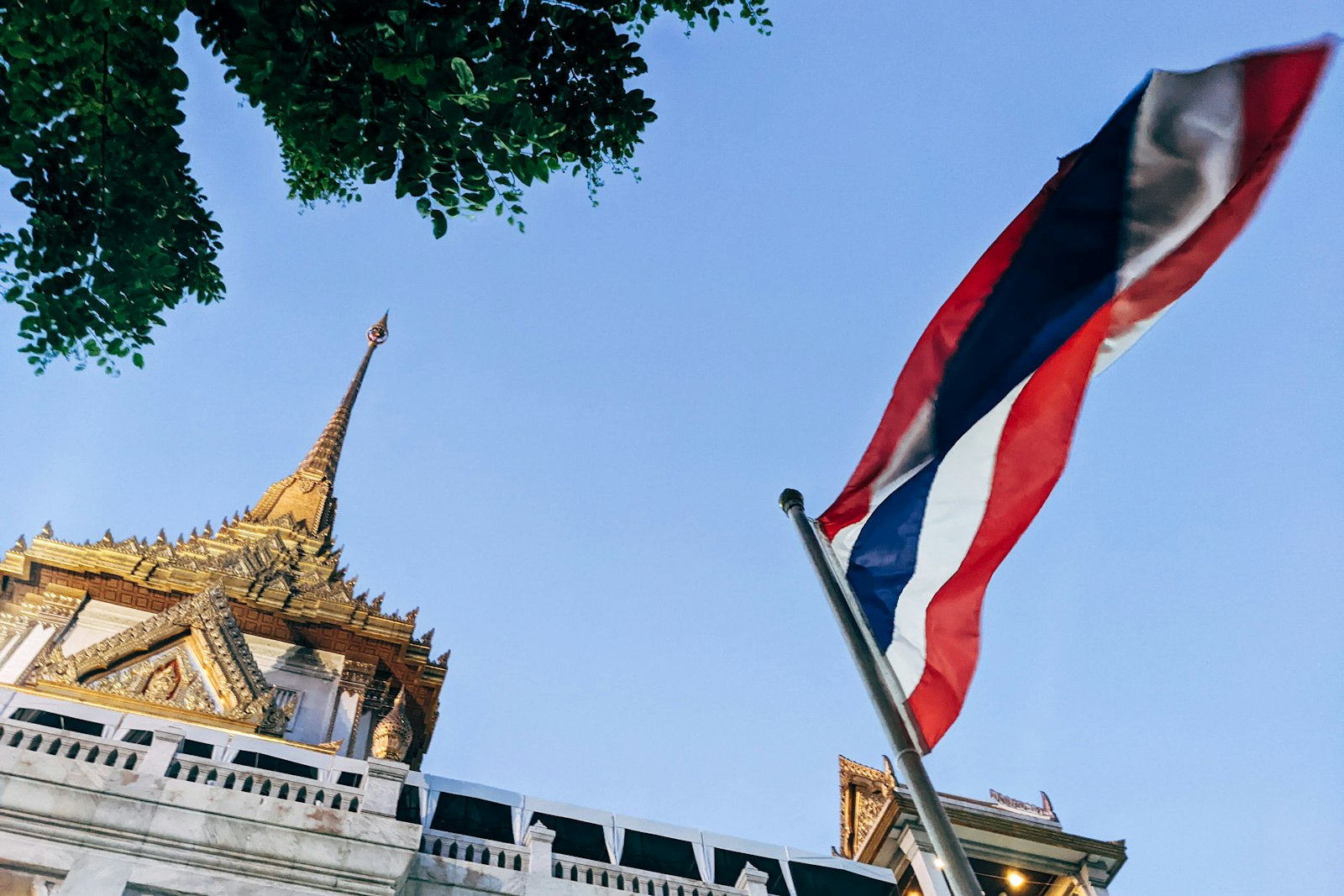
Source: Unsplash · License: Unsplash License
What Happens at 8am and 6pm in Thailand (and How to Not Be Rude)
You're walking through Hua Lamphong station, or a market in Chiang Mai, or a public square in Khon Kaen. At exactly 8am — or 6pm — a song starts playing over loudspeakers. Every Thai person around you stops mid-step. Conversations cut off. A vendor freezes mid-transaction. You keep walking, because nobody told you, and for a long ten seconds you are the only moving thing in a still room. Strangers are not impressed.
This piece exists so that doesn't happen to you.
The honest answer
Twice a day, every day, Thailand plays its national anthem — Phleng Chat Thai — at 8am and 6pm over loudspeakers in public spaces. People stop. You stop too. It lasts about a minute. That is the entire rule. There's no choreography to learn, no gesture you have to get right, no Thai phrase to mumble. You just stop moving and stand quietly until it ends. Then everyone resumes their day.
It is one of the easier pieces of cross-cultural etiquette you will ever encounter, and one of the most visible to get wrong. Tourists who keep walking through it are not arrested — there is technically a law on the books, but in practice nobody hauls a confused backpacker off to the station. What does happen is that you mark yourself, for everyone watching, as someone who did not bother to find out. In a country where dignity and respect are built into the social contract more visibly than they are at home, that has a cost — small, but real.
A minute of context — Phleng Chat Thai
The melody was written in 1932 by Phra Chenduriyang, a composer who came up with it (the story goes) on a tram ride in Bangkok shortly after the bloodless revolution that ended absolute monarchy. The current lyrics, by Luang Saranupraphan, were adopted on December 10, 1939, the same year the country's name officially changed from Siam to Thailand. The song is short — about sixty seconds — and the lyrics translate, roughly, to a declaration of unity, peace, and willingness to defend the nation.
The 8am/6pm public broadcast tradition is rooted in this national-identity moment. It's not religious; it's civic. The closest Western analog is a moment of silence at a war memorial, except it happens twice a day, everywhere, and nobody schedules it on a calendar — it just is.
A separate piece of music, Phleng Sansoen Phra Barami — the Royal Anthem — is for the King. You'll meet that one in cinemas. More on it below.
Where you'll hear it and what to do

Source: Unsplash · License: Unsplash License
You'll hear Phleng Chat in:
Train and bus stations (Hua Lamphong, Mo Chit, BTS and MRT concourses)
Public parks (Lumphini, Benjasiri, Suan Rot Fai)
Government building plazas
Schools and military zones
Smaller town squares and markets — often louder, because the speaker is closer
Radio and TV broadcasts (every channel pauses)
What to do, the entire protocol:
Stop walking. Wherever you are.
Stand still. Hands at your sides. Not over your heart — that's an American gesture and looks strange here. Just neutral.
Face the flag if one is visible. If not, face any direction; what matters is that you've stopped.
Stay quiet. No phone calls, no chatting, no scrolling. Lower your camera if you're filming.
Wait for it to end. About sixty seconds. You'll feel the room exhale when it does, and that's your cue.
Things not to do: don't film the moment for content; don't make a show of standing very dramatically; don't try to sing along unless you actually know the words. If you're sitting in a café or restaurant, you generally don't need to stand up — the indoor convention is that you simply pause your conversation. Watch what the Thai people around you do and follow.
If you genuinely don't notice it has started — easy to do when you're in transit with headphones in — and you find yourself the only one walking, just stop where you are. Don't sprint to a wall. Stop, stand, wait. The recovery is the same as the protocol.
The cinema version — Phleng Sansoen Phra Barami

Source: Unsplash · License: Unsplash License
Before the trailers end and the feature starts in a Thai cinema, the screen goes dark, a short film begins — usually images of the King — and the Royal Anthem plays. Everyone stands. This still happens in 2026 at the big chains: Major Cineplex, SF, Paragon Cineplex, Krungsri IMAX at Siam Paragon, EmQuartier. It runs about a minute and fifteen seconds. Then everyone sits back down and the movie starts.
Stand up. Stay quiet. Don't film the screen. When it ends, sit.
Compliance among younger Thais has loosened a little in recent years — there have been reports since 2020 of moviegoers occasionally staying seated — but as a foreign visitor you do not want to be the test case for what counts as defiance. Standing costs you nothing.
The line you cannot cross — Section 112
This is the part of Thai etiquette that has actual legal weight, and it's the part most travel content soft-pedals. Thailand's lèse-majesté law — Section 112 of the Criminal Code — makes it a crime to "defame, insult or threaten" the King, Queen, Heir, or Regent. The penalty is three to fifteen years in prison per count, and counts stack.
The law applies to foreigners on Thai soil. Your passport does not protect you. Foreign nationals have been arrested, convicted, and imprisoned under Section 112.
What this means in practical terms in 2026:
It applies to social media posts made while you are in Thailand — yes, even from your hotel, even on your home-country account, even if your followers are all back home.
It has been applied to liking, sharing, or reposting content critical of the monarchy, not only to original posts.
Enforcement has intensified since 2020. The UN human rights office has repeatedly called on Thailand to reform the law; sentences have grown longer, not shorter. In January 2025, a Thai man received a fifty-year sentence over twenty-seven Facebook posts — the heaviest 112 sentence to date.
Casual jokes about the royal family, "ironic" memes, edgy captions on a photo of a King's portrait — all of this falls inside the risk zone.
You don't have to agree with the law to follow it. The rule for the trip is simple: don't post, share, like, or comment on anything that touches the Thai monarchy while you are in the country, and ideally not after. If you have political views about Section 112 itself — many people do — save them for when you're home. Anti-monarchy content posted from Thai soil has been prosecuted. It is not worth your freedom to make a point on Instagram.
This is also worth flagging if you're traveling with friends or family who treat social media casually. One person's "haha look at this" repost can land them in a Thai prison.
The regional context — Laos and Cambodia
Source: Unsplash · License: Unsplash License
I get asked whether the 8am/6pm anthem ritual exists across mainland Southeast Asia. Mostly: no.
Laos has its own national anthem (Pheng Xat Lao), but there's no comparable daily public-broadcast moment that brings the street to a halt. State events and schools observe it; public-space stoppages are not part of daily life. Move through it with the standard "stand still if everyone else does" rule and you'll be fine.
Cambodia broadcasts its anthem (Nokoreach) at official events and on state media, but there is no equivalent street-stopping public ritual. The cultural register around the monarchy is also different — King Norodom Sihamoni is broadly respected and there are defamation considerations, but Cambodia does not have a Section 112 equivalent that hits with the same force.
Vietnam does not have a public anthem ritual of this kind.
Myanmar has anthem traditions tied to state media and government settings, but the country's broader political situation in 2026 means most travel-safety considerations there go well beyond etiquette.
The 8am/6pm stoppage is genuinely a Thailand thing. Treat it as Thailand-specific.
What showing up well looks like
The frame I'd offer: this isn't about you performing reverence for something you don't personally feel. It's about recognizing that you are a guest in a country where a specific minute, twice a day, belongs to a shared idea of nation — and where the monarchy occupies a place in public life that is genuinely different from the constitutional monarchies most Western visitors grew up around. The asks are small. Stop walking for sixty seconds. Stand up in the cinema. Keep your social media off the royal family for a week.
That's it. None of this requires you to think Thailand's laws are right. It requires you to be a person who notices where you are.
The bottom line
Stop at 8am and 6pm. Stand in the cinema. Stay off the King on social media. Do those three things and you've covered ninety-nine percent of what a thoughtful visitor needs to know about anthem and royal etiquette in Thailand. The first time you stand still in a Bangkok station while the whole concourse pauses around you, you'll feel the strangeness of it, and then — if you let yourself — the small dignity of having shown up for something that isn't yours but matters here. That's the trip going well.
Solo female traveler from Bangalore. Safety advocate, responsible tourism, women-run cooperatives — empowering, never alarmist.
✦ More from Priya Sharma


✦ Keep reading
More from this region


More in Destinations
✦ Discussion
Start the discussion
No replies yet — yours could be the first.