
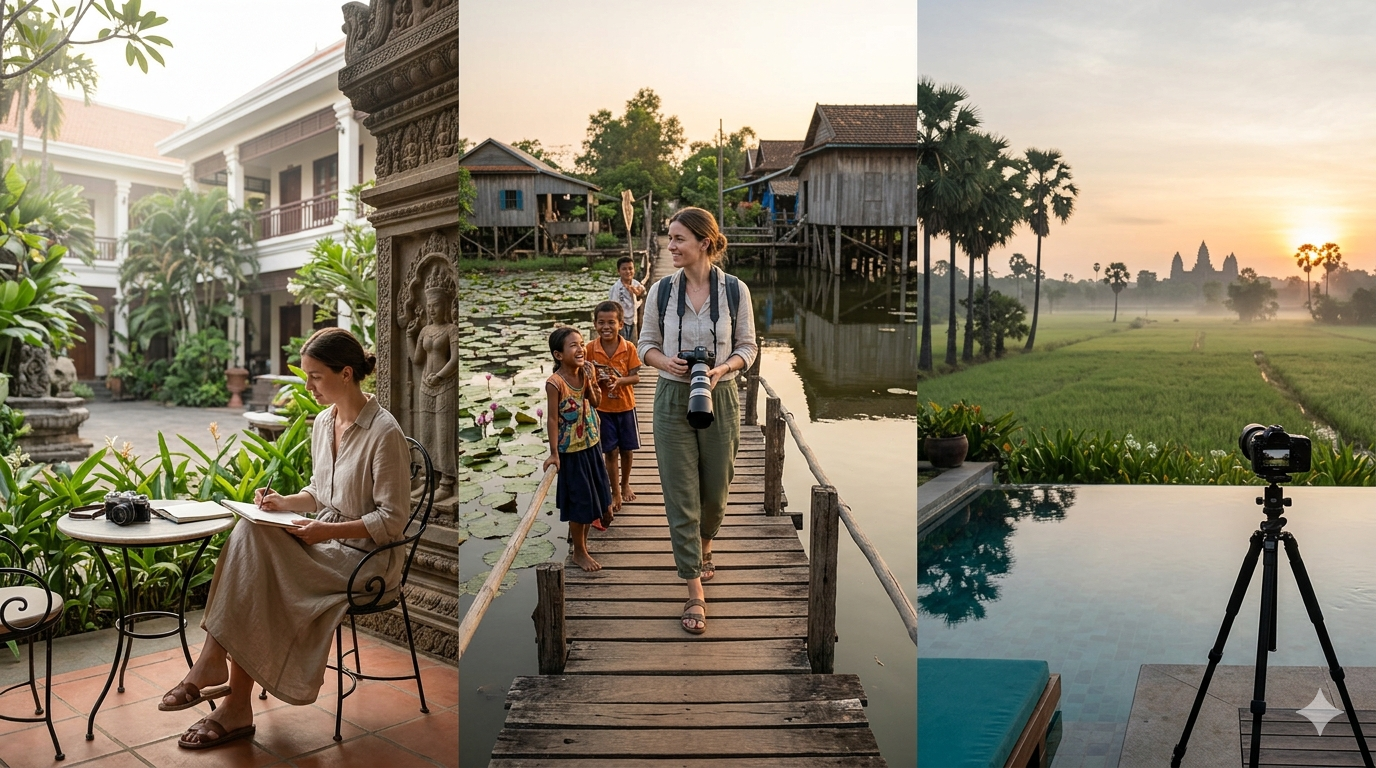
Where to Stay in Siem Reap, Through a Photographer's Eye
At 4:42 in the morning, the air in Siem Reap is a colour the rest of the day will not return to — a cool, dust-soft grey-blue that hasn't yet decided to be sky. The street outside the guesthouse is empty except for the tuk-tuk driver you booked the night before, and the small, deliberate sound he makes shutting his phone into a breast pocket so he can lean across and offer you the blanket. You are nine kilometres from the western moat of Angkor Wat. You have perhaps thirty-eight minutes before the first useful light. The choice of where you slept is, in this instant, the most consequential photographic decision of the trip.
This piece is not an accommodation roundup. It is a map drawn by someone who has missed the frame, more than once, because the hotel was on the wrong side of the river — too far for a sleepy driver, too close to a strip of late bars whose bass kept you up past one, too tucked behind a one-way system that adds nine extra minutes when nine extra minutes is the whole game. Choose the bed correctly and you wake into the picture. Choose it badly and you spend the rest of the day wondering what the reflection pool looked like at 5:55am.
The choice of where you slept is, in this instant, the most consequential photographic decision of the trip.
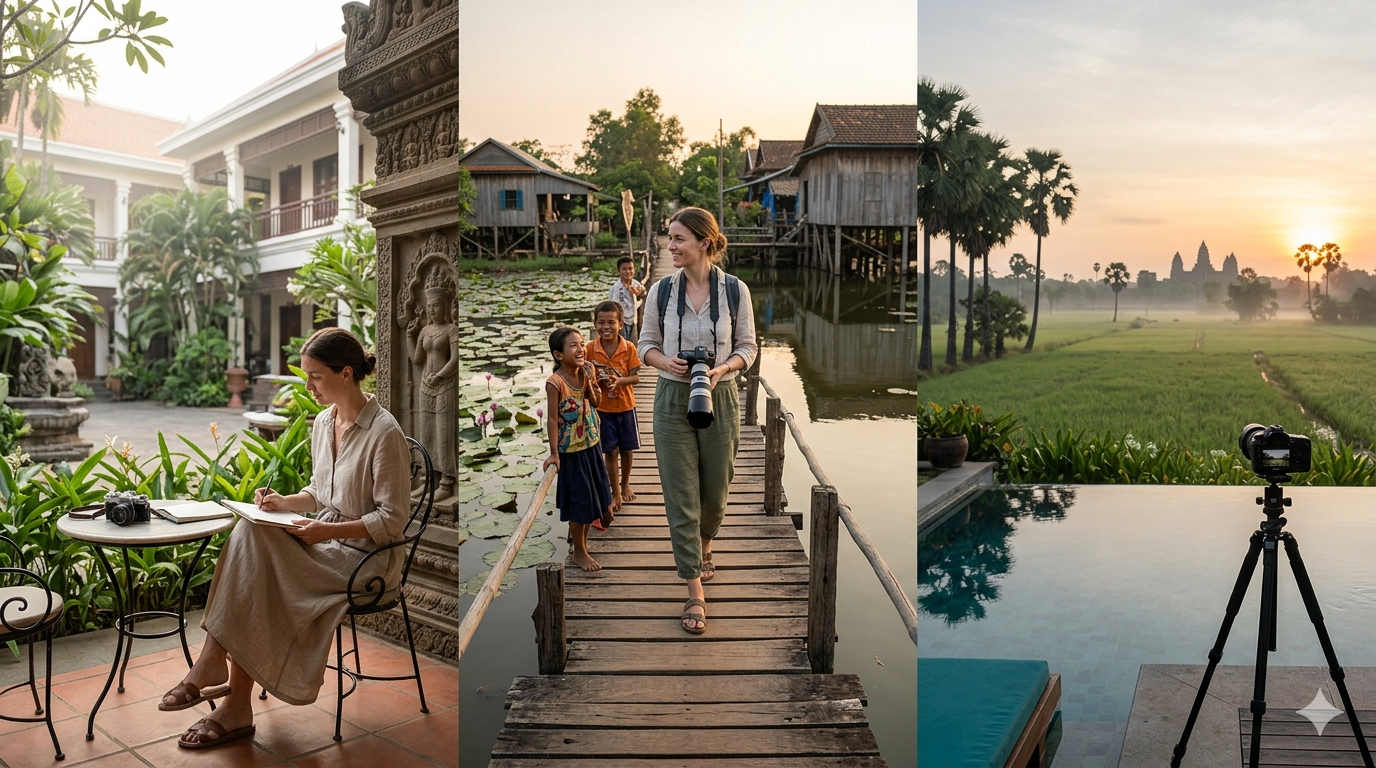
The geography you are actually choosing between
Siem Reap is a small city — small enough that "fifteen minutes away" is almost everywhere. But the city has clear neighbourhoods, and they behave differently at dawn.
The Old French Quarter, anchored by the Old Market and the 100-metre run of bars and noodle stalls called Pub Street, sits on the west bank of the Siem Reap River. This is where the night happens. It is also where many of the more breathless mid-range hotels cluster, because proximity to Pub Street still sells. Stay here and you wake to scooters, to the metallic clang of a stall shutter going up, to the smell of frying garlic by seven. The light here is flat — buildings on all sides — but the walk to a coffee at six is short.
The Wat Bo Road corridor runs the east bank of the river, roughly opposite the French Quarter, sliding southward into a quieter strip past Wat Bo itself (a working monastery whose morning bells you can set a watch by) and into the Wat Damnak area further south. This is the photographer's belt of the city. It is residential and slow. The lanes off Wat Bo Road carry the smell of cooking smoke and frangipani in the half-light. A tuk-tuk from here to the western moat of Angkor Wat is fifteen minutes, sometimes a little more if your driver is conservative on the bridge.
North of town, along the airport road and the back lanes that branch from it, you enter the rice-paddy belt — flat country planted to a horizon of sugar palms. The high-end resorts that trade on quiet (Phum Baitang, Sala Lodges, Amansara on its own private compound) live out here. From these properties you cannot walk anywhere, but you can drive to the western moat in ten minutes flat, sometimes less, and the air at five in the morning is full of frogs.
The fourth zone, Pub Street itself and its immediate side-alleys, I will simply name and step around. Stay there if the trip is mostly nightlife. Don't stay there if you mean to be at Angkor by five.
At the top: where the photograph is already in the room
The high end of Siem Reap is unusually photogenic for its own sake — these are buildings worth shooting before you've even left for the temples — and the proximity reality is better than the price might suggest.
Amansara is the historical answer to the question. The property occupies what was King Sihanouk's 1962 guesthouse, a low, white, faintly Mid-Century compound on the road out toward Angkor. It is roughly five kilometres from the western entrance of Angkor Wat — call it ten minutes by car at dawn, less if the driver knows the back routes. The rooms are intentionally small and stripped: lime-washed walls, a black-bottomed plunge pool, a single piece of stone for a writing desk. There is no television. The architecture itself is one of the more interesting examples of New Khmer Architecture you'll see in the country, and the property includes one of Cambodia's better small collections of Khmer antiquities. If you can afford it — and the rate is what you imagine it to be — you have bought yourself thirty extra minutes of sleep and a driver who already understands what 4:45 means.
Phum Baitang, operated by Zannier Hotels, sits west of the airport amid working rice paddies. The property is a village (the name translates roughly to "green village") of forty-five timber stilt-houses, each one set far enough from the next that you cannot hear your neighbour. The architecture leans into vernacular Khmer building — teak, terracotta tile, a deep-eaved silhouette — done with the restraint of a hotel that knows the rice fields outside are the real performance. From Phum Baitang to the western moat is about twenty minutes, longer than Amansara but a different drive: you cut through country lanes rather than the airport-road traffic.
Sala Lodges is the most quietly architectural of the three. Eleven traditional Khmer wooden houses — actual heritage structures, rescued from villages around the country and rebuilt on a single shaded compound about a kilometre south-east of the Old Market, on the far side of the river. Each house is different: a planter's hut from Battambang, a fisherman's house from Tonlé Sap, a teak-and-laterite merchant's dwelling. You stay inside the past tense of Cambodian domestic architecture. The light through the louvred wooden shutters at six in the morning is the kind of light you make a print of. To Angkor Wat is twelve to fifteen minutes by tuk-tuk.
All three of these belong on the same shelf for a photographer. Amansara has the modernist clarity and the shortest drive. Phum Baitang has the landscape — if you've come to shoot rice fields and palm-silhouette dawns as much as temples, this is the answer. Sala Lodges has the architecture, and the most cinematically lit interiors of any room I've slept in in Cambodia.
The light through the louvred wooden shutters at six in the morning is the kind of light you make a print of.
The middle: where most readers should actually stay
For most photographers — those staying three to five nights, those who want to be twelve minutes from a sunrise and ninety seconds from a cold beer at six in the evening — the mid-range cluster along the Siem Reap River, on or just off Wat Bo Road, is the right answer.
Jaya House River Park is the one I most reliably recommend. It sits on River Road on the east bank, a six- to eight-minute tuk-tuk into central Siem Reap and about twelve to fifteen minutes from the western moat of Angkor Wat. The building itself is a low, white, plant-heavy structure — palms and travellers' palms spilling over the boundary walls, two long swimming pools, a generous library off the lobby. The owner-operator, Christian de Boer, runs the property as a working experiment in waste reduction (no single-use plastic on the premises, full stop), and the staff turnover is so low that by your second morning the man at the breakfast pass remembers how you take your coffee. From here, the river walk back into town is twelve minutes on foot, ten if you push. At dawn, your tuk-tuk is waiting in the small forecourt by 4:30 and you are at the reflection pool by 5:15.
Treeline Urban Resort is the city's most interesting piece of contemporary architecture and arguably the most photographable hotel exterior in Cambodia. Designed by HKA & Partners, it stands a few hundred metres downriver from Jaya House, also on the east bank, in the strip between two of the river's bridges. The building is concrete — heavy arches, blocky square windows — but every ledge and recess holds a deliberate cascade of plants, so that what is monumental at noon dissolves at golden hour into something fern-soft and green. The Michelin Guide added it to the directory in the last two years and it deserves the listing. The rooms feel like a Bangkok art gallery had a child with a Khmer courtyard house. From Treeline to Angkor Wat is the same fifteen-minute window as Jaya — closer to the Pub Street strip than Jaya, with the small trade-off that comes with that.
Both properties book in the $150–$250 range depending on season, both have pools you will use, and both make the 4:30am tuk-tuk routine effortless. If forced to pick on photography alone, I prefer Jaya for the morning light through its lobby and Treeline for the afternoon light on the façade. There are worse problems to have.
Backpacker, but with one eye open
If the budget is $20–$40 a night and you still mean to take photography seriously, the trick is to choose a hostel that respects the timing of your morning more than the rhythm of its bar. The good news is that several do.
Onederz Siem Reap is the cleanest, calmest, and most photographer-tolerant of the central hostels. It sits about a three-minute walk from Pub Street — close enough to step out for cheap food, far enough to sleep through it — and has an outdoor pool, a quiet rooftop, and dormitory pods rather than open bunk rooms. Reception will book you a sunrise tuk-tuk the night before without making a face about the hour. To the western moat is fifteen to twenty minutes depending on the driver. The proximity to Pub Street works against you on Saturday night and for you on Tuesday morning.
Mad Monkey Siem Reap is honest about itself. It is a party hostel, located about a five-minute walk north of Pub Street, with a pool that turns into a bar after dark and a bar that turns into a club after that. The accommodation is fine, the location is convenient, and the noise is what you signed up for. If your trip is more about the social hours than the dawn ones, this is the place. If your trip is the reverse, choose elsewhere.
Babel Guesthouse is the answer to the question of how to spend $28 a night in Siem Reap and still wake up to the sound of the right city. It sits at the south end of the Wat Bo area, three minutes' walk from the river, tucked into a small tropical garden with a single swimming pool. The building is unfussy: tile floors, white walls, ceiling fans, mosquito-screened windows that open onto the courtyard. The host is on first-name terms with the regular tuk-tuk drivers in the lane, which matters more than it sounds — by your second morning, the same driver is waiting at 4:30, with the same blanket, and he already knows you want the reflection pool first. To Angkor Wat is fifteen minutes. You will eat dinner at the open-air restaurant in the courtyard for under ten dollars and you will sleep through the night.
The minutes that matter
For a photographer, the practical question reduces to a small grid of numbers. Here are the ones I have measured, on different mornings, with different drivers, in different seasons.
From the Wat Bo / River Road corridor (Jaya House, Treeline, Babel, the cluster of mid-range guesthouses on the east bank): twelve to fifteen minutes to the western moat of Angkor Wat. Eighteen to twenty to Bayon in the centre of Angkor Thom. Twenty to twenty-two to Ta Prohm, the jungle temple, on the eastern circuit.
From Amansara, on the road out toward Angkor itself: ten minutes to Angkor Wat. Fifteen to Bayon. Eighteen to Ta Prohm.
From Phum Baitang in the rice-paddy belt: twenty minutes to Angkor Wat. Twenty-five to Bayon. Closer to thirty to Ta Prohm.
From Pub Street and the Old Market area: fifteen to eighteen minutes to Angkor Wat, depending on whether the bridge over the river is moving freely.
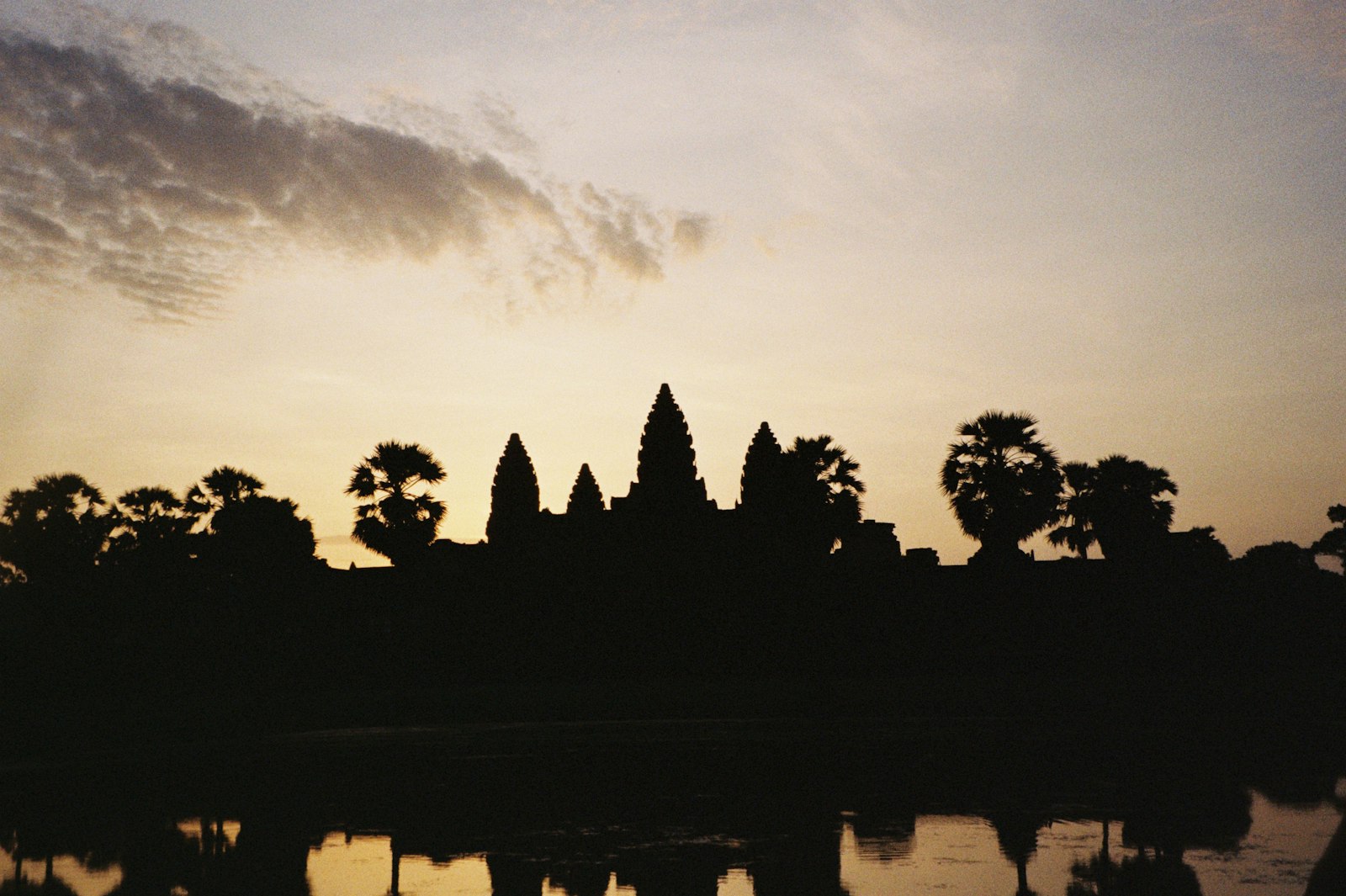
These minutes feed into a day. Angkor Wat is a sunrise temple — west-facing, so you photograph it from inside the western entrance, with the temple's five towers held in silhouette against the rising sun behind them. Bayon, the temple of the smiling stone faces at the heart of Angkor Thom, faces east; the morning light is canonical, but in my experience the afternoon — roughly three to four — works the south face beautifully and the crowds have thinned. Ta Prohm, the jungle temple, can be done either dawn or late afternoon; the morning sun lights the famous east-facing strangler-fig walls, the afternoon throws long shadows down the west passages.
So a day looks like this. Out at 4:30, at Angkor Wat for first light by 5:15, shooting until 6:30 when the sun loses its colour. Breakfast either back at the hotel or at one of the small stalls just outside the temple's western moat. Then north into Angkor Thom for Bayon at mid-morning or late afternoon, depending on weather. Ta Prohm last, when the light has lengthened. Home by six. Cold shower. Eat at seven. Asleep by ten.
The hotel makes this rhythm possible or it does not.
Where to eat after a 5am shoot
Two recommendations, and a principle.
The principle: do not try to eat the breakfast buffet at your hotel at 7:15 if you've been awake since 4:15. You will look at the eggs and feel briefly insane. Either eat early at one of the stalls outside the Angkor western gate (a bowl of noodle soup, a sweetened coffee, ten thousand riel), or push through and eat properly at nine when the morning shoot is done.
The two: Sister Srey Café on Pob Kambor Road, west bank near the river — a Khmer-Australian breakfast spot that knows what to do with a poached egg and a tired photographer. Vibe Café on Wat Bo Road, east bank — plant-based, bright, and the windows face east so the morning sun comes through the curtain of palms in the right way. Either works for the post-temple recovery meal. Both will run you ten dollars and put you back in the world.
The closing argument
Choose Wat Bo or River Road and you have chosen the photographer's belt of the city — the right driving distance to all three of the canonical temples, walking distance to the river-walk at golden hour, far enough from the bass of Pub Street to sleep when you need to. Choose Amansara or Phum Baitang or Sala Lodges and you have bought yourself architecture in the room, ten extra minutes of sleep, and a property that is itself part of the photograph. Choose Onederz or Babel and you have made the right $30 trade.
What you don't want is to be the photographer who, at 4:42 in the morning, in that one impossible blue moment when the air still hasn't decided to be sky, is fourteen minutes further from the western moat than they needed to be.
The light doesn't wait.
Italian travel photographer-writer. Architecture, landscape, the light. Slow, deliberate, image-led essays.
✦ More from Marco Rossi


✦ Keep reading
More from this region


More in Cambodia
Where this happens
✦ Discussion
Start the discussion
No replies yet — yours could be the first.