
Source: Unsplash · License: Unsplash License
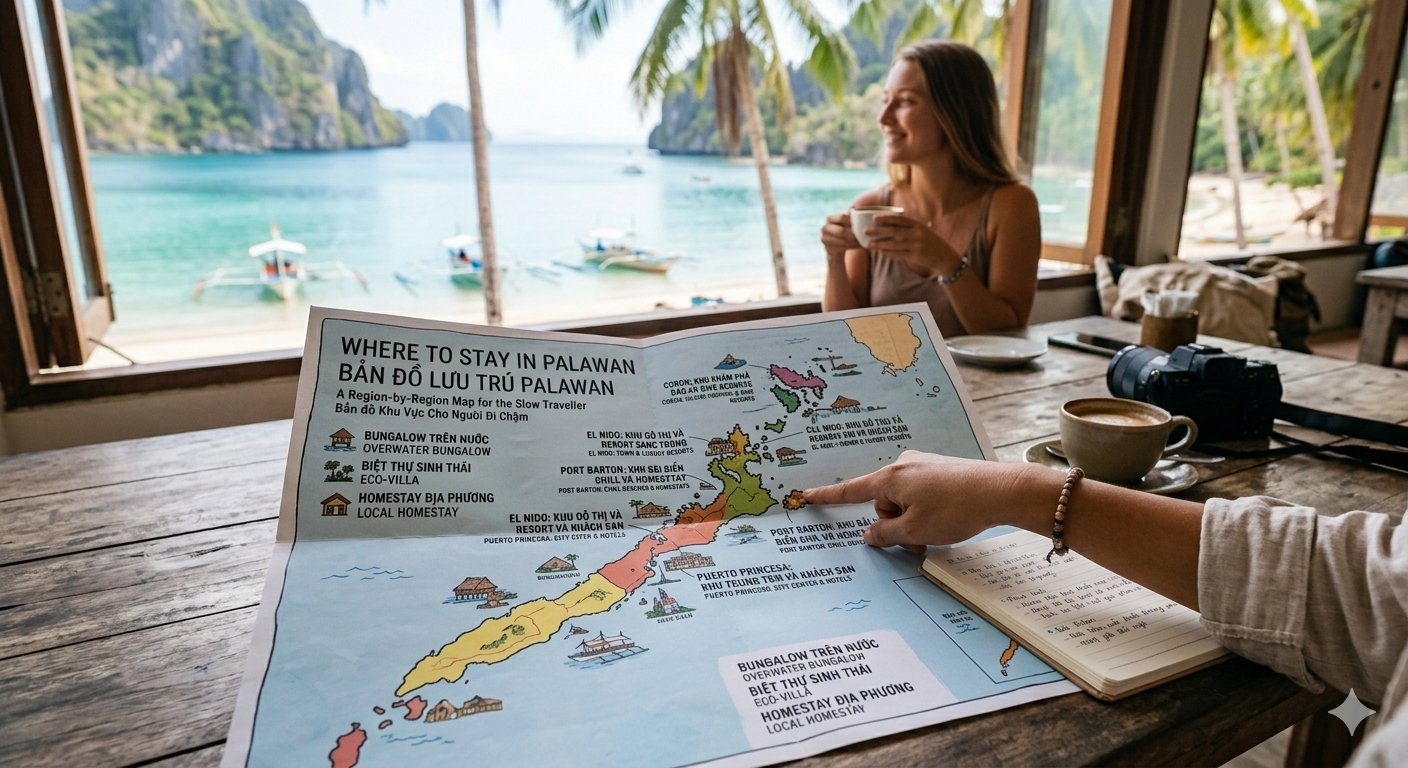
Where to Stay in Palawan: A Region-by-Region Map for the Slow Traveller
The first thing to understand about Palawan is that it is not a place. It is a 450-kilometre sliver of limestone and jungle pointing south-west from the Philippine archipelago toward Borneo, and the distance from its northern tip to its southern frontier is roughly the distance from Milan to Rome. The question is not whether to come — the question is which Palawan you are coming for, because choosing your base on this island is closer to choosing a country than to choosing a hotel.
I have been making this drive, in pieces and across years, since the first time a fixer in Manila told me that El Nido and Coron were "just up the road from Puerto Princesa." They are not. They are a six-hour van ride, a separate flight, or a slow boat away — and between them lie quieter coastlines that almost no one writes about. What follows is a map of where to base yourself for each kind of Palawan trip. It is geography first, hotel second.
The season decides everything
Palawan runs on two calendars. From late November through April the amihan — the north-east monsoon — settles in cool and dry, the bays go glassy, and the boats run reliably. From May through October the habagat arrives from the south-west, bringing heavy afternoon rain, a churned sea, and the very real possibility that the island-hopping bangka you booked yesterday will not leave the pier today.
Travel in the dry months and Palawan rewards you with a postcard. Travel in the wet months and Palawan rewards you with itself — emptier, greener, and considerably more honest.
The peak window inside that dry season is February and March, when the air sits around twenty-seven degrees, the humidity slackens, and the late-afternoon light goes the colour of weak tea on the limestone cliffs. January is excellent and slightly less crowded. December and Easter weeks are the most expensive and the most thronged. If you can travel in the shoulders — late November, early December, or the last week of April — you will find a softer version of the same island.
Puerto Princesa sits at roughly 9.7 degrees north, which means the sun comes up and goes down within a half-hour of six o'clock every day of the year. There is no long Mediterranean dusk here. The golden hour is closer to a golden twenty minutes, and you plan around it accordingly.
Puerto Princesa — the airport, the Underground River, and one day to acclimatise
Source: Unsplash · License: Unsplash License
Almost everyone arrives through Puerto Princesa, the provincial capital on the island's east coast. It is a working city of about three hundred thousand people, with tricycles and jeepneys and a long bayside boulevard, and it suffers in most travel writing by being treated as a layover. That is a mistake. One full day in Puerto Princesa is enough — and one full day in Puerto Princesa is what the journey ahead deserves.
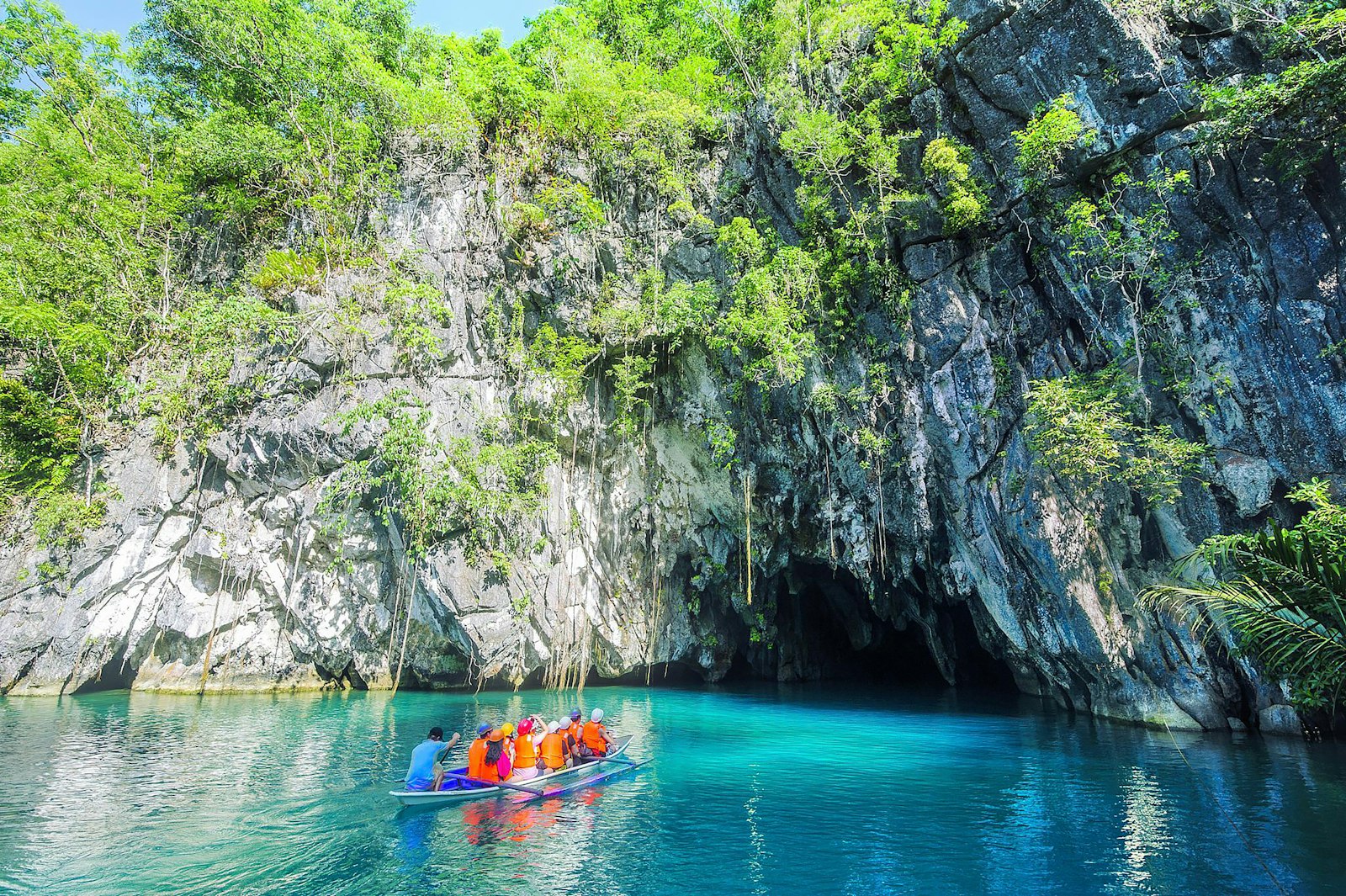
The reason to base here even briefly is the Puerto Princesa Subterranean River National Park, a UNESCO site about seventy-six kilometres north-west of the city. The river runs eight kilometres through a karst cave system carved into the St. Paul limestone — a geology between sixteen and twenty million years old — and emerges directly into the South China Sea. You ride a paddleboat in. The chambers open above you at sixty metres, the speleothems hang in sheets, and the only sound is the dripping echo of the cave's own slow water sculpture.
Stay one or two nights in Puerto Princesa: a heritage casita near the Baywalk, or one of the small resorts out toward Honda Bay if you want a beach without leaving the airport's gravitational pull. Then move on. The city is a hinge, not a destination.
El Nido — the famous north, and why you go anyway
Source: Unsplash · License: Unsplash License
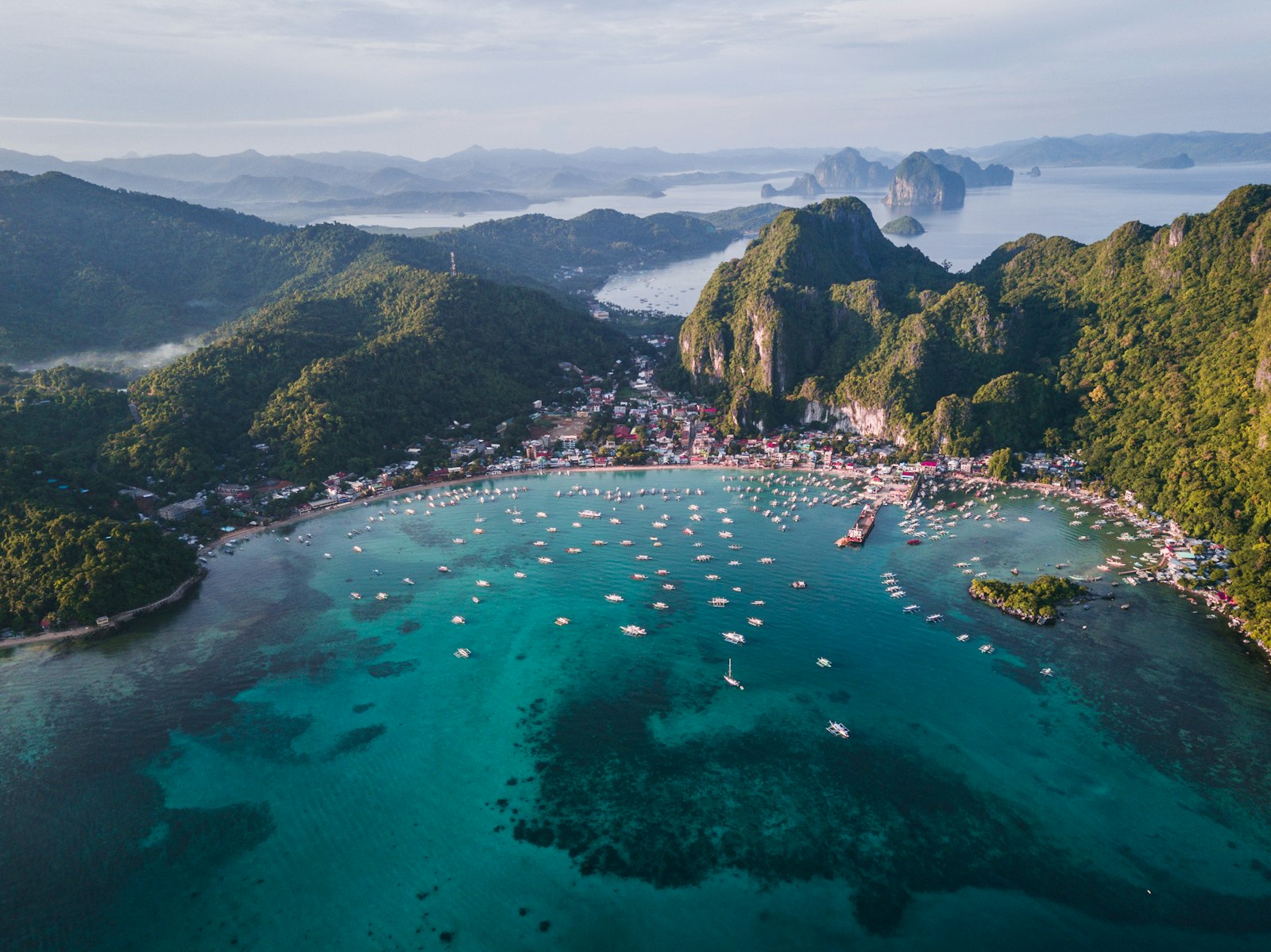
El Nido is the picture you have already seen of Palawan: Bacuit Bay's wall of grey-green limestone karst, the bangka boats moored in the shallows, the lagoons the colour of oxidised copper. It is also crowded, increasingly built-out, and the centre of nearly all the marketing that has put Palawan on every traveller's longlist for the last decade.
You go anyway. The landscape is one of the most extraordinary in South-East Asia, and no amount of overdevelopment along Hama Street has diminished what happens when a bangka rounds the corner into the Big Lagoon at seven in the morning and the cliffs reflect on water still untroubled by another boat. The trick is where you sleep. The town itself is loud and getting louder; the quiet versions of El Nido are out at Corong-Corong (just south, sunset-facing), on Las Cabanas Beach, or — if budget permits — on one of the private-island resorts in the bay itself, where the boatmen pick you up directly from the airstrip at Lio.
We have written about El Nido in detail elsewhere. For this piece, take it as given: if it is your first time in Palawan and you have a week, El Nido gets two to three nights. Any longer and you risk wearing out the postcard.
Coron — wrecks, lakes, and the other Palawan
Source: Unsplash · License: Unsplash License
Strictly, Coron is not Palawan-island; it is the main town of Busuanga, in the Calamian group several hours by ferry to the north. Practically, it is part of any serious Palawan itinerary, and increasingly travellers arrive directly via the small airport at Busuanga and skip the southern island entirely.
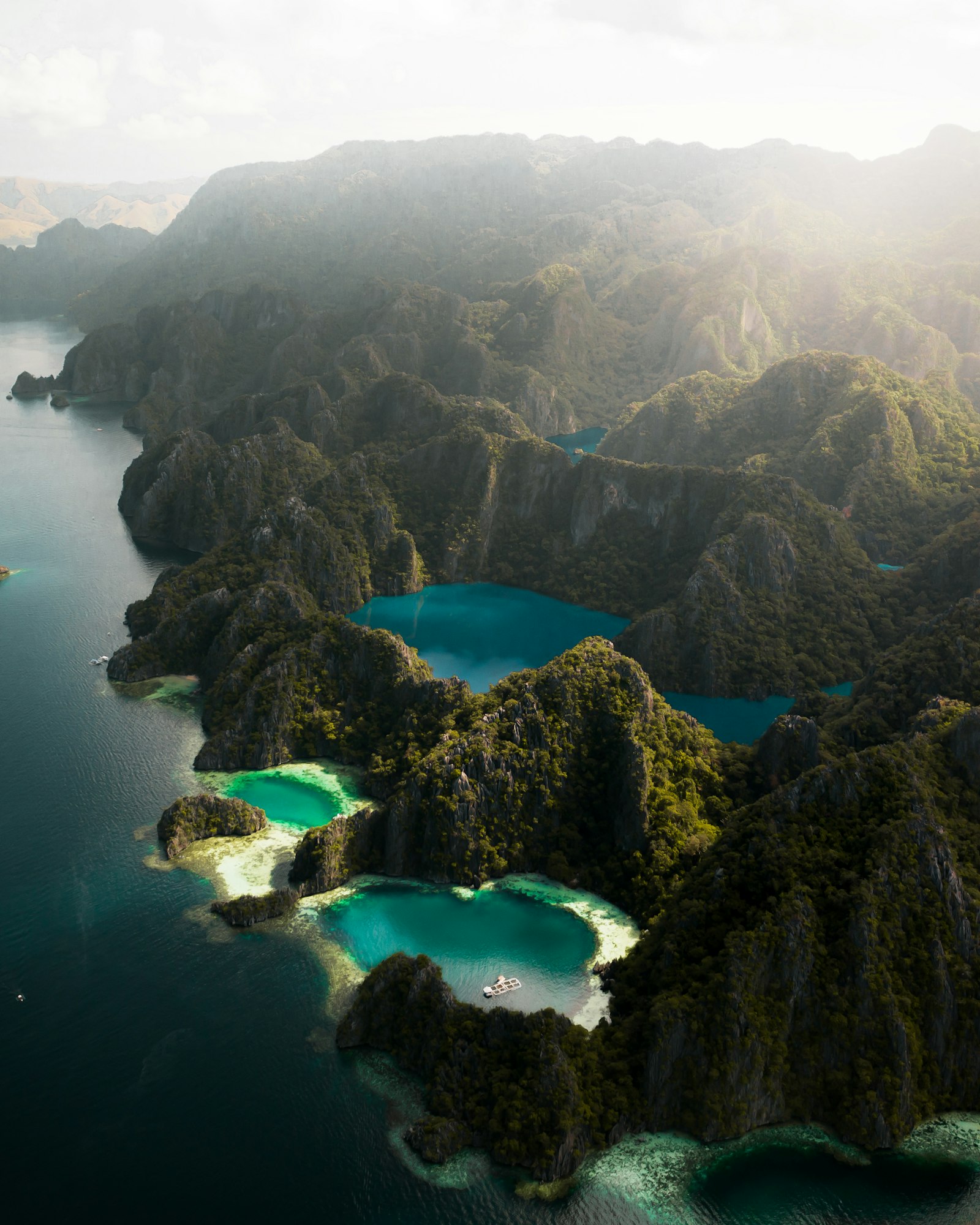
What Coron offers that El Nido cannot is depth — both literal and figurative. Kayangan Lake holds water so still and clear it confuses scale. Twin Lagoon presents the geological oddity of warm saltwater and cool freshwater stratified into the same pool, divided only by a karst rock. And below the surface of Coron Bay lie a dozen Japanese supply ships sunk by American carrier planes in September 1944 — one of Asia's great wreck-diving sites, intact at depths a recreational diver can reach.
Stay in Coron Town for the easy logistics; stay at one of the resorts along the bay (Two Seasons, El Rio y Mar, Sangat Island) if you want to wake up already on the water. Like El Nido, Coron deserves its own piece, and gets one elsewhere on this site. Two to three nights, minimum.
San Vicente and Port Barton — the quiet middle
Source: Wikimedia Commons · License: CC BY 4.0 · Credit: Vyacheslav Argenberg
Here is the Palawan that almost no one writes about, which is precisely the case for going.
San Vicente is the municipality between El Nido and Puerto Princesa on the west coast, and it contains the longest white-sand beach in the Philippines — Long Beach, fourteen kilometres of fine sand running essentially undeveloped from one headland to the next. There is now a small regional airport at San Vicente town, which means you can fly in from Manila or Cebu and skip the road journey entirely. Most travellers don't, yet.
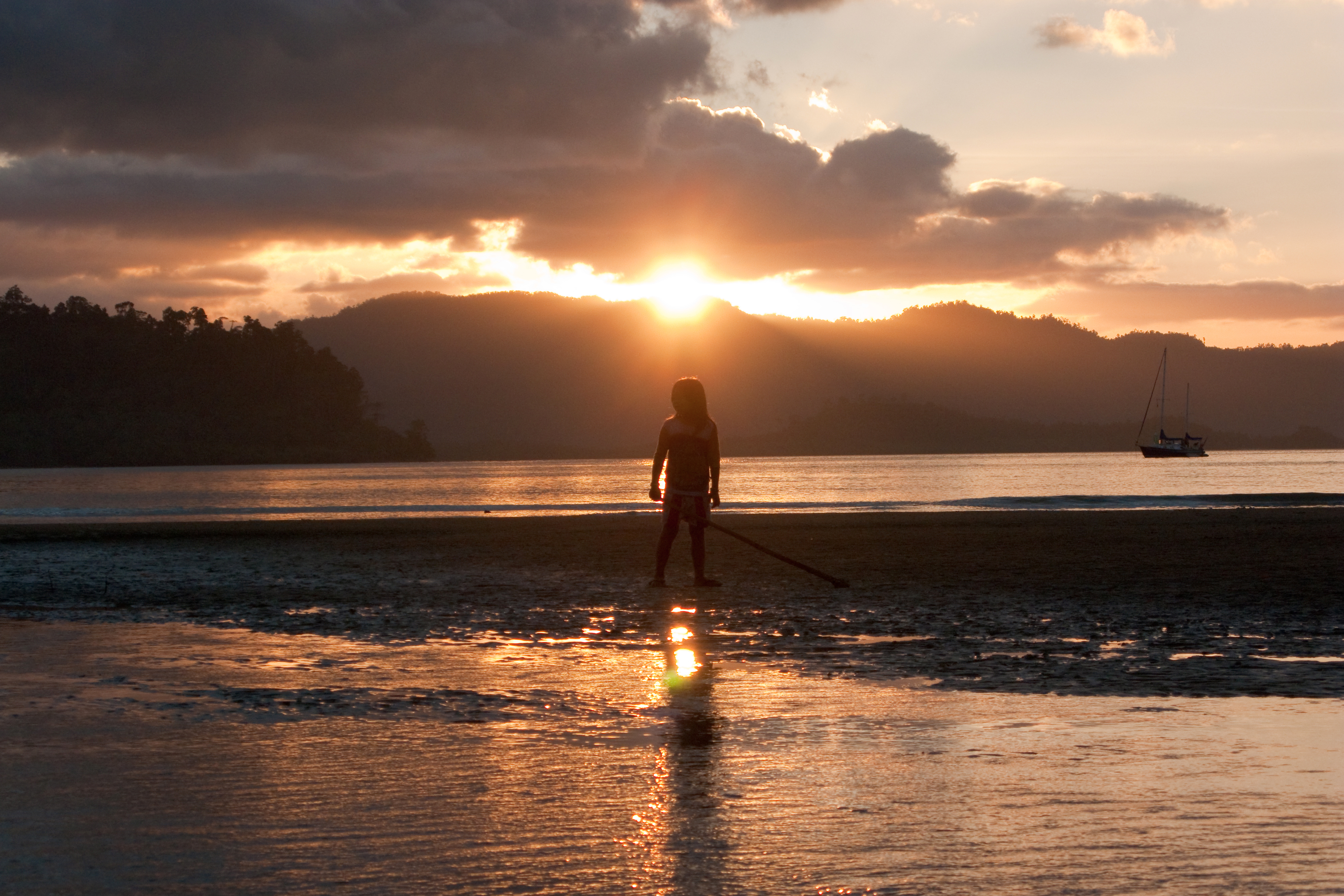
Inside San Vicente sits Port Barton, a fishing village on a half-moon bay that has built, slowly and stubbornly, a backpacker-and-quiet-couples scene without losing the village underneath. The electricity has historically been part-time. The wifi is part-time. The bangka boatmen run small island-hopping trips to a handful of nearby sandbars and snorkel spots — the same business as El Nido, at perhaps a third of the volume and a fifth of the noise.
Port Barton is the Palawan that exists between the two famous Palawans — a bay where the boatmen still know each other's names, the sunset is no one's photograph but yours, and the silence at nine in the evening is the silence of a working coastline going to sleep.
The aesthetic here is wood, palm thatch, lime-washed plaster bungalows, the occasional concrete cube done poorly. The light at the end of the day moves from a warm coral wash to a sodium-coloured stillness, and then to dark, very fast. Three or four nights here is the correct dose if you have come to Palawan to slow down rather than to perform a checklist. If you want to base on Long Beach itself, the strip is dotted with a handful of mid-range resorts at the northern and southern ends; the middle is still mostly sand and Casuarina trees.
Balabac — the unfinished frontier
Source: Unsplash · License: Unsplash License
At the far southern tip of Palawan, where the island finally breaks up into an archipelago pointing toward Sabah, lies Balabac. This is not a place you visit. This is a place you commit to.
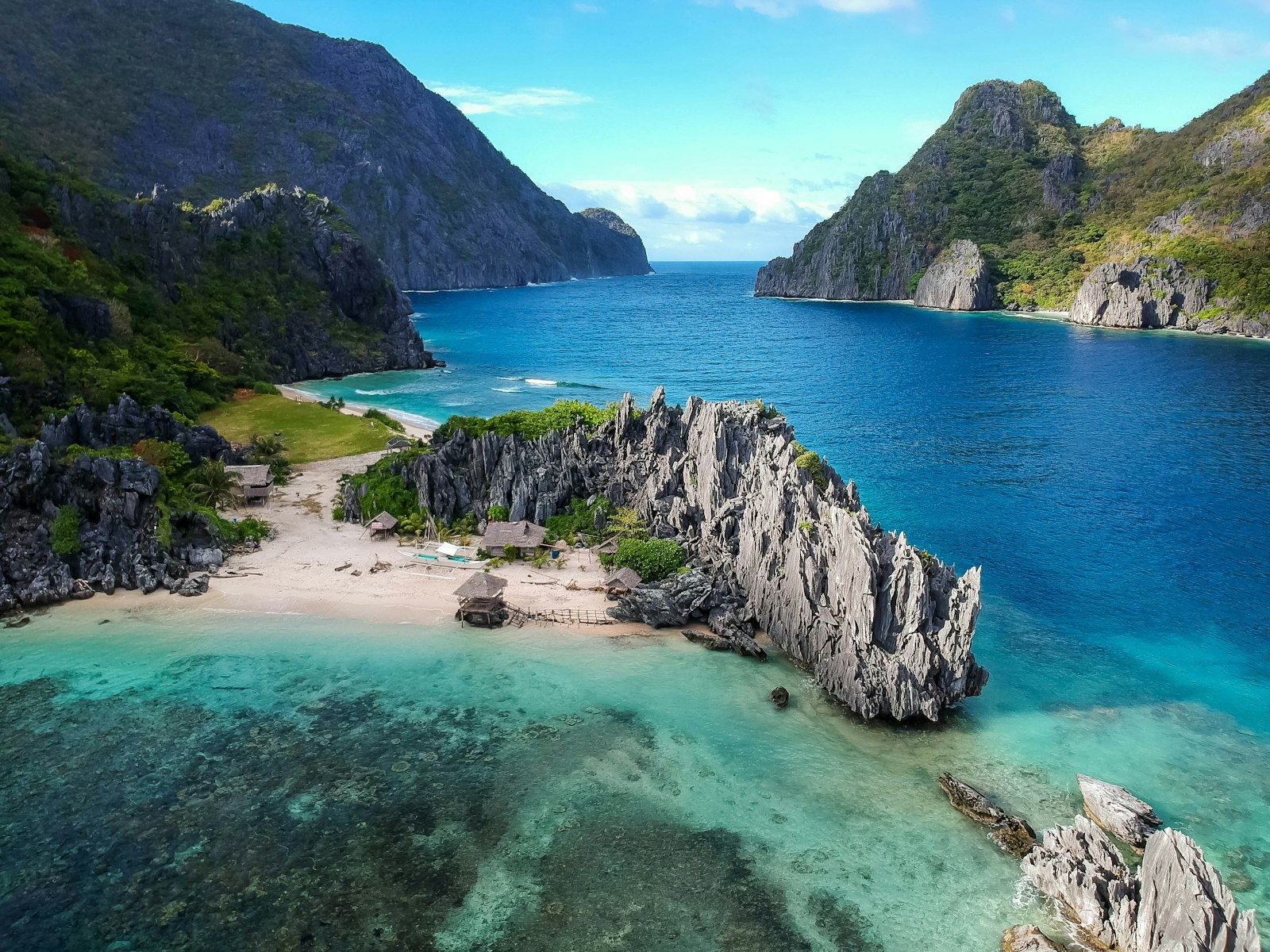
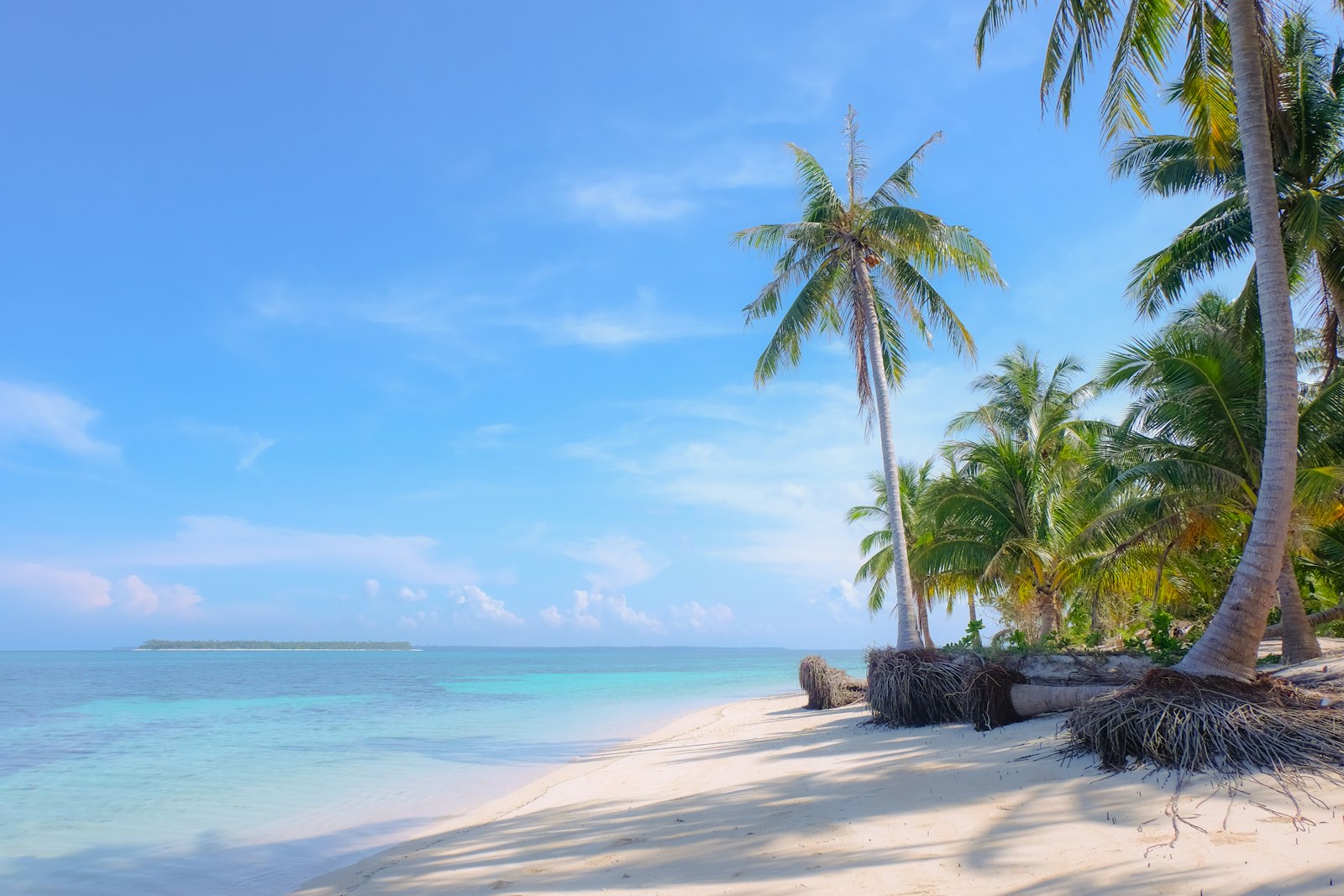
Balabac is a chain of more than thirty islands — many uninhabited, several encircled by sandbars that surface only at low tide — and reaching it requires a road journey from Puerto Princesa to the port at Rio Tuba (six to eight hours, depending on the road), a ferry crossing to Balabac town, and then a multi-day boat expedition through the islands themselves. Most travellers do the trip as a three- or four-night liveaboard-style package out of Rio Tuba, sleeping in basic homestays and rustic island camps. Comfort is limited. Connectivity is non-existent. The reward is Onuk Island with its kilometre-long bone-white sandbar and an overwater walkway; Comiran Island with its famous blush of pink sand — the residue of crushed red coral mixed with white; shallow turquoise reefs in water so clear the boat appears to be floating in air; and a sense of remoteness that has nearly vanished from the more famous corners of South-East Asia.
A few practical notes. Balabac requires the dry season — full stop. The crossing is exposed and the boats are small, and any tour operator running you here during the habagat is doing something you should not pay them for. Bring cash. Bring a power bank. Treat the Tausug and Molbog communities you stay among as the hosts they are. And accept, before you go, that you will not have a hot shower for four days. That is not a flaw of the trip; it is the entire point.
Putting it together
If you have a week, divide it: one or two nights in Puerto Princesa, three in El Nido, two in Coron — or trade Coron for Port Barton if you prefer quiet to wrecks.
If you have ten days, add Port Barton in the middle.
If you have two weeks and the patience to commit, end with Balabac. You will come home tired, slightly sunburnt in the strange wedge-shaped pattern of a bangka's awning, and unable to fully explain to anyone at home why an island with no signal and four-day showers was the part you keep thinking about.
What stays with you
What stays with you about Palawan, in the end, is not the colour of the water — though the colour of the water is extraordinary, and somewhere between the green-tinted teal of a copper roof gone old and the pale aquamarine of cut glass held to a window. What stays with you is the particular quality of distance the island insists on. Things are far apart here. The journey between two of its famous places is genuinely long. The boats genuinely depend on the wind. The dry season genuinely ends, and when it does, the rhythm of the place changes in ways you can feel.
This is what choosing your region of Palawan really gives you. Not a hotel. Not a postcard. A relationship to a coastline that is still, for now, mostly itself.
Italian travel photographer-writer. Architecture, landscape, the light. Slow, deliberate, image-led essays.
✦ More from Marco Rossi


✦ Keep reading
More from this region


More in Destinations
✦ Discussion
Start the discussion
No replies yet — yours could be the first.