
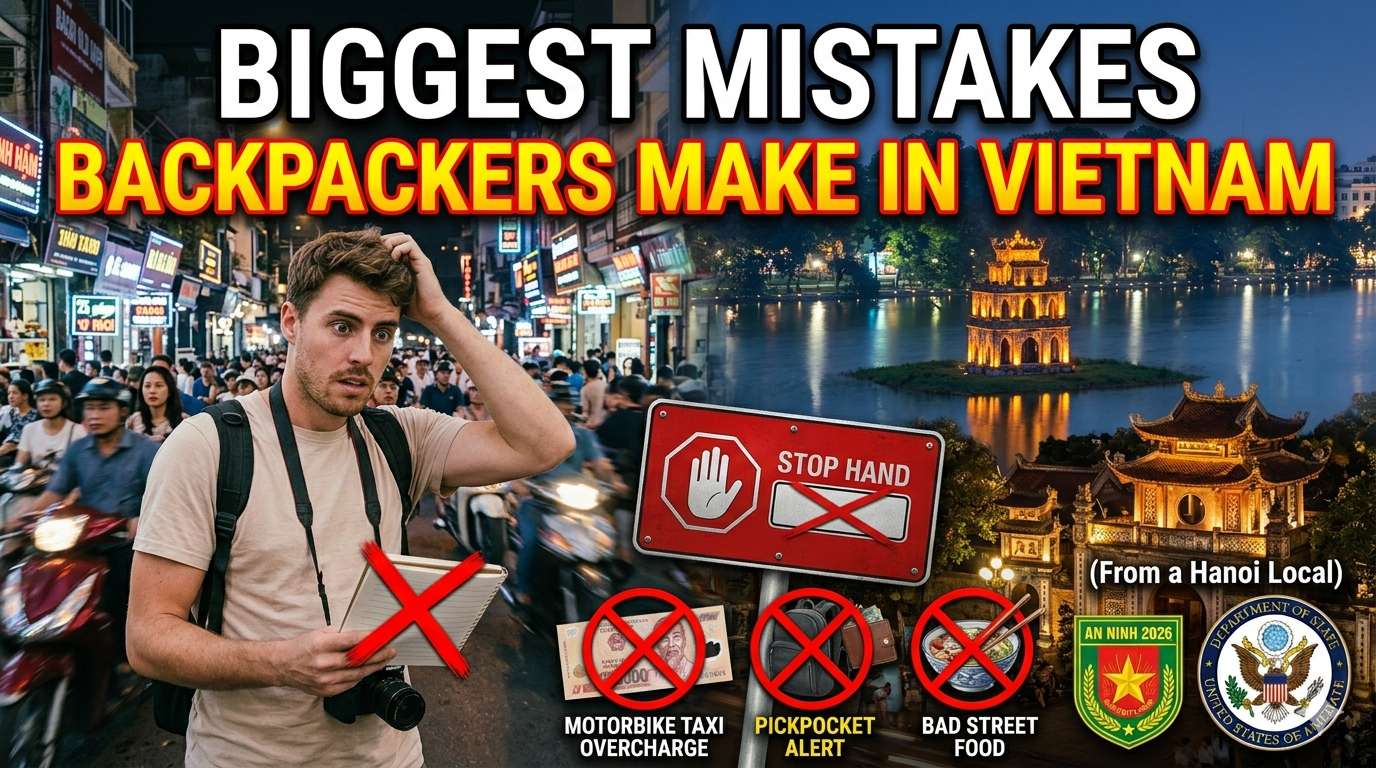
The Biggest Mistakes Backpackers Make in Vietnam (From a Hanoi Local)
I grew up in Hanoi. I watch the same five mistakes play out every Tuesday morning when the night bus from HCMC unloads in front of Sinh Tourist. Sunburnt kids with neck pillows still around their throats, already arguing with a xe ôm driver about a 200,000-dong fare that should be 40,000. So before you walk into the same wall — here are the actual mistakes that cost backpackers real money in my country, with the practical fix for each. I'll also flag the things that look like scams but aren't, because foreigners get this wrong constantly.
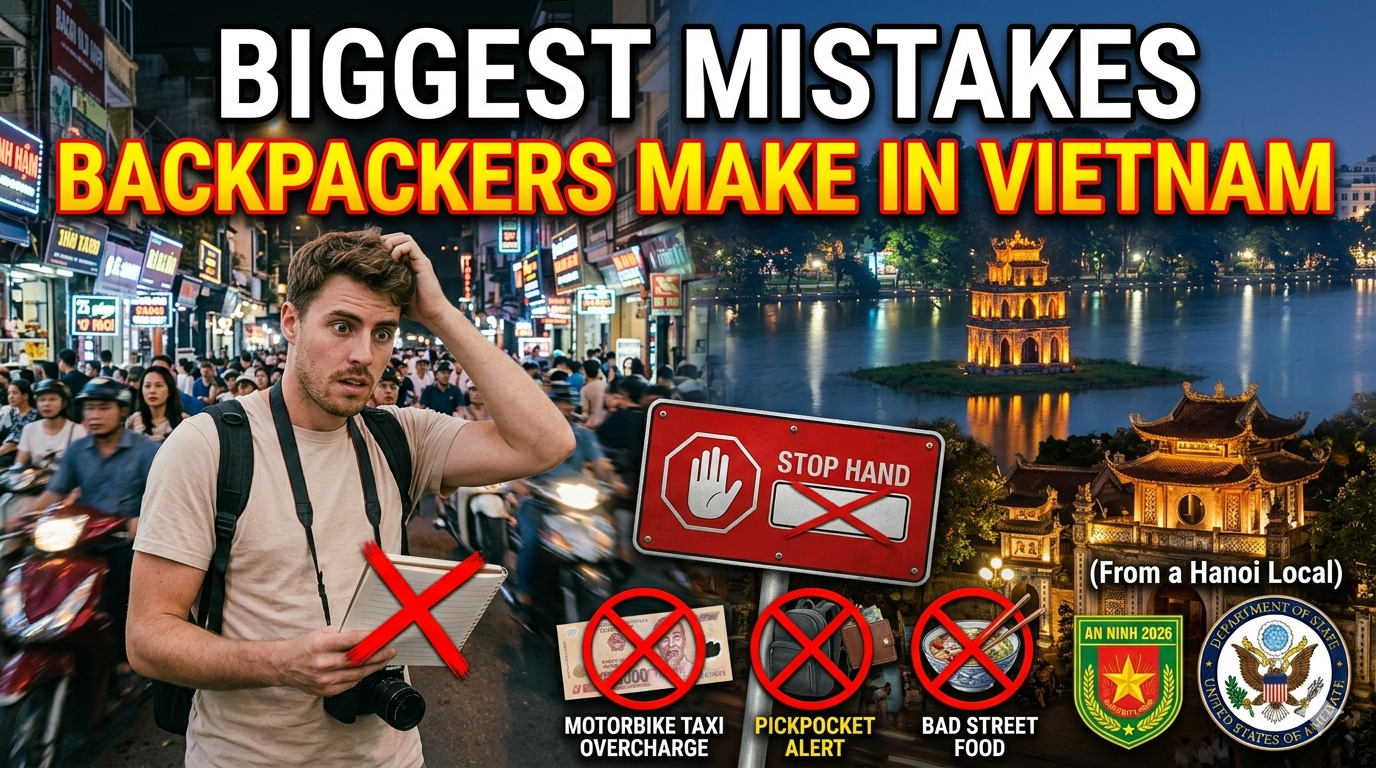
Mistake 1: Trying to do Hanoi to HCMC in a week
This is the king of them all. Vietnam is 1,650 km long. The country has six climate zones. You cannot see it in 7 days. You will see the inside of buses.
The reason this mistake keeps happening: the open-tour bus ticket. Hostels in Hanoi sell you a $35–45 "Hanoi → HCMC" pass with hop-on-hop-off stops in Ninh Bình, Hue, Hoi An, Nha Trang, Mui Ne, HCMC. Feels efficient. It locks you into one operator's schedule, one operator's hotels at each stop, and a route that prioritizes the operator's affiliates, not your time. Miss a bus and the ticket dies.
The fix: don't buy the open ticket. Book buses segment-by-segment on 12go.asia or directly at the Sinh Tourist office (the legit one — see Mistake 2). Costs basically the same. You're not locked in. Better yet, take the night train Hanoi → Hue or Da Nang. Soft-sleeper is 800,000–1,200,000 VND ($30–45), you actually sleep, and the views the next morning crush any bus window.
Also: pick two regions, not seven cities. North (Hanoi + Ha Giang + Ninh Bình) and Centre (Hue + Hoi An + Da Nang) for two weeks. Or Centre + South. You'll have a trip. The kids doing the whole length in 7 days do not have a trip — they have a transit log.
Mistake 2: Walking into the wrong "Sinh Tourist"
Sinh Tourist is the legit OG budget bus and tour operator. Founded 1993, became Sinh Tourist in 2009. Around their Hanoi and HCMC offices, there are now half a dozen lookalikes: "The Sinh Cafe", "Sinh Travel", "Sinh Tourist Vietnam", same green-and-yellow shopfront, same uniforms, all running garbage buses on the cheap.
The fix: the real one is The Sinh Tourist, address 64 Trần Nhật Duật, Hà Nội and 246–248 Đề Thám, Quận 1, HCMC. Plug those addresses into Google Maps yourself. If a xe ôm driver or hostel staff "helpfully" walks you to "Sinh Tourist", they're walking you to whoever paid them commission. Walk yourself.
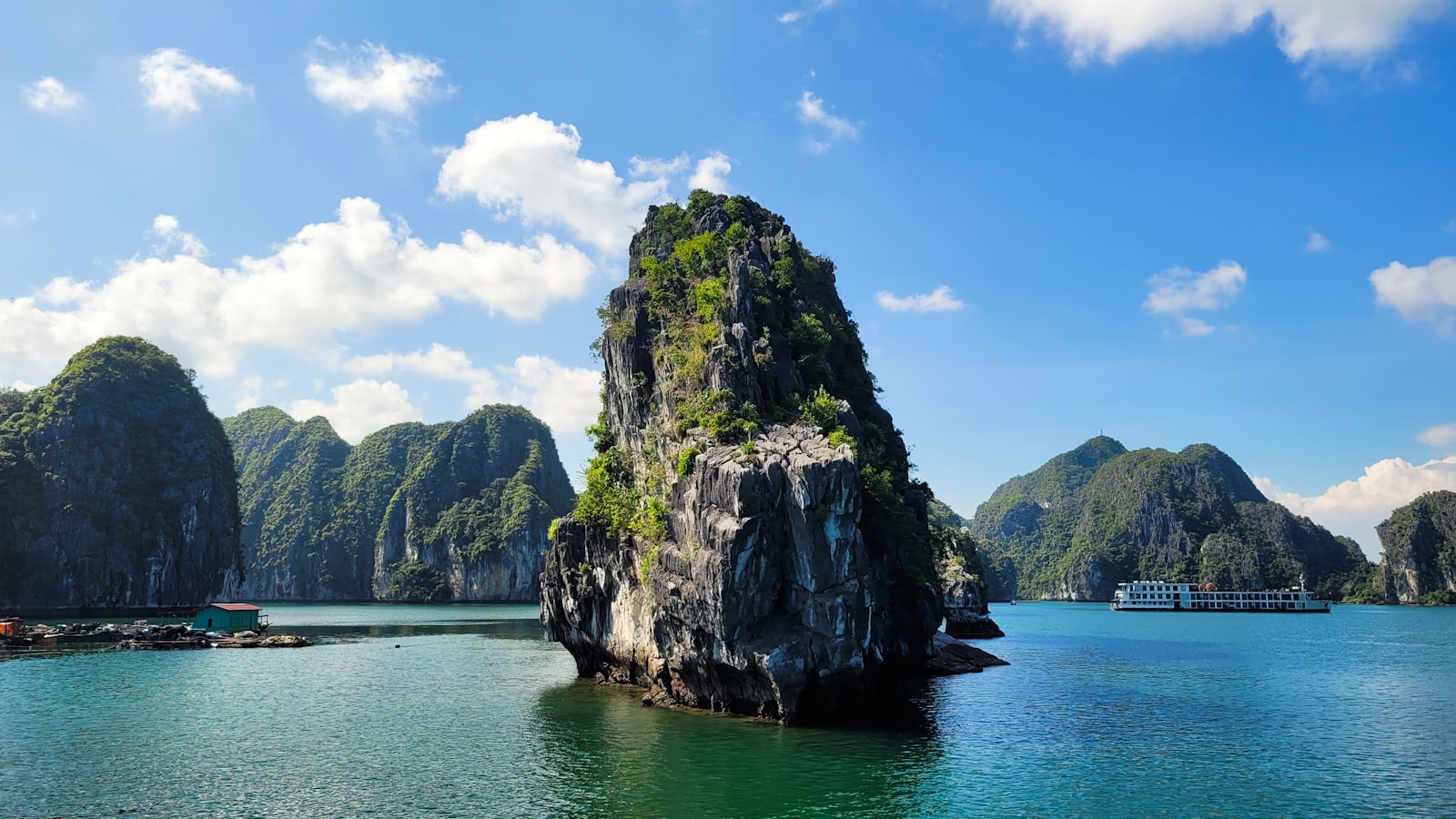
Mistake 3: The Ha Long Bay overnight cruise upsell pyramid
Ha Long is gorgeous. The cruise industry around it is a layered con. Here's how it works:
You see a brochure: "2-night luxury Ha Long cruise — $89, was $180!" You book it. You arrive at the harbor. "Oh, your original boat is overbooked, we put you on the sister boat." Sister boat is rust, served lunch from yesterday, no kayak, no cave, no view from your "ocean-view" cabin because the window is the size of a shoebox.
The fix: book through an operator with dated reviews from the last 90 days on TripAdvisor or Google Maps, with photos. Pay $130–180 for a 2-day/1-night on a Bai Tu Long Bay route (less crowded than the main Ha Long route — the boats go further out). Below $100 is almost always the bait-switch. If you're truly tight, do a day trip from Hanoi for $35–50 instead and skip the overnight. You see the same rocks.
Also — don't book at 10pm in your hostel after three beers from the kid with the laminated brochure. Book in the morning, sober, at the actual agency.
Mistake 4: Motorbike rental scams (deposit, fake scratches, dodgy bike)
This is the one that costs the most when it goes wrong. Three flavors:
The passport hostage. Shop "needs your passport as deposit". They have it. They claim damage on return. You owe whatever they ask, or no passport.
The fake scratches. Bike returns fine. Owner produces scratches "you caused" — usually pre-existing, often added with a key after you ride off. They want 3–5 million VND ($115–190) for "repair".
The clunker. Bike is mechanically dying. Breaks down on day 2 of your Ha Giang loop. Repair costs are yours. Or "they have to come get it" and that costs $200.
The fix, no exceptions:
Never leave your passport. Offer a high-quality color photocopy plus a cash deposit ($50–100). Reputable shops accept this. Shops that refuse are the ones to walk away from.
Photograph every panel of the bike before you ride. Time-stamped. Both sides, front, back, tank, mirrors, lights. Email them to yourself.
Test ride for 10 minutes before paying. Brakes, lights, horn, indicators, kickstart. If anything is off, walk.
Pay normal money. A semi-auto in Ha Giang is 200,000 VND/day ($7.50), a Honda XR 150 manual is 230,000 VND/day ($8.70) at trusted shops. Anything under 150k is the scam shop trying to recoup with fake damage claims. In Hanoi and HCMC, day rental is 150,000–250,000 VND; monthly is 1.5–2 million VND ($55–75).
For Ha Giang specifically, the well-reviewed shops are Bong Hostel, QT Motorbikes, Style Motorbikes, and Mr Hung. Book the bike and the loop tour through the same operator if you don't have clutch experience — for $120–180 over 3 days you get a bike, an Easy Rider who knows the road, and zero scam risk. Worth it.
Mistake 5: The "Easy Rider" and Sapa trekking touts
In Da Lat and Sapa, you'll be approached on the street by guys in branded jackets claiming to be "Easy Riders" or "official trekking guides". Some are great. Many are unlicensed freelancers riding the name. The unlicensed Sapa trekking guides are technically illegal — both they and you can be fined, though it's rare.
The real problem isn't legality, it's quality. Unlicensed guides don't have insurance, often don't speak enough English to actually guide, and the "homestay" they take you to is often the cheapest possible deal where they take a 50% commission on whatever you pay.
The fix: book through Sapa Sisters (women-only Hmong guide collective, legit since 2009), Sapa O'Chau (Hmong-run social enterprise), or your hostel's verified partner. Pay $25–35/day for a 2-day trek with homestay including meals. For Da Lat Easy Riders, the original collective is dalat-easyrider.com, $50–70/day all-in including bike, guide, food, and homestay. Anyone with a laminated card on Bui Vien is not them.
Mistake 6: The Bến Thành Market vs. the actual market
Bến Thành in HCMC is photogenic. It is also a tourist museum where the conical-hat seller wants 350,000 VND for a hat that costs 60,000 VND two streets away. Same with everything else inside. You will overpay 3–5x.
The fix: shop at Bình Tây Market in District 6 (wholesale, real prices, Chinatown energy), Tân Định Market in District 1 (locals' market, fabrics and fruit), or honestly any neighborhood chợ. For souvenirs, the shops on Đông Khởi and Lê Lợi post prices and won't gouge you the way Bến Thành will. Bến Thành is fine for the photos. Don't buy there.
Mistake 7: The đồng/dollar swap and ATM tricks
Vietnamese dong has a lot of zeros. 500,000 VND looks similar to 20,000 VND if you're tired and the colors are faded. Scammers exploit this two ways:
The swap-out. You hand over a 500k for a 60k bowl of phở. Vendor disappears for 30 seconds, comes back, "Sir, you gave me 50,000, not 500,000." Same color family (both blue-purple). Disputed. You pay again.
ATM shortchange. Less common in real banks, real common at unbranded ATMs in tourist zones. ATM fees in Vietnam are 3% of the withdrawal on top of your home bank's fee. Standalone "Euronet" style ATMs are the worst — skip them.
The fix:
Count your change in front of the vendor, every time. Locals do this too. Not rude.
Use ATMs attached to real banks: Vietcombank, BIDV, Techcombank, Sacombank. The withdrawal limit is usually 3–5 million VND per pull. Just pull the max to minimize the 3% fee.
Memorize the colors. 500k is teal-blue. 200k is red-brown. 100k is green. 50k is pink. 20k is dark blue. 10k is yellow-brown. Look at the number of zeros before you hand it over.
Mistake 8: The 2-million-dong cyclo ride
Around Hoan Kiem Lake and the Hanoi Old Quarter, a cyclo driver offers a "20-minute tour" for "200,000 dong". You agree. At the end he says "no no, 200 dollars" or "2 million dong, that was per person, you have 4 people, 8 million." Argument ensues. He has the bag you put in the back. Or his three mates "happen" to be standing nearby.
The fix: don't take cyclos in Hanoi or HCMC unless you're at a hotel that books them officially. They're a tourist-trap relic now, not actual transport. Use Grab (the app, never the street guy who says "yes Grab"), XanhSM (electric taxi app, often cheaper than Grab in Hanoi and HCMC, all-EV fleet), or Bee taxis. All are metered and the price shows before you ride. Walk the Old Quarter. It's the point.
Mistake 9: The Bui Vien late-night taxi (and the "lady drink" bar)
Bui Vien Walking Street in HCMC after midnight is two scams:
The taxi. A "metered" taxi sits at the end of the street. Meter is rigged to run 3–5x normal. A 50,000-dong ride to your hostel suddenly shows 280,000. To avoid: only Vinasun (white) or Mai Linh (green) taxis, or Grab. If the taxi name is "Vinasum" or "MaiLink" or anything one letter off, it's a clone.
The lady-drink bar. Friendly woman invites you in for "one beer". You buy her one. Then another. At the bill, it's $80 for two beers and four "lady drinks" you didn't know cost $15 each. Bouncer at the door. You pay.
The fix: drink at the open-front bars where the prices are on a chalkboard and the staff don't pull you in. Saigon Saigon, View Rooftop, the bia hơi corner at the top of the street. If anyone pulls you into a closed-front bar in a side alley off Bui Vien, walk out.
Mistake 10: The visa-on-arrival "approval letter" racket
Vietnam's e-visa is $25 single-entry, $50 multi-entry, 90 days, applied for at evisa.gov.vn. That's it. No middleman.
There's a whole industry of sites selling "Vietnam VOA approval letters" for $40–80, offering "express processing" for $120. Some are legit visa-agent services for niche cases. Most are reselling the e-visa application at 2–4x markup. A few are straight scams that take your money and never file anything.
The fix: evisa.gov.vn — only. 3 business days, $25, done. If a site has a different URL, even one that looks official, it's a markup or worse.
Mistake 11: The airport SIM card
Hanoi/Da Nang/HCMC airport tourist SIMs are 30–50% more expensive than the same SIM in town. The airport kiosk will sell you 20GB for $10. A Viettel store in District 1 or near Hoan Kiem will sell you the same plan — 3GB/day for 30 days — for 150,000 VND ($6), plus you'll get a real receipt and the SIM properly registered.
The fix: use airport WiFi to grab a Grab to your hostel, then visit a Viettel or Vinaphone store the next morning. Bring your passport (legally required for SIM registration in Vietnam since 2023). Don't get the eSIM-only tourist plans pushed at the airport — they're priced for someone who arrived without a plan. You have a plan now.
Mistake 12: Paying in USD when you should pay in dong
Some hotels, dive shops, and tour operators quote you in USD. Then they convert at a terrible rate (24,000 VND/USD when the real rate is 26,300+) when you pay in cash dong. Or they accept USD but won't give change in USD — they short you on the dong return.
The fix: always ask the dong price, even if they quoted USD. Pay in dong. Withdraw enough at a real ATM to avoid this. The dollar isn't doing you any favors in Vietnam; it's a tool the operators use to skim 8–10% off you.
The things that look like scams but aren't
A quick clarifier, because half the "Vietnam scam" Reddit posts I read are just commerce being read wrong by people who've never been here:
Two prices, one for locals, one for tourists. Common at non-fixed-price spots (markets, xe ôm, small attractions). Not a scam — it's normal in most of Asia. Negotiate down to the local price if you can, but don't get angry. You earn more in a week than the vendor earns in a month.
The "service charge" on your sit-down meal. 5–10% is standard at real restaurants. Printed on the menu. Not a tip-trick.
The motorbike taxi driver waving at you on the street. He wants a fare. He is not scamming you. Just say no thanks (or "không, cảm ơn") and walk.
Vendors quoting you 10% high to start. That's bargaining. Counter at 60–70%. Settle in the middle. It's a transaction, not a moral failure.
The bottom line
Vietnam is one of the safest backpacker countries in SEA. Violent crime against travelers is rare; the scams are almost all transactional, and they all share one trait — they require you to be in a hurry or in the dark. Slow down. Walk yourself to the real Sinh Tourist office. Photograph the bike. Count the change. Use Grab. Drink where you can read the chalkboard.
Do those five things and you'll spend the same trip everyone else spends, minus the $300 in stupid taxes. Welcome to Vietnam. Eat the bún chả.
Vietnamese backpacker, 5 years zigzagging across SE Asia on a shoestring. Budget travel, street food, hidden gems — the honest version.
✦ More from Alex Nguyen


✦ Keep reading
More from this region

More in Destinations
Where this happens
✦ Discussion
Start the discussion
No replies yet — yours could be the first.