
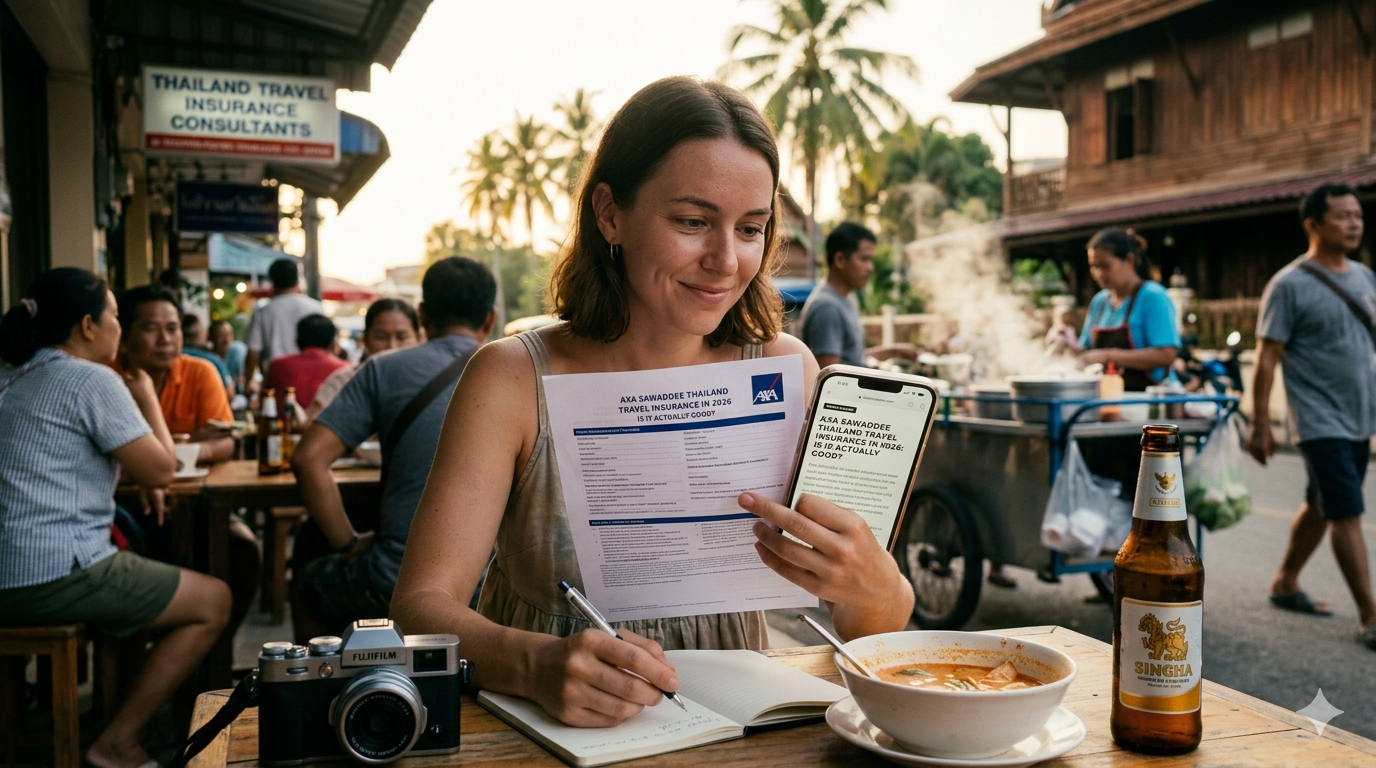
Thailand Travel Insurance in 2026: Is AXA Sawasdee Actually Good?
The first time I sat in a Bangkok hospital admissions office — a friend, a scooter, a pothole on Sukhumvit Soi 31 — the clerk slid a clipboard across the laminated counter and asked for a card before she asked for a name. That is the texture of Thai private healthcare: world-class, brutally efficient, and payable on arrival. It is also why the words travel insurance stop being abstract roughly four hours into your first trip, usually in the back of a taxi at 2 a.m. AXA Sawasdee is the policy the Thai-side of the internet pushes hardest, and a fair share of foreign travelers buy it because their flight comparison site nudged them toward it. Reasonable. Locally fluent. Not, in my view, the best plan most readers should be buying.
The 30-second answer
AXA Sawasdee is a competent inbound product priced for the Thai market. For a healthy traveler on a short trip — say, ten days in Bangkok and Krabi, no motorbike, no diving below recreational depth — it does what it claims, settles claims at major hospitals through direct billing, and costs less than most Western policies for equivalent length. Medical coverage tops out at THB 750,000 (roughly USD 21,000 at current rates) on the standard tier and rises modestly on Plan 2. That is enough for a broken wrist and a night of observation. It is not enough for a serious head injury that ends in neurosurgery and a medevac to Singapore.
AXA Sawasdee is built for the Thai market's idea of a worst case. Western worst cases are larger.
If you are riding a scooter, traveling more than three weeks, working remotely from a Chiang Mai co-working, or bringing children, you almost certainly want a different policy — one whose medical cap clears USD 100,000 and whose evacuation cover is uncapped or close to it. The rest of this piece is the comparison, with the receipts.
What Thailand actually requires in 2026
Let's clear the regulatory haze first, because there is a lot of bad information online and most of it dates from the pandemic era.
The Thailand Pass — the COVID-era entry system that demanded proof of insurance with a USD 10,000 medical minimum — was scrapped on 1 July 2022. For most of 2023 and 2024, Thailand had no mandatory insurance requirement for tourists on visa-exempt or standard tourist-visa entries. You could land at Suvarnabhumi with a passport and a return ticket and that was that.
In late 2024 the Thai cabinet floated, then deferred, a tourist insurance mandate tied to an Electronic Travel Authorization (ETA) system. As of this writing in May 2026, the mandate has been announced in principle but not enforced uniformly at the border. Travel industry sources expect cabinet review later in 2026; the Ministry of Public Health cited THB 3 billion in unpaid foreign medical bills from 2025 as the rationale. Long-stay categories — the Long-Term Resident visa, the Destination Thailand Visa, and the Non-Immigrant O-A retirement track — already require formal insurance documentation with set minimums (typically USD 100,000 inpatient, USD 50,000 outpatient for LTR).
So: if you are a short-stay tourist in 2026, you are not currently required to show proof of insurance to enter Thailand. You are required to have it the moment something goes wrong, because no Thai hospital — public or private — will treat a non-resident without payment or a verified guarantee of payment. The "requirement" is functional, not bureaucratic. Confirm the current rule on the Tourism Authority of Thailand's site within forty-eight hours of your flight; this is one of the regulations that can change between booking and boarding.
AXA Sawasdee at a glance — what you actually get
Sawasdee — hello, in the most over-printed Thai greeting in the world — comes in two tiers. The plan structure has been remarkably stable since 2023.
Plan 1 (Standard) covers medical expenses from accident or illness up to THB 750,000 (around USD 21,000), accidental death and permanent disability up to THB 1,000,000, and includes COVID-19 treatment with no deductible and no waiting period. It also covers emergency evacuation and repatriation of remains, though the operational cap on long-haul evacuation is the part nobody quotes in the marketing copy: it sits well below what an air ambulance from Phuket to Singapore actually costs. Expect to find roughly USD 100,000 in combined evacuation/repatriation capacity in the small print, and treat that as a soft cap rather than a guaranteed ceiling.
Plan 2 (Top-tier) lifts the medical limit, adds baggage and transportation benefits, and raises the personal liability number. Premiums are modest. A 14-day single-traveler policy can run under USD 25 in low season — genuinely cheap, and one reason it appears on every Thai-side comparison engine.
Plans are sold for fixed durations of 30, 60, 90, 180, 270, or 365 days. Eligibility is ages 1 to 74. You can cancel within seven days of purchase for a full refund, provided you have not yet entered Thailand. Direct billing is in place at the major private hospital networks — Bangkok Hospital, Bumrungrad, Samitivej, BNH — which matters more than any line item in the schedule. You do not want to be wiring funds from a Bangkok ICU at 4 a.m.
That last point is genuinely Sawasdee's competitive advantage. AXA Thailand has the local infrastructure and the cashless agreements. SafetyWing and World Nomads, for all their virtues, will reimburse you. AXA will pay the hospital directly. When you are unconscious, that distinction is the policy.
Where AXA Sawasdee falls short

Three places.
Motorbike accidents — read your wording twice. AXA Sawasdee's English-language FAQ says motorcycle accidents are covered. The deeper policy wording requires a valid international driving permit with the motorcycle endorsement, and most rentals in Chiang Mai, Pai, Koh Pha Ngan, and Koh Tao are 110cc to 125cc scooters — above the engine-size threshold some travel policies quietly enforce. Bangkok-based brokers I trust class AXA, Allianz, and Travel Guard together as insurers whose motorbike claims are denied at a meaningful rate when riders cannot produce the right license. If you ride, do not assume the policy covers you because the brochure says it does. Read the certificate wording, secure the IDP endorsement before you fly, and consider a dedicated motorbike rider — Genki and SafetyWing's Complete plan are the cleanest two for this.
The medical cap is geographically narrow. THB 750,000 is enough for almost any single incident treated entirely within Thailand. It is not enough for a complex case that requires international medevac, multi-week ICU care at a top hospital, or repatriation in a critical-care configuration. A serious motorbike head injury — neurosurgery, ICU, rehab — runs USD 50,000 to USD 150,000 at Bangkok Hospital. A medevac flight from Phuket to Los Angeles in a stretcher configuration with a flight nurse can cost USD 200,000 by itself. AXA Sawasdee is not built for that ceiling.
Pre-existing conditions are excluded — properly. Sawasdee follows the standard Asian-market exclusion: anything you knew about, were treated for, or had medication prescribed for within the look-back window is not covered. There is no upgrade tier that buys it back. If you have a managed chronic condition — Type 1 diabetes, controlled hypertension, anything with a recent ER visit on the record — get a policy with explicit pre-existing-condition cover, almost certainly from a Western insurer with a stability clause.
The right question is not "is Sawasdee good?" It is "is Sawasdee enough for the version of my trip where everything goes wrong?"
The credible alternatives a Bangkok broker would recommend
Four names come up in every honest conversation I have had with Thai-based brokers and long-staying expats. None are perfect; each suits a profile.
SafetyWing Nomad Insurance runs roughly USD 45 per four-week period for under-40 travelers, renews monthly, and is the default for digital nomads. The Essential plan covers medical to USD 250,000 with a USD 250 deductible; the Complete plan layers in primary care and mental health. The Complete plan also covers 125cc motorbikes with a valid license, which is the unusual cover digital nomads in Chiang Mai actually need. SafetyWing reimburses; it does not direct-bill, so you will front the costs.
World Nomads is the legacy adventure-traveler brand. More expensive than SafetyWing — expect USD 100 to USD 200 for a one-month Thailand trip — and covers 250-plus listed activities including most adventure sports. Medical caps are higher (up to USD 100,000 on Standard, USD 300,000 on Explorer). They have had a mixed claims-handling reputation in recent years, but the breadth of activity cover is unmatched.
IMG Global (Patriot Travel) is the broker's pick when a traveler wants to dial in the policy: choose your deductible, choose your medical maximum, add evacuation. Useful for older travelers, families, and anyone with specific evacuation needs. Less plug-and-play than SafetyWing.
Allianz Travel is the right answer for trip-cancellation-heavy itineraries — high-end hotels, paid tours, internal flights. Their OneTrip Premier plan meets long-stay visa minimums and includes USD 50,000 medical and USD 500,000 medevac. Allianz does not cover motorbikes; do not buy them if Pai is on your itinerary.
For most readers of this publication — paying for the Aman or the Capella, flying premium economy, doing a tour in the Golden Triangle — Allianz OneTrip Premier or World Nomads Explorer is the right shape of policy. AXA Sawasdee is a useful supplement at its modest premium, layered for the direct-billing advantage at Thai hospitals, but it should not be your only cover.
The Schengen confusion
This one comes up enough that it needs flagging: AXA Sawasdee is not a Schengen-compliant policy and will not be accepted by any European consulate processing a Schengen visa application. Sawasdee is an inbound-to-Thailand product. If you are flying Thailand-then-Europe and need a Schengen visa, the product you want is AXA Schengen (their separate outbound line, with the EUR 30,000 minimum coverage and explicit Schengen-zone repatriation language), or any equivalent Western insurer with Schengen wording in the certificate. Travelers occasionally buy Sawasdee thinking it stacks across both legs. It does not.
The credit-card insurance question
The Chase Sapphire Reserve and the American Express Platinum both carry travel insurance benefits, and both are real but narrow. Sapphire Reserve includes up to USD 100,000 in emergency medical evacuation when at least a portion of the trip was charged to the card; the Platinum's evacuation cover is uncapped under its terms, with the same trip-charge requirement. Both cards include trip-cancellation, baggage delay, and travel-accident benefits.
Neither covers motorbike accidents. Neither covers the actual hospital bill — only evacuation. Neither covers pre-existing conditions. The Sapphire Reserve and Platinum benefits are best understood as a secondary layer that handles the catastrophic medevac scenario your primary policy may cap, not as a replacement for a real travel insurance policy. If you are flying to Bangkok on miles transferred from a Sapphire Reserve, you still need to buy a policy.
Decision framework — three reader profiles

The backpacker (mid-20s, three months, hostels, scooters, Full Moon Party). SafetyWing Complete is the answer. USD 80 to USD 100 a month, motorbike cover at 125cc with the right license, monthly renewal so you can extend if you stay longer. Skip AXA Sawasdee; the medical cap will not match a real scooter accident in the islands.
The digital nomad (six to twelve months, Chiang Mai or Bangkok base, occasional regional travel). SafetyWing Nomad Insurance for the rolling monthly cover, plus a dedicated motorbike policy from a Thai broker (LMG or Roojai) if you are riding daily. AXA Sawasdee can be added as a layer for direct-billing access at Bangkok Hospital — at its premium it is almost free, and on a long stay it pays for itself the first time you need an ER visit.
The family (two weeks, mid- or high-end hotels, no motorbikes, possibly older parents). Allianz OneTrip Premier or World Nomads Explorer for the primary policy, with trip-cancellation cover and the higher medical and evacuation limits a family needs. Sapphire Reserve as the medevac safety net. AXA Sawasdee is not the right product here — its caps are below what an evacuation of a child or an elderly parent will run.
The pattern is consistent. AXA Sawasdee is a fine entry-level product for the right profile, and a dangerous false comfort for the wrong one. Buy it when the local-fluency and direct-billing edge matter. Pair it — or replace it — when the medical and evacuation caps need to be larger than the Thai-market default. The clerk at the admissions counter will not check which logo is on your certificate. She will check that the number on it is large enough.
Asian-American travel writer + photographer based in SF. Luxury and culture, design-forward destinations, slow travel.
✦ More from Sarah Chen

✦ Keep reading
More from this region


More in Destinations
✦ Discussion
Start the discussion
No replies yet — yours could be the first.