

The App Is a Map of Where Locals Actually Eat
I used to be a snob about delivery apps. If you flew to Chiang Mai to eat khao soi from a polystyrene box sweating in the back of a motorbike topcase, you had, in my view, failed the assignment. I have changed my mind, and not because I got lazy. I changed it because somewhere around my fourth or fifth year of doing this, I realized the apps had quietly become the single best research tool a traveling eater has. Not for eating, necessarily. For knowing.
Here is the thing nobody tells you. When you open GrabFood in a city you've never visited and sort a neighborhood by rating and order volume, you are looking at a live, crowd-weighted ranking of where the people who live there actually spend their money. It is more honest than any guidebook, because nobody is comping the algorithm. A stall with eleven thousand orders and a 4.8 average is not a tourist trap. It is a local institution that happens to have a digital storefront.
So this is not a logistics piece. I'm not going to walk you through delivery fees and promo codes. This is about how someone who takes food seriously uses these apps to eat better in an unfamiliar Southeast Asian city, and just as importantly, when to close the app and walk.
Grab Is the Default, But It Isn't Always the Best Table
Start with the lay of the land, because it changed a lot between 2023 and 2026 and most advice online is stale. Grab is the regional heavyweight. By 2025 it held roughly 55 percent of Southeast Asia's food-delivery gross merchandise value, and it operates in every major market from Jakarta to Phnom Penh. If you download one app for a multi-country trip, it's Grab. The green jacket is the closest thing the region has to a universal currency.
But market leader does not mean best deep bench in every city, and a good eater should know the difference. Grab's strength is coverage and reliability. Its weakness, in certain cities, is that the genuinely great small vendors, the aunty with one wok and no English, are sometimes listed more completely on a local competitor that did the legwork of onboarding them. Treating Grab as your only window means missing whole categories of restaurant. The smart move is to install Grab everywhere and then install the local champion in each country you're spending real time in.
Country by Country: Who Actually Owns the Curb
In Thailand the duopoly is Grab and LINE MAN, which together command close to 90 percent of delivery volume after Foodpanda pulled out of the country in May 2025. LINE MAN is the one to prioritize, and here's why it matters to an eater: it's married to Wongnai, Thailand's homegrown restaurant-review platform. That pairing makes it the richest discovery tool in the country, with deep listings of one-table noodle shops and night-market stalls that Grab sometimes doesn't carry. ShopeeFood is a distant but voucher-heavy third, useful if you're price sensitive.
In Vietnam the field narrowed hard. Grab and ShopeeFood now control more than 85 percent of the market between them. Baemin, the Korean app a lot of older blog posts still recommend, exited Vietnam at the end of 2023, and Gojek followed in September 2024, so ignore both. ShopeeFood is genuinely strong in Ho Chi Minh City and worth having alongside Grab for the breadth of com tam and banh mi vendors it lists. Be, a Vietnamese operator, is mainly a ride-hailing play with a thinner food selection, and Xanh SM is an electric taxi service, not a place to find your bun cha.
In Indonesia the real fight is Grab against GoFood, the delivery arm of Gojek, and GoFood is the local soul of the thing. For warung food in Jakarta, Yogyakarta or Bandung, GoFood's listings of nasi padang counters and satay carts run deep. ShopeeFood is present as a budget third option. In Singapore, Malaysia and the Philippines, Foodpanda is still alive and still useful, the one major Southeast Asian region where it kept its footing, so pair it with Grab there. Note the asymmetry: Foodpanda is dead in Thailand and Vietnam, very much alive in Singapore, KL and Manila. Get that wrong and you'll download an app that can't take your order.
Reading a Menu You Can't Read
The single skill that separates a good app order from a sad one is reading the menu in the original language, or at least reading it well enough to find the dish you came for. The in-app translations are improving but they are still a minefield. Thai gets mangled into things like spicy salad pork neck floating, which is in fact a perfectly good nam tok moo. Vietnamese tone marks get flattened so that distinct dishes blur together. Trust the romanized or local-script dish name over the English gloss.
My method is simple. Before I order in a new country I memorize five or six dish names in the local script, the ones I actually want, and I scan for those rather than reading top to bottom. In Thailand I'm hunting the characters for moo (pork), gai (chicken), and the soup words. In Vietnam I'm looking for the difference between bun, pho and mien, three different noodles that an English menu will lazily call noodle soup. The photos help, but vendors reuse stock images constantly, so a picture is a hint, not a contract.
One more tactic that consistently works: sort by best-selling within a single stall. The dish a vendor sells the most of is almost always the dish they are built around. You are letting ten thousand locals order for you. That is not a compromise. That is the correct way to eat at a place you've never been.
How to Spot the Stall Worth Ordering From
Ratings alone lie. A 5.0 with nineteen orders means nothing; it's a new listing or the owner's relatives. What I read is the intersection of three numbers: a rating above roughly 4.6, an order count in the thousands, and a price band that sits at local-normal rather than tourist-inflated. A boat-noodle stall charging 18 baht a bowl with twelve thousand orders is telling you it feeds the neighborhood every single day. That is the listing you want.
Look hard for the single-category specialists. A stall whose entire menu is six variations on Hainanese chicken rice, or nothing but chicken-and-rice and a soup, is a stall that has made the same thing ten thousand times. Compare that to the places offering pad thai and pizza and bubble tea and fried chicken under one banner, which are optimized for the app's broad search, not for cooking. In hawker and warung terms, narrow menu plus high volume is the signal. Breadth is the noise.
Read the photos diners upload, not the ones the restaurant posted. User images, usually further down the listing, show you the food as it actually arrives, in the actual box, at the actual portion. That's where you catch the broth that travels badly or the rice that came drowning in sauce.
What to Order, and What Never Survives the Trip
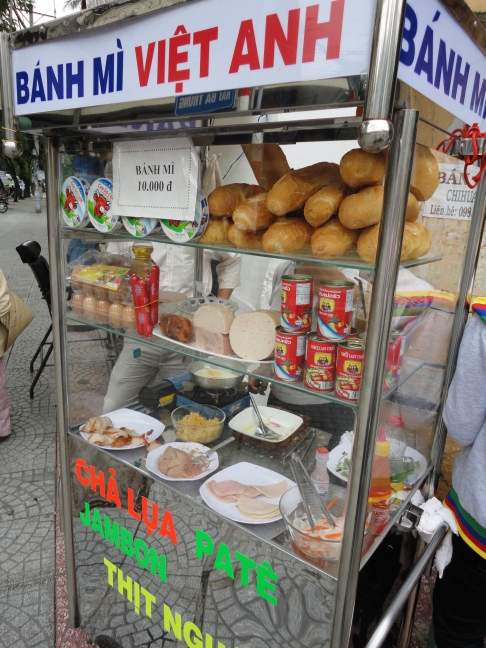
Here is where honesty matters, because the apps will happily sell you food that has no business being delivered. Anything whose entire identity is crispness dies in transit. Fried chicken loses its shatter and goes leathery under its own steam. A fresh Vietnamese banh mi, whose whole argument is the contrast between a crackling baguette and the soft inside, arrives as a sad damp sandwich twenty minutes later. Spring rolls go limp. Order these from the counter, eat them standing up, or don't order them at all.
Soup noodles are the trickier case. A great bowl of pho or khao soi is an assembly that's meant to happen in front of you: broth poured over noodles at the last second so the strands don't bloat. Delivered, the noodles sit in the liquid and turn to paste. The good vendors know this and pack the broth separately in its own bag, with noodles, herbs and protein kept dry until you combine them. If a noodle listing doesn't separate the components, skip it for delivery and go in person.
What delivers beautifully: anything braised, stewed, curried or built on rice. Massaman and other long-cooked Thai curries actually improve with a little more time in the bag. Nasi padang, com tam, Hainanese chicken rice, rendang, claypot dishes, grilled satay with the sauce on the side, all of these are engineered by tradition to sit and hold. When in doubt, order the dish that was already designed to wait.
Landing Late: Dinner to the Hotel at Midnight
The most defensible use of a delivery app on a food trip is the late arrival. You touch down in Bangkok at 11pm, clear immigration at midnight, and reach the hotel starving with every decent kitchen near you shuttered. This is the night the app earns its place on your phone. Southeast Asian cities run a deep late-night delivery economy, and a serious bowl of jok, the rice congee that Thais eat at all hours, or a plate of khao man gai, is twenty minutes away while you're still unpacking.
My rule for the airport-to-bed order is to pick something forgiving, because you're tired and you can't taste-test the city yet. Congee, a curry over rice, a bowl of something brothy from a vendor that packs the components separately. Skip the ambitious first meal. Save the crispy, the contrast-dependent, the eat-it-now dishes for tomorrow, on foot, at the source. The midnight delivery is for refueling with dignity, not for your trip's defining meal.
The Verdict
Use the apps as a scout, not a crutch. Install Grab for region-wide coverage, then add the local champion: LINE MAN in Thailand, ShopeeFood alongside Grab in Vietnam, GoFood in Indonesia, Foodpanda in Singapore, Malaysia and the Philippines. Ignore the apps that have left the building, Baemin and Gojek in Vietnam, Foodpanda in Thailand. Read the original-language menu over the English gloss, sort by best-selling, and trust the listing with thousands of orders at a local price over the shiny one with five reviews.
Then know the line. The apps are unbeatable for research and for the midnight rescue, and they're genuinely good for braised and rice-based food that's built to wait. They are no substitute for standing at the stall where the wok is roaring and the banh mi is still crackling. Let the app tell you where the locals eat. Then, for anything that lives or dies on crispness and timing, go there yourself.
If You Can Only Do One Thing
Before you fly, open Grab and your destination's local app, drop a pin on your hotel's neighborhood, and sort the nearby listings by rating and order count. Screenshot the three highest-volume stalls with prices that read local rather than touristy. Those are your first three meals, and probably your best three. You just did the research the guidebook charged you for, with better data, in five minutes, before you even left home.
Food journalist based in Seoul. Restaurant criticism, regional cuisines, comparative analysis. Hawker stalls and tasting menus, same standards.
✦ More from David Park


✦ Keep reading
More from this region


More in Activities
✦ Discussion
Start the discussion
No replies yet — yours could be the first.