
First, Forget the Idea of a Single Bali
Bali is not one place, and the fastest way to waste a first trip is to treat it like one. The island folds together at least four distinct moods: the cool, art-soaked uplands around Ubud; the surf-and-sunset south; the temple coast to the west; and the quiet, terraced east that most itineraries never reach. A week here is not enough to see all of it, and that is the secret most guidebooks bury. Choose two or three of these worlds and give them real time, rather than collecting a dozen viewpoints through a car window.
What follows is not a list of everything. It is a shortlist with a point of view, built for someone arriving for the first time who wants the places that genuinely earn their reputation, and an honest word about the ones that do not. I am writing as someone who came back to Southeast Asia again and again before I ever understood it, and Bali rewards the traveler who slows down enough to notice that the island is, first and last, a living Hindu culture, not a backdrop.
Start in Ubud, but Don't Mistake It for the Whole Island
Ubud is where most first-timers begin, and they are right to. Set in the central foothills, it is cooler than the coast by a few merciful degrees, green in a way that feels almost edible, and built around a culture of carving, dance, and offering that has survived a century of visitors. Mornings smell of frangipani and wet stone. By mid-morning the main roads clot with scooters and the famous spots fill, so the trick is to be early or to be elsewhere.
Walk the Campuhan Ridge at first light, when the grass spine of the hill glows and the crowds are still at breakfast. See a Legong or Kecak performance at the palace in the evening, where the gamelan does something to the air that no recording captures. Skip the Monkey Forest if you are precious about your sunglasses; the macaques are practiced thieves, and the temple ruins inside, beautiful as they are, are not worth a bitten finger. Ubud is also the right base for the terraces and temples to its north, which is why it earns the first leg of almost every good itinerary.
The Rice Terraces: Tegalalang for the Photo, Jatiluwih for the Truth
Everyone wants the rice terraces, and the two names you will hear are Tegalalang and Jatiluwih. They are not the same experience, and conflating them is a common first-timer mistake. Tegalalang, a short drive north of Ubud, is the postcard: a steep, sculpted ravine of green steps with a celebrated jungle swing and a photographer at nearly every turn. It is genuinely beautiful and genuinely crowded, and the famous swings cost real money. Go at sunrise, take the shot, and accept that you are sharing it.
Jatiluwih is the deeper cut, and to my eye the more rewarding one. A UNESCO-listed expanse in the island's center, it stretches to the horizon in broad, ancient tiers watered by the subak, the Balinese cooperative irrigation system that is as much a spiritual institution as an agricultural one. There is no swing, no queue, just walking paths through working farmland and the sound of water moving exactly as it has for a thousand years. If you have a single morning for terraces and you want to feel something rather than capture something, drive the extra distance to Jatiluwih.
Uluwatu at Sunset, and the Dance That Earns the Cliff
On the southern tip of the Bukit Peninsula, Pura Luhur Uluwatu stands on a limestone cliff that drops a sheer two hundred feet into the Indian Ocean. It is one of Bali's most important sea temples, and at sunset it does the thing that makes people fall for this island: the light goes molten, the surf below turns to lace, and the whole headland glows. Hold your bag close here too, because the resident monkeys are notorious for snatching glasses and phones to barter back for fruit.
Stay for the Kecak fire dance performed in the cliff-top amphitheater as the sun goes down. A circle of men chants the chak-chak-chak rhythm that gives the form its name, voices standing in for an entire gamelan, while the Ramayana plays out against a sky on fire. It can feel staged, because it is a performance, but it is also a living art the Balinese have shaped for visitors without hollowing it out. Book ahead in high season; the good seats fill fast.
The cliffs below Uluwatu hold the south's most famous surf breaks and a string of beach clubs carved into the rock. If your trip leans toward beaches, this peninsula is the place to point yourself.
The South: Where to Surf, Where to Skip
The southern beach strip is where the airport deposits you and where many first-timers spend too long. Kuta, the original backpacker beach, has been loved nearly to death; I would not plan a stay around it. Seminyak is its polished older sibling, with the better restaurants, the sunset beach bars, and the boutiques, and it makes a comfortable, easy landing for a first night or two.
Canggu is where the island's center of gravity has shifted: a sprawl of cafes, surf schools, and co-working studios full of long-stay remote workers, threaded by rice paddies that are vanishing year by year under construction. It is fun, it is exhausting, and it is not the Bali on the postcards, so go in clear-eyed. For surf and cliffs without the gridlock, the Uluwatu side of the Bukit, Bingin and Padang Padang and their neighbors, gives you the south at its best. The honest verdict on the deep south: use it for arrival, eating, and beach days, then move on.
Tanah Lot and Besakih: The Temples Worth the Crowd
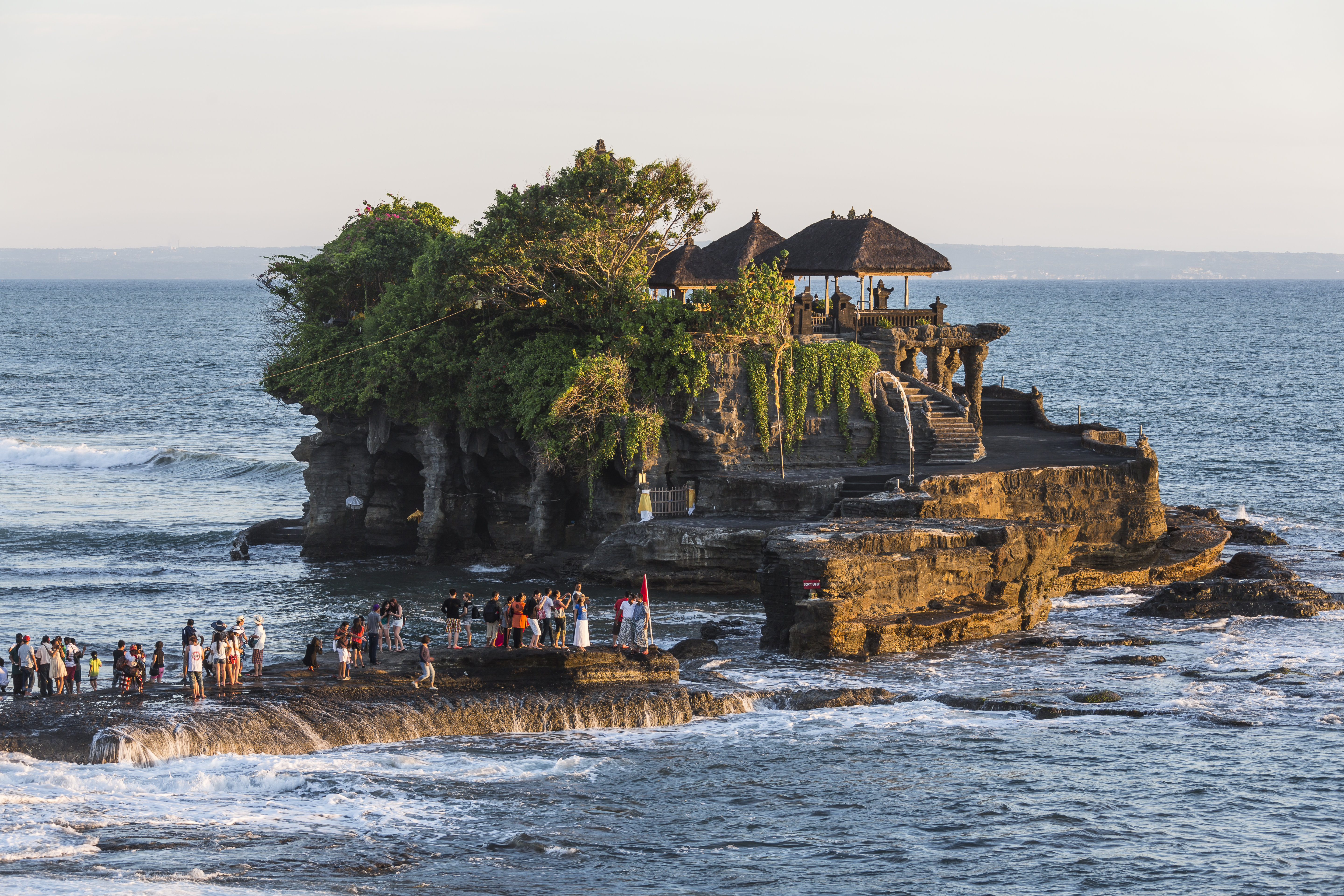
Tanah Lot is the image on the cover of half the brochures, a small temple perched on a sea rock that becomes an island at high tide, silhouetted against the sunset off the west coast. Yes, it is crowded, and yes, the approach is a gauntlet of souvenir stalls. It is still worth it, because the sight of that dark shrine against a burning sky is genuinely one of the great views in Indonesia. Time your visit for late afternoon and walk out toward the rock at low tide. Note that tourists cannot enter the temple itself, which is reserved for Balinese Hindus at prayer; you admire it from the shore, as you should.
If you want the spiritual heart of the island, make the longer trip to Pura Besakih, the Mother Temple, on the slopes of Mount Agung, the volcano the Balinese consider the home of the gods. It is a vast complex of more than twenty temples climbing the mountainside, and it carries a gravity that the photo spots do not. A sarong and sash are required to enter, as at any working temple, and you can rent both at the gate for a small fee if you have not brought your own.
Lempuyang's Gates, and the Mirror They Don't Show You
You have seen the photo: a figure standing between two soaring split gates, mirrored perfectly in still water, Mount Agung rising behind. That image has sold a million flights, and here is the honest truth a first-timer deserves. There is no pool. The flawless reflection is made by a guide holding a small mirror or pane of glass beneath the camera lens, shooting from a low stool so the gates appear to float on water. The reality is a steep journey to the temple, a numbered ticket, and a queue that on a busy day can stretch to hours for a handful of frames.
Pura Lempuyang is a sacred site, one of Bali's oldest and most revered, and it deserves more than to be treated as a photo studio. If the trick shot is your only reason for going, I would spend that half-day elsewhere, on the terraces of Jatiluwih or the quiet of Sidemen. If you go, go for the temple and the view of Mount Agung that needs no mirror at all, dress respectfully, and treat the long climb as the pilgrimage the Balinese intend it to be rather than a line at an attraction.
A Day on Nusa Penida, or Lembongan if You Want It Gentler
Off Bali's southeast coast lie the Nusa islands, reached by a fast boat of roughly forty minutes from Sanur, and they belong on a first itinerary if you have a clear day to give them. Nusa Penida is the dramatic one: raw limestone cliffs, the cove of Kelingking Beach shaped like a diving dinosaur, and water in shades of blue that genuinely look retouched and are not. Be warned that Penida's roads are rough and its famous viewpoints involve real scrambling, so it rewards the surefooted and frustrates anyone hoping for an easy stroll.
If you want the islands at a softer setting, take the boat to Nusa Lembongan instead. It is smaller, calmer, and easier to navigate, with mangrove channels, gentle snorkeling, and a pace that lets you exhale. Either way, go as a planned day trip with an early boat, not as a rushed afternoon. The crossing and the island roads eat more time than people expect.
Sidemen and the East: The Bali That Slowed Down
If there is one piece of advice I would press on a first-timer willing to take it, it is this: trade one day of the south for the Sidemen valley in the east. An hour or so from Ubud, Sidemen is what the central highlands felt like a generation ago, a green river valley of working rice terraces under the shoulder of Mount Agung, with weaving villages, almost no traffic, and a silence at dusk that the rest of the island has lost. The light here in the late afternoon, sliding low across the wet terraces, is the most beautiful I have seen anywhere on Bali.
The wider east, toward Amed and the old royal water palaces of Tirta Gangga, runs at the same unhurried tempo. There is little nightlife and few crowds, which is precisely the point. For a first trip, a single night in Sidemen does something a week of beach clubs cannot: it shows you that the postcard island and the real one are still, quietly, the same place.
Before You Go: The Levy, the Sarong, and the Small Courtesies
Two practical things will smooth your arrival. First, since early 2024 every foreign visitor pays a one-time tourist levy of 150,000 rupiah, around ten US dollars, on entry to Bali, and it remains in force through 2026. Pay it in advance on the official Love Bali website to avoid the airport queue, keep the QR receipt on your phone, and know that the money is earmarked for protecting Balinese culture and the island's environment, which makes it the rare tourist fee worth paying gladly.
Second, dress for the temples before you reach them. At any working temple, a sarong wrapped around the waist and a sash tied over it are required of everyone regardless of age; both can be rented at major sites for ten to twenty thousand rupiah if you arrive without them. Cover your shoulders and knees, step around the small palm-leaf offerings you will see on every doorstep and sidewalk rather than over them, and never climb on a shrine for a photograph. Bali gives generously to travelers who remember that they are guests in a place of devotion, and the courtesy costs you nothing. Come for the terraces and the sunsets, but leave having understood that the island's real wonder is the faith that built all of it.
Asian-American travel writer + photographer based in SF. Luxury and culture, design-forward destinations, slow travel.
✦ More from Sarah Chen


✦ Keep reading
More from this region


More in Destinations
Where this happens

✦ Discussion
Start the discussion
No replies yet — yours could be the first.