
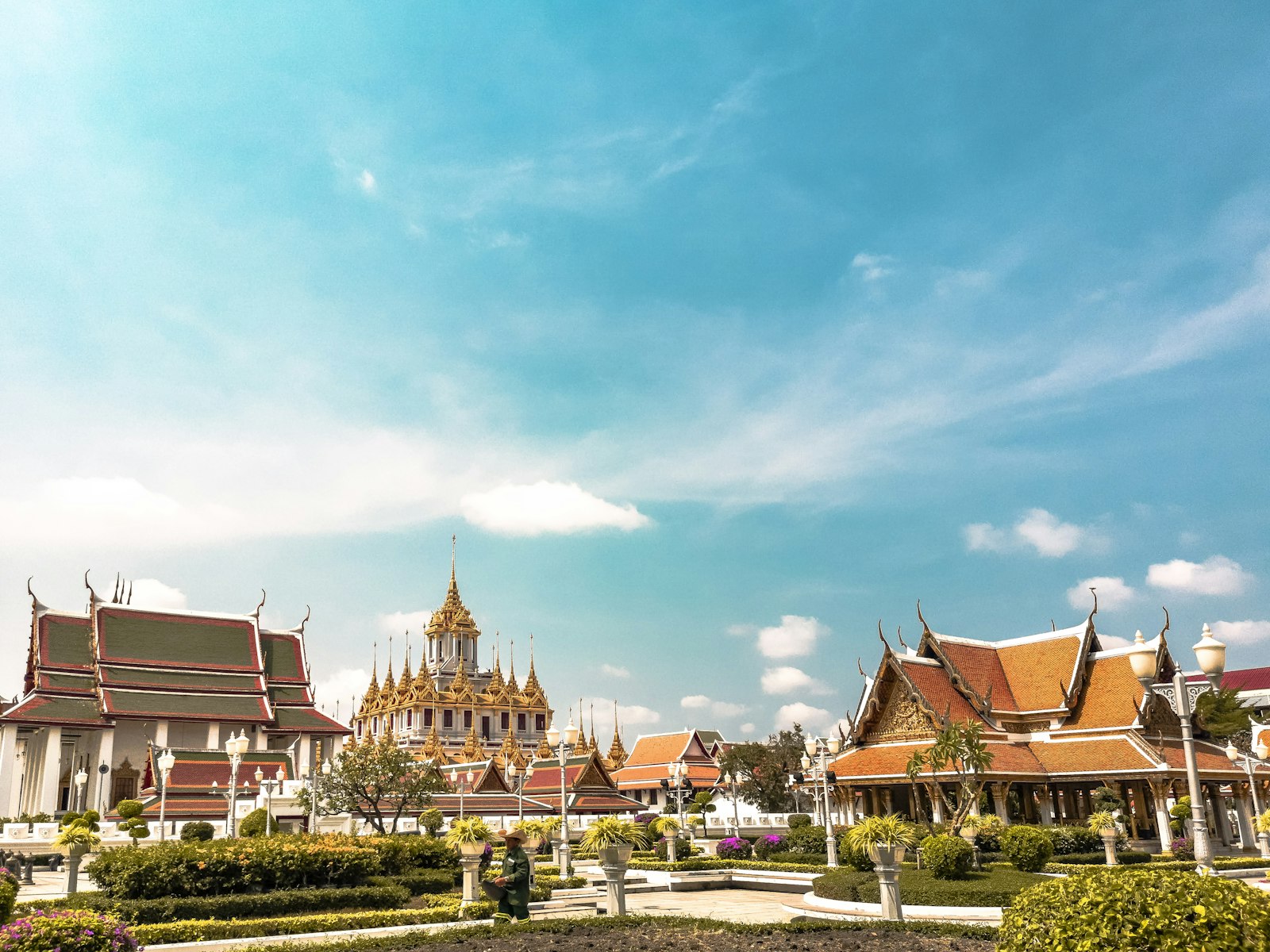
The Light Comes First
Arrive before the heat does. In Thailand the temples are easy to find and hard to see — easy because they are everywhere, the gilded chofah finials catching sun from a thousand rooflines; hard because most travellers come at eleven in the morning, when the light falls straight down and flattens everything into postcard glare. Come instead at the edges of the day, when the sun rakes low across the surfaces and the gold stops being a colour and starts being a texture.
These are working buildings. Monks live here, sweep here, chant here at dawn while you are still framing your shot. The reverence the place asks of you is also, conveniently, the reverence that makes a better photograph: slow down, lower your voice, watch where the light goes. What follows is less an itinerary than a way of seeing — five places, the hours that suit them, and the small disciplines of dress and conduct that let you stay long enough to wait for the light.
Bangkok's Three: Wat Phra Kaew, Wat Pho, Wat Arun
Wat Phra Kaew, inside the Grand Palace, is the most ornamented sacred space in the country and the most crowded. Entry is 500 baht (about US$15), valid seven days, and it includes the palace grounds and the Queen Sirikit Textile Museum. Go at opening, 8:30am — the compound runs to 3:30pm — when the early sun hits the glass-mosaic chedi from the east and the gold leaf throws back a hard, clean light. The Emerald Buddha itself (carved jade, not emerald) may not be photographed; honour that without being told twice.
A ten-minute walk south is Wat Pho, home of the 46-metre Reclining Buddha and the spiritual home of Thai massage. Entry is 300 baht (about US$9). The hall is dim and the statue enormous; expose for the gold soles of the feet, inlaid with mother-of-pearl, and let the rest fall to shadow. Wat Pho is also simply the calmer room — far fewer tour groups, and a quieter light filtering between the chedi.
Then cross the Chao Phraya for the one most people get wrong. Wat Arun, the Temple of Dawn, is named for the morning but photographed at dusk. Entry is 200 baht (about US$6). Pay it, climb the steep central prang for the river view — but the real frame is from the eastern bank, near the Tha Tien pier, at last light. The 70-metre spire, crusted with broken Chinese porcelain, turns from cream to amber to a deep ember as the sun drops behind it, and the river in front goes the colour of weak tea under a violet sky.
Ayutthaya, the Hour the Brick Turns Gold
Eighty kilometres north of Bangkok lies the old capital, sacked by Burmese armies in 1767 and never rebuilt — a city of headless Buddhas and laterite stupas the colour of dried blood. Each temple charges its own small fee, typically 50 baht (about US$1.50); the famous sites — Wat Mahathat, Wat Phra Si Sanphet, Wat Chaiwatthanaram — are individually ticketed, so carry coins.
Ayutthaya is brick, and brick wants warm light. At 6am the rising sun sidelights the eroded prang of Wat Chaiwatthanaram and the orange of the masonry deepens against a still-blue sky. The stone Buddha head wrapped in the roots of a bodhi fig at Wat Mahathat is the photograph everyone wants — kneel to shoot it, because by local custom your head must never be higher than the Buddha's, and the low angle is the better composition anyway.
Sukhothai, Where the Stillness Was Designed
Further north and far quieter is Sukhothai, the thirteenth-century kingdom that gave Thailand its alphabet, its lotus-bud stupa, and the festival of Loy Krathong. The historical park is zoned: the Central zone costs 200 baht (about US$6), the Northern and Western zones 120 baht each (about US$3.50). Rent a bicycle at the gate — the park is flat, green, and made for slow circling.
The serene seated Buddha of Wat Si Chum, framed in a narrow brick mandapa so that you meet its half-closed eyes through a vertical slot of light, is best in mid-morning when the sun reaches in. But the signature image is Wat Mahathat's lotus-bud chedi reflected in its surrounding pond at first light, when the water is glass and the only sound is your own bicycle ticking to a stop.
Chiang Mai and the Lanna Line
The north was its own kingdom, Lanna, and its temples speak a different dialect of form — lower, darker teak halls, multi-tiered roofs sweeping nearly to the ground, naga serpents pouring down the staircases. Within Chiang Mai's old square, Wat Phra Singh and the ruined brick massif of Wat Chedi Luang are free or near-free to enter (a 50-baht donation is asked at some halls). Shoot the teak interiors in the soft, diffuse light of late afternoon, when the lacquer and gold glow rather than glare.
Above the city, at 1,000 metres, sits Wat Phra That Doi Suthep, reached by 306 naga-flanked steps or a small funicular. Entry for foreigners is 30 baht (about US$1), the funicular another 20. Come for sunrise: the gilded central chedi catches the first light from the east while Chiang Mai lies under valley mist below, and the monks' morning chanting carries across the terrace before the tour buses arrive.
What to Wear, How to Behave
The dress code is real and it is enforced — at Wat Phra Kaew especially, guards turn people away daily. Cover shoulders and knees, both men and women. No vests, no shorts, no sheer fabric, no tight leggings as trousers. Carry a light scarf or a pair of long trousers in your bag; some sites lend sarongs, but the queues are long and the supply runs out. Remove your shoes before entering any building that houses a Buddha image, and never point the soles of your feet toward the statue — sit with your legs folded back.
Women must not touch monks or hand them anything directly. Keep your head lower than Buddha images and senior monks where you can. Speak quietly. And read the small signs: photography is welcome in most outdoor spaces but forbidden before certain images and during services. None of this is decorative etiquette — it is the basic courtesy of being a guest in someone's place of prayer, and it costs you nothing but a moment's attention.
Festivals: Loy Krathong and Songkran
Twice a year the temples spill outdoors. Loy Krathong falls on the full moon of the twelfth lunar month — 25 November in 2026 — when people set lotus-shaped floats of banana leaf, candle, and incense onto the rivers. In Chiang Mai it coincides with Yi Peng (24–25 November in 2026), the night the sky fills with thousands of rising paper lanterns. For the floats, shoot at blue hour with a slow shutter to draw the candlelight into streaks on the water; for the lanterns, go wide and expose for the warm points of light against the dark.
Songkran, the Thai New Year, runs 13–15 April — the hottest stretch of the year, marked by nationwide water fights but rooted in the gentle temple ritual of pouring scented water over Buddha images and the hands of elders. If you bring a camera into the streets, seal it: the water is relentless and indiscriminate. The quieter, more photographable Songkran is at dawn in the temple courtyards, before the hoses come out, when families come to bathe the Buddhas in silence.
Going Quietly
The dry season, November to February, is the photographer's window — clear skies, low humidity, the cleanest light Thailand gives. But the best image you take here will not be of a building. It will be of light doing something brief to gold or brick or teak, witnessed because you arrived early enough and stayed quiet enough to see it. Set the alarm. Cover your knees. Wait for the hour. The temples have been keeping it for nine hundred years; they can keep it a few minutes more while you find your frame.
Italian travel photographer-writer. Architecture, landscape, the light. Slow, deliberate, image-led essays.
✦ More from Marco Rossi


✦ Keep reading
More from this region


More in Destinations
✦ Discussion
Start the discussion
No replies yet — yours could be the first.