

The criteria, before the quarrel
Ask a photographer which country in Southeast Asia is the prettiest and you are really asking which one survives a viewfinder. Beauty in the eye is generous; beauty in a frame is unforgiving. The eye forgives haze, forgives a flat noon, forgives a postcard it has seen a thousand times. The frame does not. So before I rank anything, let me say what I am measuring, because a ranking without criteria is just a louder opinion.
Four things. Variety, first: how many different landscapes a country can hand you before it repeats itself. Light, second: not whether the sun rises, but the angle and quality it rises at, the raking gold of a humid dawn against the sodium flatness of a hazed-out afternoon. Water and colour, third: the particular palette a place owns, the teal that no filter invented. And last, the hardest to name, how a country photographs, which is to say how it renders, how foreground separates from haze-blue distance, whether a scene has depth or only width.
I have shot all of these countries at the hours most people are asleep or at dinner. This is where I land.
Vietnam: two grammars of karst
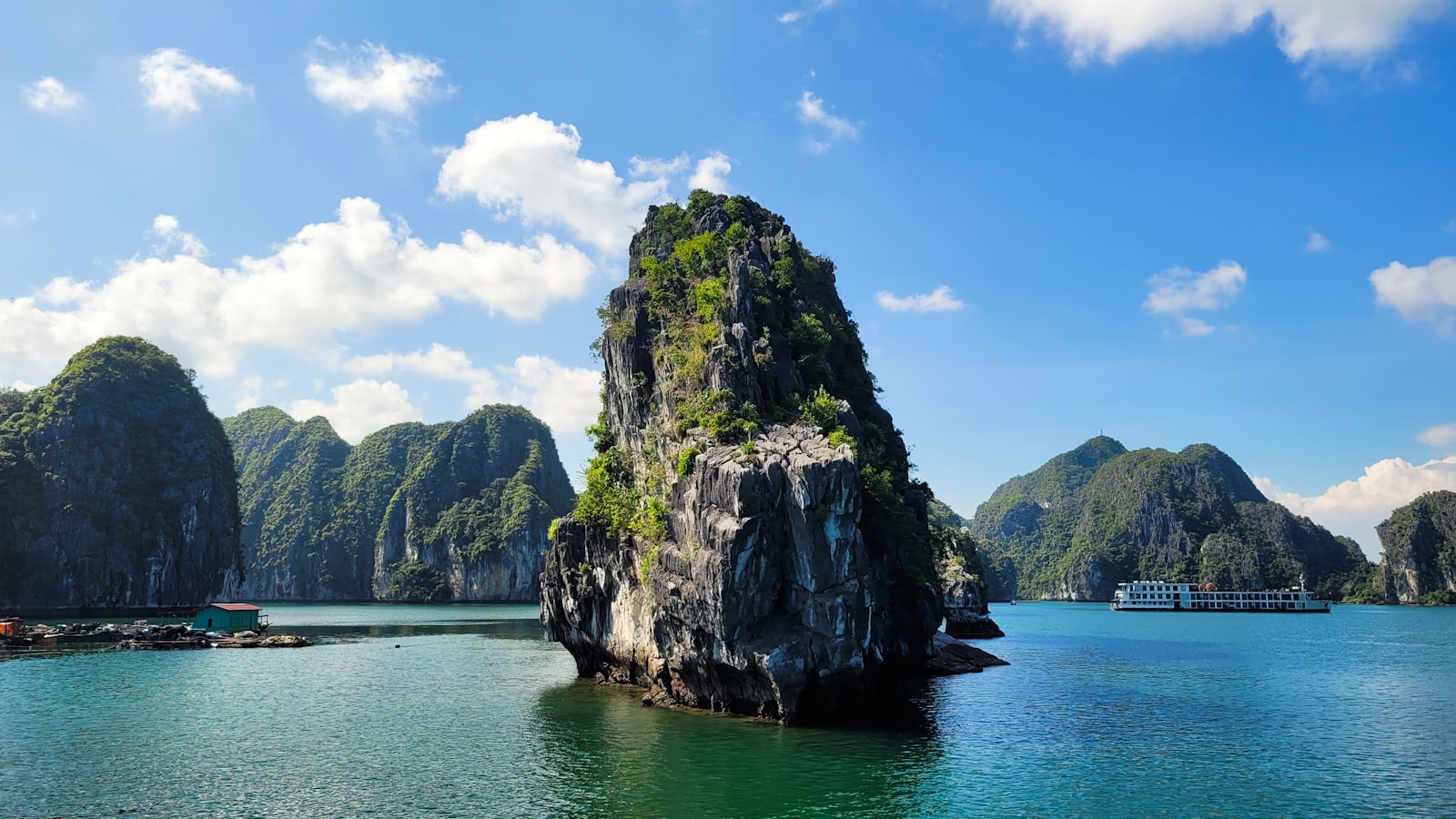
Vietnam is the country I most often recommend to people who want to come home with photographs, and it nearly tops this list. It owns two completely different grammars of the same rock. There is the drowned karst of Ha Long Bay and its quieter cousin Bai Tu Long, limestone towers standing in jade water like a sentence left unfinished. And there is the land-locked version inland at Ninh Binh, around Trang An and Tam Coc, where the same towers rise out of flooded rice fields and a woman rows a sampan with her feet through a colour I can only describe as green tea poured over slate.
Then, as if that were not enough, Vietnam pivots entirely and gives you the rice terraces of the north. Mu Cang Chai and the valleys around Sa Pa, in late September and early October, turn into stacked sheets of ripening gold, each paddy holding the sky in its water like a broken mirror laid into a hillside.
What keeps Vietnam from first place is consistency of light. The north spends much of the year under a soft grey lid of cloud and drizzle, beautiful in its own muted way but stingy with the raking sun that makes karst three-dimensional. When Vietnam is good it is among the best on earth. It is simply not good often enough.
Myanmar: the plain that swallows light
I cannot write this ranking honestly and leave out Bagan, even in a country whose recent years have made travel a fraught and often unwise proposition. As a photographic landscape it has few equals on the planet. On a bend of the Ayeyarwady River, more than two thousand brick temples survive on the plain, the remnant of over ten thousand raised between the eleventh and thirteenth centuries when this was the seat of a kingdom.
What Bagan does to light is unlike anywhere else here. In the dry months, roughly November to February, the morning sun does not so much illuminate the plain as get caught in it. Dust and woodsmoke hang at the height of the spires, and the light comes through that suspended haze in visible shafts, turning the terracotta and laterite to the colour of dried blood and old gold. From a height, the temples recede into that haze in flattening layers, near ones sharp and rust-red, far ones dissolving to a violet-grey.
It is the single most cinematic ground in the region. I rank it where I do only because one extraordinary plain, however unrepeatable, is one note, and because I will not glibly tell a reader the practicalities are simple. They are not.
Laos: the river as a colour
Laos wins almost nothing on this list and I love it more than that sentence suggests. Its beauty is not spectacular, it is atmospheric, and atmosphere is the hardest thing to photograph because it refuses to sit still for a frame.
The whole country is organised around the Mekong and its tributaries, and the Mekong is a working brown river, the colour of milky coffee, not the picture-book blue people expect. The reward comes at the edges of the day. At Nong Khiaw, where the Nam Ou cuts between sheer limestone walls, the dawn arrives as a literal river of mist lying on the water, and the karst stands above it in flat blue paper cut-outs, each ridge a shade lighter than the one in front. There is no drama of colour here, only the drama of tonal separation, distance made visible.
Luang Prabang at dusk does the same trick in miniature, the low sun coming sideways through riverside teak and lime-washed shophouse plaster. Laos is a study in soft light and depth. It is a photographer's country in the way a quiet poem is a reader's. It is not, by my own criteria, the prettiest.
Thailand's Andaman: limestone in warm water
Thailand is the most photographed country in the region and that is held against it unfairly. The cliché is real because the source material is genuinely superb. The Andaman coast, Phang Nga Bay and the cliffs around Railay and the Phi Phi islands, is the warm-water answer to Ha Long: limestone towers again, but here standing in water that runs from pale aquamarine in the shallows to a deep bottle-green where it drops off.
The signature Andaman feature is the undercut cliff, the stone bitten away at the waterline so the towers appear to float on their own reflection, mushroom-footed. In the right side light, the wet black-streaked limestone above and the lit turquoise below give you a contrast that needs no help in post.
Where Thailand loses ground is crowding and sameness. Beyond the Andaman and a scatter of northern hills around Pai and Chiang Dao, the country does not vary its landscape as much as its neighbours, and the very best viewpoints now come with a queue of long-tail boats and selfie sticks in your foreground. The light is reliably good. The solitude that makes a landscape feel discovered is increasingly hard to buy.
The Philippines: the country that wins on water
If this ranking were decided on a single element, water and colour, the Philippines would take it outright and the argument would be over. No country in Southeast Asia owns a sea like this one. Around El Nido and the Bacuit archipelago, and again up at Coron, the limestone is the same family as Ha Long and the Andaman, but the water is a register brighter: a luminous, almost backlit turquoise over white sand, shading to ink where the lagoons deepen, the whole thing ringed by black-green jungle clinging to grey rock.
And the country does not stop at the coast. Inland on Luzon, the rice terraces of Banaue and Batad climb the Ifugao mountains in amphitheatres of stone-walled paddy, a built landscape on a scale that genuinely humbles you in the frame. Bohol gives you the Chocolate Hills, more than a thousand near-identical green mounds that turn cocoa-brown in the dry season. And in the Bicol region, Mayon raises one of the most symmetrical volcanic cones on earth.
So why not first? Geography, the thing that makes it spectacular, also makes it diffuse. The beauty is scattered across thousands of islands and notoriously fickle weather, and assembling a single trip that strings the highlights together without losing days to ferries and squalls is genuinely hard. The Philippines wins the most individual frames. It does not win the body of work.
Indonesia: the unfair advantage
And then there is Indonesia, which on my four criteria simply has more of everything, and which I am giving first place. The variety is almost unfair. Where every other country here owns one or two signature landscapes, Indonesia owns a full deck.
Volcanoes, to start, and not as scenery but as architecture: at Bromo, an active grey cone sits inside the vast Tengger caldera, a flat sea of ash with the higher peak of Semeru smoking on the horizon behind it, and at dawn the whole bowl fills with mist that the rising sun turns peach and rose. On Flores, the three crater lakes of Kelimutu sit side by side in different and shifting colours, turquoise and olive and near-black, a thing that should not be real. In Komodo, the ridgeline view from Padar looks down on three crescent bays whose beaches are each a different shade, pale, dark, and a faint blush of pink.
Off the far east, the Raja Ampat karst scatters cone-islands across some of the clearest water on the planet, the Philippines' palette with Vietnam's geology. And underpinning all of it, Bali and its emerald amphitheatres of terraced rice at Jatiluwih, the most photographed paddies in Asia and still, in the low morning sun, worth every frame.
Indonesia gives you tropical sea, alpine crater, jungle, savanna, and rice terrace, often within a single week of travel, and it gives them at a latitude where the light stays generous. That is the whole game.
The verdict
Indonesia is the prettiest country in Southeast Asia, and it is not particularly close, precisely because prettiness measured across a body of work rewards range, and nothing here has Indonesia's range. It can hand you a volcano at dawn and a turquoise lagoon at noon and a terraced hillside at dusk, and never repeat a note.
But a ranking that pretends the others are also-rans is a dishonest one, so let me be fair about what each wins. The Philippines wins water and colour outright; no single frame here will be bluer than a Palawan lagoon. Vietnam wins karst and is the safest bet for a traveller who simply wants to come home with photographs. Thailand wins reliability of light, Myanmar's Bagan wins the single most cinematic ground in the region, and Laos wins the quietest, most atmospheric depth, the thing you feel in a print months later.
Beauty, in the end, is not foreignness, and it is not the thing you have not seen before. It is the thing that survives the frame and keeps something back for the next morning. By that measure I would put Indonesia at the top and then, the moment the argument was won, quietly book a flight to Laos and the river light I cannot stop chasing.
Italian travel photographer-writer. Architecture, landscape, the light. Slow, deliberate, image-led essays.
✦ More from Marco Rossi


✦ Keep reading
More from this region


More in Activities
✦ Discussion
Start the discussion
No replies yet — yours could be the first.