

The Problem of Going to Both
Plan a single country and the weather question is almost gentle. Plan Vietnam and Cambodia on the same ticket and you are no longer choosing a season. You are choosing a compromise, and the better you understand what you are trading away, the kinder that compromise becomes.
Here is the difficulty, stated plainly. Cambodia keeps things simple: one wet season, one dry season, the whole country breathing in roughly the same rhythm. Vietnam does not. The country is a long, narrow body curled around fifteen degrees of latitude, and it holds three distinct climates at once. The north around Hanoi and Halong has a true cool winter. The centre around Hue, Da Nang and Hoi An runs on its own contrary calendar. The south around Ho Chi Minh City and the Mekong is tropical, two seasons, warm always.
So a Vietnam-and-Cambodia trip is really an attempt to satisfy four weather systems with one set of dates. You will not win every frame. The job is to lose the right ones.
Four Skies, One Suitcase
Think of the trip as four rooms with different lights, and you walking through all of them in a fortnight.
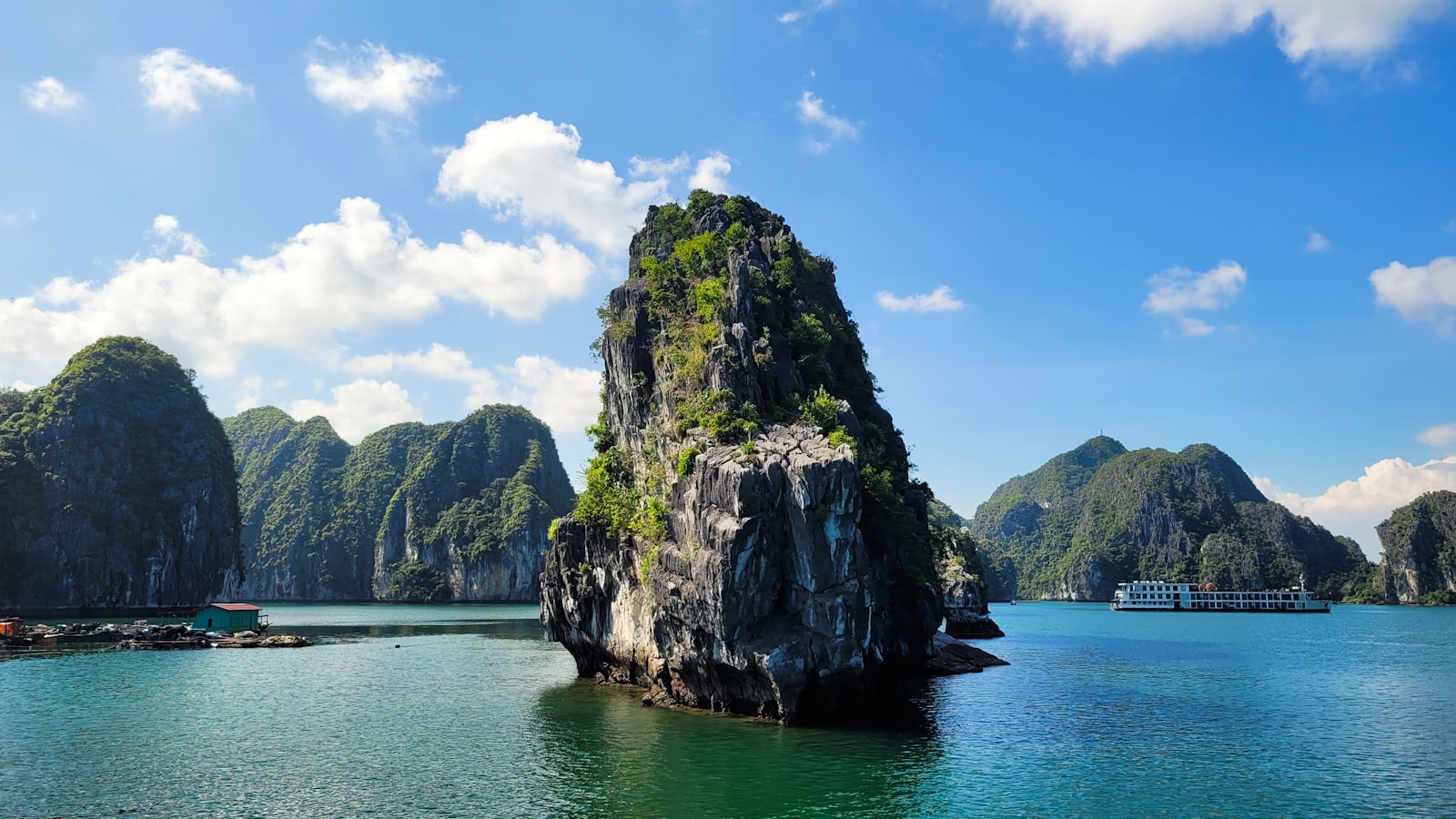
Northern Vietnam is the room with the cool grey winter. From November to March, Hanoi turns crisp and the limestone of Halong Bay sits under a soft, often hazy diffusion that flattens the horizon into pale grey-green water and paler sky. It is not the postcard blue, but it is quiet, atmospheric, and the karst towers gain mystery in the mist rather than losing it.
Central Vietnam is the difficult room. Hoi An, Da Nang and Hue run their rains late, soaking from September into December while the rest of the country dries out. This single fact bends the entire trip, and we will come back to it.
Southern Vietnam is steady tropical light. Dry from roughly December to April, the Mekong delta in those months gives you hard morning sun, long shadows across the water markets, and skies that hold their colour through the day.
And then Cambodia. Siem Reap and the Angkor plain dry out from November and stay parched until April, the laterite and sandstone going from rain-darkened to bone-pale as the months pass.
The Overlap That Works: November to April
If you want the short answer, here it is. The window where all four rooms are at or near their best is November to April. That is the dry season for the south, for Cambodia, and the cool clear season for the north. It is the band every honest planner circles, and the reason fares climb and the temples fill.
But a six-month window is not an answer, it is a shrug. The months inside it behave very differently, and a photographer feels those differences in the first hour of the first morning. So let us walk the band, edge to edge, and find where the compromise costs you least.
One thing to fix in your mind before we start: the limiting factor on this trip is almost never Cambodia and almost never the south. It is central Vietnam, and the Angkor moat. Watch those two and the rest falls into place.
Why October and November Belong to Central Vietnam's Rain
There is a romance to the idea of catching the shoulder season in October, beating the crowds, paying less. For a Vietnam-Cambodia trip routed through Hoi An, October is a trap.
Central Vietnam takes its heaviest rain in October and into November, the tail of the typhoon season slamming against a narrow coast backed by mountains. The Thu Bon river rises and Hoi An's old town does what it has done for centuries: it floods. The lantern-lit lanes become canals, sampans replace bicycles, and in the bad years the water has climbed past the height of the historic 1964 flood. It is genuinely beautiful in a sombre, reflective way if you are a photographer who came for exactly that. It is a disaster if you came to walk the streets dry and shoot the tailors' shopfronts in low gold light.
Cambodia, meanwhile, is drying out and lovely in these same weeks. That is the cruelty of the combined trip. The two countries are out of step in late autumn, and central Vietnam is the one that loses. If your itinerary touches Hoi An or Hue, do not arrive before mid-November. Let the centre drain first.
December and January: The Best Weather, the Heaviest Crowds
By December the centre has mostly wrung itself out, the south is firmly dry, Cambodia is clear, and the north is cool and crisp. This is the engineering ideal. Every room is lit close to its best at once.
The cost is people and price. December and January are peak across both countries, and Angkor at sunrise in late December is a wall of phone screens held above the reflecting pool. The light is still extraordinary, the towers still go black against a kindling sky, but you share the embankment with several hundred others, and the hotels know exactly what their rooms are worth.
There is also a small honest caveat for the north. A December cold snap can drop Hanoi and the Halong karst into genuine chill and thick grey, more raincoat than sunhat. It rarely ruins a trip, but do not pack for the tropics alone if your route runs that far north in deep winter.
My verdict on these two months: take them if the calendar forces your hand, but know you are paying top fare for weather that February will hand you almost as cleanly, with more room to breathe.
February to Early April: The Quiet Sweet Spot
If you let me choose, I choose now. February, March, into the first half of April is, for a combined trip, the most generous compromise on the calendar.
March and April carry the least rainfall of the year across both countries. Cambodia is in its cool-into-hot stretch, the Angkor stone dry and pale and walkable in the early hours. The south of Vietnam is reliably warm and bright. The north has begun to soften out of its winter grey toward clearer, kinder skies. And central Vietnam, which spent the autumn underwater, is now firmly dry, the Hoi An lanes returned to bicycles and low afternoon gold.
The crowds of Christmas and New Year have thinned. Prices ease off their peak. You get peak-season light at shoulder-season pace, and for a photographer that pace is everything: it is the difference between waiting for a frame to clear and giving up on it.
The one tax to note is heat. By late April, Cambodia and the Vietnamese south start to build toward the pre-monsoon furnace, midday temperatures climbing and the air going heavy. Shoot early, rest at noon, shoot again at the gold hour. It is the rhythm Angkor has always demanded anyway.
The Case for Angkor in the Green Season
I want to argue against my own verdict for a moment, because the dry season is not the only honest answer, and the guidebooks undersell the alternative badly.
Cambodia's wet season, roughly May to October, does not mean rain all day. It means clear, washed mornings and a downpour that usually arrives in the afternoon and leaves. Start early, as Angkor asks of you in any season, and you will often finish the temples before the sky opens.
What you gain is worth saying out loud. The rice paddies and jungle around the temples turn a saturated, electric green. The moat and the reflecting pools fill to their brim, so the long classic reflection of the five towers in still water, the one everyone travels for, is at its fullest precisely when the crowds are at their thinnest. Low-season visitor numbers run at something like a fifth of the peak. You can have the north reflecting pool nearly to yourself.
The catch, of course, is Vietnam. The same months that flood Angkor green soak the Vietnamese south and the centre in turn, and bring the heat and storms that make the long combined journey harder. The green season is a magnificent answer for Cambodia alone. For the pairing, it asks more of you than most travellers will want to give.
How to Read the Light, Month by Month
Let me set the whole calendar down as a single verdict, the way I would tell a friend over coffee before they booked.
September and October: do not. Central Vietnam is flooding and the typhoons are at their worst. Save these for a Cambodia-only trip if you must travel then.
November: the doors begin to open. Wait until at least mid-month so the centre has drained, then the whole route lines up nicely and the crowds have not yet arrived. An underrated choice.
December and January: the best all-round weather and the heaviest crowds and prices. Bring a layer for the north. Worth it only if the calendar gives you no other window.
February to early April: my pick. Driest of all, crowds thinned, prices eased, every region near its best. Shoot early as the heat builds toward April's end.
May to August: Cambodia turns green and gloriously empty, but Vietnam goes wet and hot. Brilliant for Angkor alone, a hard sell for the pairing.
If you take one sentence from all of this, take this: arrive after mid-November, leave before the end of April, and let central Vietnam, not Angkor, set your earliest possible date.
What You Are Really Choosing
Every combined trip is a negotiation between places that do not keep the same calendar, and Vietnam and Cambodia are a harder negotiation than most because Vietnam alone cannot agree with itself. You will not get four perfect skies. You get to decide which compromise you can live with, and which frames you are willing to lose.
My own answer, after enough mornings on that embankment, is the back half of the dry season. Late February into March. The moat still holds enough water to throw the towers back at you, the Hoi An lanes are dry underfoot, the northern haze has begun to lift, and the worst of the crowds have gone home. You wake in the dark, you walk to the water in the cool, and you wait for the sandstone to catch fire from the east while the heat of the day is still an hour away.
Time it for that, and the whole long journey between the two countries arranges itself around a single recurring hour. The light arrives, you are ready for it, and for once the weather and the place and the camera are all in the same room at the same time.
Italian travel photographer-writer. Architecture, landscape, the light. Slow, deliberate, image-led essays.
✦ More from Marco Rossi


✦ Keep reading
More from this region
More in Destinations
✦ Discussion
Start the discussion
No replies yet — yours could be the first.