
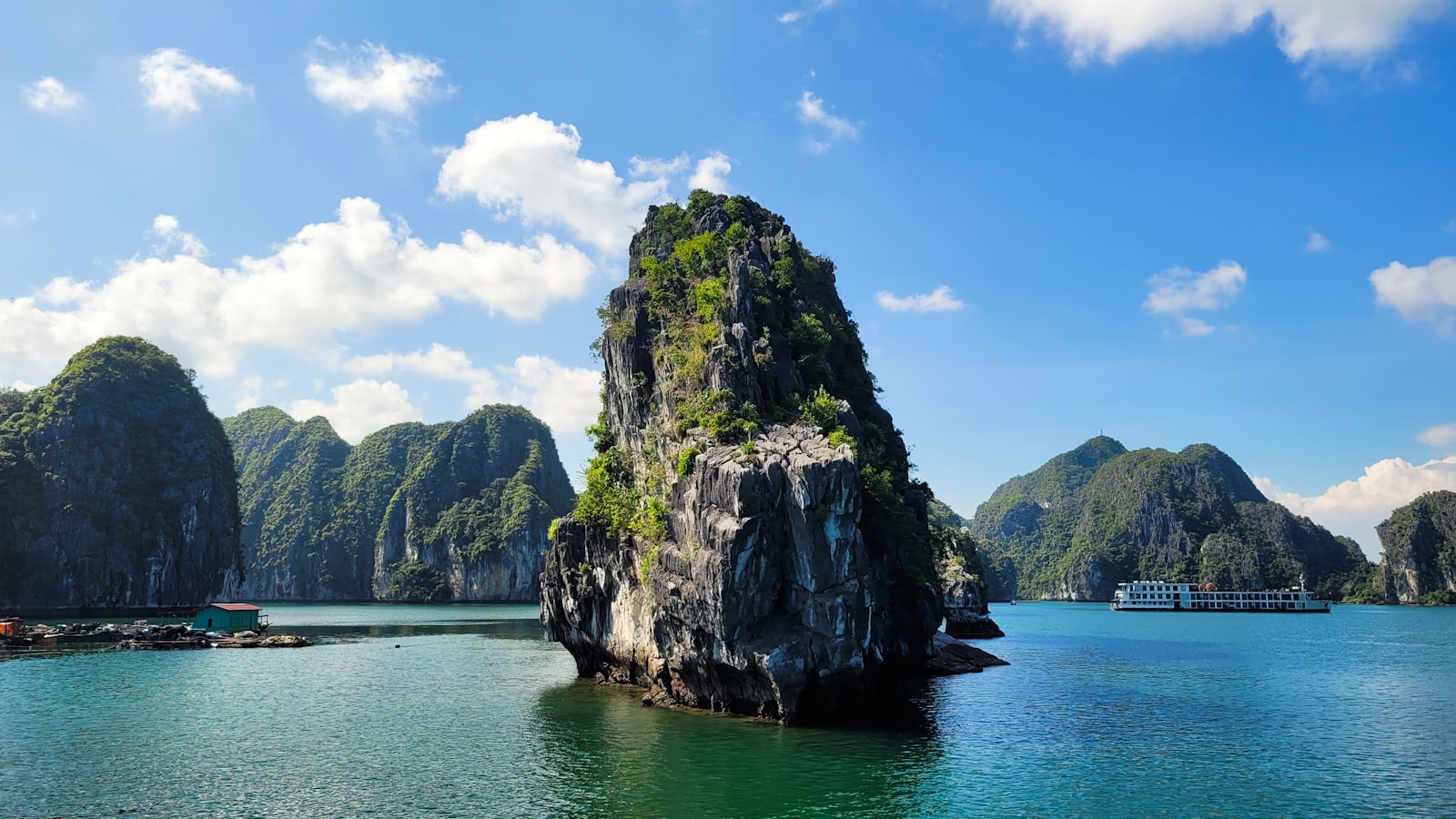
At half past six on a February morning in Hanoi, the light does not arrive so much as leak. There is no sunrise — the sky simply moves from charcoal to a pale, unresolved grey, like a print pulled too early from the developer, and stays there. Six hundred kilometres south, in Hue, the same hour is a hard clean blue. Six hundred kilometres further south again, in the Mekong Delta, it is already 24°C and the light is coming in low and gold across the water hyacinth. Three photographs. One country. One morning.
This is the thing nobody tells you before you book. Vietnam is roughly 1,650 kilometres from Lang Son to Ca Mau, and the country crosses climate zones the way a train crosses provinces. Hanoi sits at 21° north and has a genuine winter. Ho Chi Minh City sits at 10.8° north and has two seasons, both hot. Between them, the central coast runs on a calendar of its own — dry when the north is drowning, drowning when the north is at its best.
So there is no answer to "when should I go to Vietnam." There is only an answer to "what is Vietnam doing in March," and then a decision about which Vietnam you want.
Three countries, one flag
Hold three patterns in your head and every month below becomes legible.
The north — Hanoi, Ninh Binh, Ha Long, Sapa, Ha Giang, Mu Cang Chai — has four seasons, compressed. A cold, grey, damp winter from roughly December to March. A short, luminous spring. A hot, wet, storm-prone summer from May to September, with August the wettest month at around 338 mm. Then October and November, which are the two best months in the region and, in my view, the two best months in the country.
The centre — Hue, Da Nang, Hoi An, Quy Nhon — inverts it. Dry and increasingly hot from roughly February through August. Then the rain arrives, and it arrives in a way that has no equivalent elsewhere in Southeast Asia. Hue receives something on the order of 2,800 mm a year, and close to 750 mm of that falls in October alone.
The south — Ho Chi Minh City, the Mekong Delta, Phu Quoc, Con Dao — has a dry season from December to April and a wet season from May to November. The wet season is not a wall of rain; it is a schedule. Mornings are usually clear. The rain builds through the afternoon and falls hard between three and six. September is the wettest month in Saigon at around 321 mm across twenty rainy days.
One exception worth carrying: the pocket of coast around Nha Trang, Phan Rang and Mui Ne sits in a rain shadow and runs on a fourth calendar entirely — dry from January to August, wet from September into December. In October, when Hoi An is under water, Mui Ne is having its wettest month too. In July, when everyone assumes Vietnam is a write-off, that whole strip is at its driest and brightest.
There is no answer to "when should I go to Vietnam." There is only an answer to "what is Vietnam doing in March."
January and February — grey north, bright south
The north is cold and it surprises people. Hanoi averages a high of about 21°C in January with lows near 15°C, and cold snaps push lower. Sapa, at 1,500 m, drops close to freezing; the summit ridge of Fansipan takes frost most winters and occasionally snow. Guesthouses in the northern highlands are frequently unheated. Pack as you would for a damp English November, not for the tropics.
What the north gives you in return is atmosphere. Ha Long and Lan Ha sit under a low marine haze that can hold for days, dissolving the karst into receding grey planes — a photograph made of tonal separation rather than colour. The tradeoff is real: that same fog cancels boats, sometimes at short notice, and there are mornings where you will simply not see the far islands at all.
The south, meanwhile, is at its best. February is Saigon's driest month by a wide margin — roughly 12 mm across four rainy days. The air is clearest in the early morning, before the traffic haze thickens; from a rooftop in District 1 the light at 06:15 comes in almost horizontally across the river.
Tet is the hinge. In 2027 the first day of the lunar new year falls on Saturday 6 February, with the national break running roughly from the 5th to the 13th. For about a week either side, domestic transport is fully booked, many family-run restaurants close, and the cities empty out as the country travels home. It is a beautiful thing to witness and a difficult thing to travel through. Decide which you are doing.
March and April — the best-lit weeks of the year
If someone asked me for a single fortnight to photograph the whole country, I would take late March.
The northern drizzle — mưa phùn, the fine, persistent crachin that greys out February — thins out. Hanoi warms into the high twenties. The centre is dry and not yet punishing: Hue and Hoi An in March get long clear days, and the Citadel's ochre walls take mid-morning light with the raking angle that makes brickwork legible. The south is still in its dry season, hot but predictable.
April is the same country turned up. Hanoi climbs toward 30°C, the humidity thickens, and the first storms start arriving in the north. The central coast becomes properly hot. It remains an excellent month, but the light gets harder and flatter through the middle of the day, and the window for good work narrows to the first two hours and the last two.
Note the clock. In Hanoi, mid-March sunrise is around 06:00 and sunset around 18:08; by mid-April that has shifted to 05:33 and 18:18. In Saigon the same dates barely move — 05:58/18:04 and 05:39/18:05. The further north you go, the more the year actually behaves like a year.
May and June — the terraces fill with sky
This is the month I go north for, and almost nobody does.
From May into June, the highland terraces of Mu Cang Chai, Sapa and the Hoang Su Phi district are flooded for transplanting. Before the seedlings close over, each terrace is a separate sheet of standing water holding a separate piece of the sky, stacked in contour lines up an entire mountainside. In late afternoon the water goes from silver to a warm pewter to, for perhaps eight minutes, the exact colour of the clouds above it. It is the most purely optical landscape in Vietnam and it lasts a few weeks.
It rains. Hanoi averages around 185 mm in May and 250 mm in June, and the highland roads take mudslides. The rain is convective — it comes in blocks, and the light after a storm clears is the best light of the season. You are trading reliability for a picture nobody else has.
The centre is bone dry and getting hot; Da Nang and Hoi An are in their beach months. The south has entered the wet season, but a May afternoon shower in Saigon is a forty-minute event, not a day.
July — the month you have been warned off wrongly
More readers ask us about July than about any other month, and most of them have already been told not to come. That advice is wrong more often than it is right — it just needs the map applied to it.
What July actually is, region by region. The north is hot and wet: Hanoi around 35°C, roughly 280 mm of rain, high humidity, and the early typhoon track running across the Gulf of Tonkin toward Quang Ninh and Hai Phong. Vietnam takes four to six named storms a year and the June–August ones tend to hit the north. The centre, by contrast, is in the middle of its dry season — Da Nang, Hoi An, Quy Nhon and Nha Trang are hot, bright and largely rainless. The south is in the afternoon-rain pattern: mornings clear, a hard hour of rain after three, evenings washed and cool.
Where to base yourself in July. The honest answer is the central coast. Da Nang gives you an airport, a long beach and easy reach to Hoi An and the Hai Van Pass; Hoi An gives you the old town, and its lantern-lit riverfront photographs best in the ten minutes after the streetlights come on. Quy Nhon is the quieter version of the same thing. Nha Trang is in its rain-shadow dry season and is at its most reliable. Avoid Phu Quoc — the island is in the thick of its southwest monsoon and July is one of its wettest months.
What to actually do in July. Two things worth building a trip around. First: the northern terraces are solid green — young rice, dense and uniform, the colour of new limes, running in ribbons across Sapa and Mu Cang Chai. It is less spectacular than the September gold and far less crowded, and the frequent cloud gives you soft, even light instead of high contrast. Second: the central coast is doing exactly what people think they are coming to Vietnam for, at half the price of March. Take the Hai Van Pass in the morning. Cross to Cham Island if the sea is flat. Shoot the Hoi An riverfront at blue hour and be indoors by the time the afternoon builds.
July is not a bad month in Vietnam. It is a bad month in part of Vietnam, and the part it is bad in is not where you were going anyway.
The one genuine July caution: watch the storm forecasts if you have Ha Long or Cat Ba locked in. Boats are cancelled for weather, and a cancelled cruise in the wet season is not unusual.
August — the wettest north, the last dry light in the centre
August is July with the volume raised in the north. Hanoi averages around 338 mm, its wettest month; Ha Giang and Sapa take road closures. Ninh Binh, though, is at its best — the Tam Coc rice fields turn gold in late May and early June and the karst is at its greenest through summer, and the boat rivers run high and clear between storms.
The centre holds. August is the last fully dry month on the central coast, and it is worth understanding that as a deadline rather than a season. The south continues its afternoon pattern, with the rainfall curve climbing toward the September peak.
September — gold in the north, the door closing in the centre
September is a month of two very different answers, which is exactly why people search for it.
In the north, it is the best photographic window of the year. From early September into the first week of October, the highland terraces ripen and turn — a deep, saturated gold that is nothing like the yellow of European wheat; it is browner, warmer, closer to old brass. Mu Cang Chai runs a terraced-fields festival across September and October. Mid-September sunrise in Hanoi is around 05:46 and sunset around 17:52, and the low sun rakes across the terrace contours at both ends of the day, which is the whole point — those steps only read as steps when the light is coming from the side.
In the centre, September is when it turns. The typhoon track shifts south from September onward, the rains begin in Hue and Da Nang, and the risk profile changes materially. September is still often fine on the central coast — but "often fine" is a different proposition from August's near-certainty, and travel insurance stops being an abstraction.
In the south, September is the wettest month of the year — around 321 mm over twenty rainy days in Saigon. The pattern still holds (clear mornings, hard afternoons), but the afternoons get longer and the Delta roads flood in places. This is also, for what it is worth, when the Mekong floodwaters are highest and the flooded-forest landscapes around Tra Su and Chau Doc are at their most photogenic.
October — the centre goes under
I want to be precise here, because this is where generic travel advice fails people.
October in central Vietnam is not "rainy." It is the single most concentrated rainfall event in Southeast Asia, and it has been getting worse. Between 23 October and 3 November 2025, totals across the central provinces ran 500–800 mm, exceeding 1,500 mm in Hue and Da Nang, with 2,452 mm recorded at Nam Dong. At Bach Ma peak above Hue, 1,739 mm fell in twenty-four hours — the highest 24-hour rainfall ever measured in Vietnam. Hoi An's old town stood in waist-deep water. A second pulse followed in mid-November.
Hoi An floods most years to some degree; the shophouses have flood-height marks painted on their walls and boats stored upstairs. Locals manage it with a competence that borders on choreography. That is not the same as it being a good month to visit, and a piece that tells you October is "atmospheric" in Hue is not being honest with you.
Everywhere else, October is superb. The north is dry, clear and cool, the last of the harvest is in, and Ha Giang's buckwheat begins to open across the Dong Van plateau from mid-October — small pink-white flowers running in sheets under the limestone. The south is drying out and steadily improving.
November — the month I would book
If you gave me one month to send a first-time traveller to Vietnam, and they wanted the north, it would be November.
Hanoi in November averages a high near 27°C with lows around 19°C and roughly 57 mm of rain across eight days — the driest, clearest, most comfortable conditions of the year. Ha Long has its best visibility of the autumn. The Ha Giang plateau is at peak buckwheat, with the festival in Dong Van running through the middle of the month. Mid-month sunrise is around 06:10 and sunset around 17:14, which is a short day but a generous one: the sun is low enough for long enough that you get workable light for most of the afternoon rather than a ten-minute scramble.
The south has turned the corner — around 134 mm across twelve days in Saigon, sunnier week by week, on its way into the dry season.
The centre is still the problem. October is Hue's wettest month at around 770 mm and November is not far behind at roughly 640 mm, and the late-season typhoon track still runs there. If your itinerary is Hanoi–Hoi An–Saigon in November, understand that you have booked two excellent thirds and one lottery ticket.
December — cold light in Hanoi, high season in the delta
December splits the country cleanly.
The north goes cold and dry. Hanoi drops to a high near 23°C with lows around 16°C and only about 37 mm of rain — the least of any month. The light is thin and low; mid-December sunrise is around 06:29, sunset around 17:21, and the sun never climbs above roughly 45° even at midday. For architecture that is a gift. The colonial facades of the French Quarter and the shophouse fronts of the Old Quarter get side-lit all day rather than flattened from overhead. It is also when the Ha Long fog season begins, so build in a spare day.
The south is entering its best stretch. The rain stops, the humidity drops a notch, and December through February is the answer to "when is the best time to visit Ho Chi Minh City" — with February the driest and January the most comfortable. The Delta is dry enough for the back roads, and the light over the water at 17:30 goes a warm, silty gold that has no equivalent in the north.
The centre begins to recover. Late December in Hoi An can be genuinely pleasant; it can also still be wet. It improves every week from here.
So, when?
If you want one honest recommendation rather than twelve: go in late March, or go in November. March gives you the whole country at once, which is the only month that reliably does. November gives you the north at its clearest and the south at its most improving, and asks you to be flexible about Hue and Hoi An.
If you are chasing a specific picture, the calendar narrows: late May for the flooded terraces holding sky, September for the harvest gold, February for the Ha Long fog if you have the patience to wait it out.
And if July is the only month you have — go. Fly into Da Nang, not Hanoi. Give the central coast a week while it is dry and bright and half-empty. Then run north for four days and stand on a ridge above Mu Cang Chai while the green comes up the mountain in steps, and understand that the reason nobody warned you about this is that nobody was here.
Italian travel photographer-writer. Architecture, landscape, the light. Slow, deliberate, image-led essays.
✦ More from Marco Rossi


✦ Keep reading
More from this region
More in Destinations
✦ Discussion
Start the discussion
No replies yet — yours could be the first.