
Why go
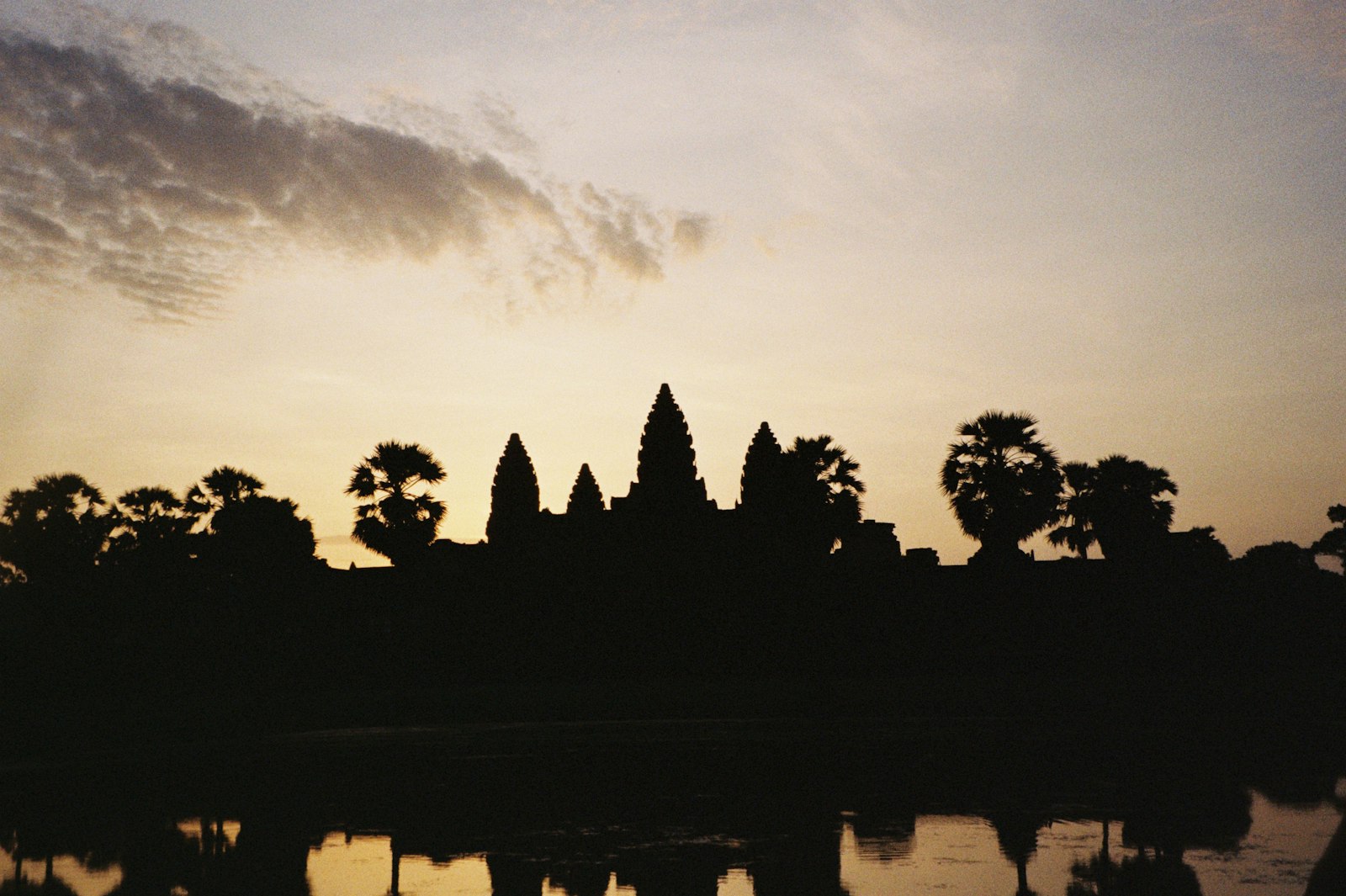
Most people come to Siem Reap for a single photograph — the five towers of Angkor Wat held upside down in a reflecting pool at dawn. It is worth coming for. But the reason to stay is that the Angkor complex is not one temple; it is the stone skeleton of a capital that ruled mainland Southeast Asia for six centuries, built between roughly 802 and 1431, and abandoned slowly enough that the jungle never quite finished the job. Angkor Wat, completed around 1150 under Suryavarman II, is the largest religious structure on earth and the best-preserved. A few kilometres north, the Bayon wears 200-odd serene stone faces, each catching the side-light differently as the morning moves. At Ta Prohm the strangler figs and silk-cotton trees have grown into the masonry until you cannot say where the temple ends and the forest begins. For a photographer this is a rare gift: laterite and grey-green sandstone, ogee pediments and corbelled galleries, all of it raked by a low tropical sun. Siem Reap, the town, is the modest base camp to all of it — and a fine place in its own right, once the cameras are put away.
When to go
Anchor your trip to the dry season, roughly November to March, when the skies clear and the laterite dries to a warm rust. November is my quiet favourite: the monsoon has just lifted, the moats are full, the foliage at Ta Prohm is still green rather than dusty, and the air holds enough moisture to build cloud at dawn — and cloud is what saves an Angkor Wat sunrise from being a flat orange smear. December and January are the coolest and the most crowded; by 4:45am the reflecting pools have a wall of tripods. February and March are dry, hot, and hazy, the light going milky by mid-morning. The wet season, May to October, is hot and humid with heavy late-afternoon storms — but it is also the green season, the moats brim, and you may have the Bayon nearly to yourself. Sunrise in dry season falls around 6:00–6:20am, sunset around 5:40–6:00pm. The hours either side of those are when the stone is alive; from 10am to 3pm the light is harsh and vertical, and you are better off in a café.
How to get there
Most visitors now arrive at Siem Reap–Angkor International Airport (SAI), opened in late 2023, about 40km east of the temples and 50km from town — a deliberate distance, meant to keep aircraft vibration away from the monuments. A pre-booked car transfer to town runs around $25–30; a metered Grab or PassApp ride is usually $18–25. The older in-town airport (REP) is closed to commercial flights. Within Siem Reap, the tuk-tuk is the honest way to see Angkor. Hire a driver for the day — expect $20–25 for the inner temples (the 'small circuit'), $30–40 for the wider 'grand circuit' or a sunrise-plus-full-day run. A good driver becomes your fixer: he knows which gate is empty at 5am and waits in the shade while you walk. For the truly independent, a bicycle is wonderful in the cool months but the distances are real — the small circuit alone is over 20km. Bring small US dollars; Cambodia runs on them, with Cambodian riel given as coins-equivalent for change under a dollar.
Where to stay
Siem Reap divides neatly into the loud and the quiet, and they are five minutes apart. Around Pub Street and the Old Market (Psar Chas) you get walkable noise, late food, cheap massage, and a constant tuk-tuk chorus — convenient, and exhausting by the third night. I prefer the strip along the Siem Reap River, north of the centre, and the lanes around Wat Bo and the Wat Damnak/Sala Kamreuk side, where the guesthouses sit behind walls and the loudest sound at dawn is a monk's broom. This whole town runs cheap by regional standards: clean air-conditioned guesthouses go for $20–40, characterful boutique hotels in restored shophouse and New-Khmer-style buildings for $60–120, and a handful of genuinely lovely heritage and pool-garden properties from $150 up. Whatever you choose, ask one question before booking: how far to the Angkor ticket office, and will the hotel arrange a 4:30am tuk-tuk? Every place that's serious about its guests says yes without blinking.
What to eat
Khmer cooking is gentler than its neighbours' — less chilli-forward than Thai, sweeter and more herbal, built on prahok (fermented fish paste), lemongrass, galangal, and kroeung, the yellow spice paste that anchors half the kitchen. The dish to know is fish amok: river fish folded with kroeung and coconut, steamed in a banana-leaf cup until it sets like a savoury custard. Order it where it's actually steamed, not stirred in a wok. Beyond it, look for lok lak (peppered beef over rice with a lime-and-Kampot-pepper dip), kuy teav (the morning noodle soup), and num banh chok, the green fish-curry rice noodles eaten at breakfast. Pub Street will feed you — and there's no shame in a cold Angkor beer after a temple day — but the better eating is a block back: family restaurants around Wat Bo, the food stalls inside Psar Chas and the night markets, and a serious cluster of chef-led Khmer kitchens that have made Siem Reap a real food town. A street bowl runs $2–4; a proper sit-down dinner with drinks, $10–20.
Things to do
First, the pass. The Angkor Archaeological Park ticket (the 'Angkor Pass') is bought from the official ticket centre on Apsara Road, not at the temples: one day $37, three days $62 (valid over a 10-day window), seven days $72 (over 30 days). Buy the three-day at minimum — temple fatigue is real and one day is a forced march. Spread it: dawn at Angkor Wat on day one, walking the bas-reliefs of the outer gallery before the heat; the Bayon and the walled city of Angkor Thom mid-morning on day two, when the side-light rakes those faces; Ta Prohm in the soft overcast of late afternoon, when the figs photograph best without hard shadow. Save sunset for Pre Rup or Phnom Bakheng if you don't mind company, or skip the crowds entirely and sit at the moat. Beyond the inner ring: the rose-pink carving of Banteay Srei, an hour out; and Tonle Sap, the great inland lake, where the stilted and floating villages are best seen by boat in late afternoon — go with a reputable operator, and be wary of the harder-sell tourist circuits. Pace yourself. The temples will outlast your stamina.
Italian travel photographer-writer. Architecture, landscape, the light. Slow, deliberate, image-led essays.
✦ More from Marco Rossi


✦ Discussion
Start the discussion
No replies yet — yours could be the first.