
When the Rains Come, and Where They Land First
Let me answer the question plainly, because the question deserves a plain answer before the weather earns its poetry. Myanmar's rainy season is the southwest monsoon, and it runs from roughly mid-May to early October. The climatological mean is almost absurdly precise: onset around the fourteenth of May, withdrawal near the fourth of October, a season some hundred and forty-odd days long. June, July and August are the wet heart of it, with July usually the single wettest month, and the most relentless, sky-shuttered rain falling across August and September.
But a monsoon does not arrive everywhere at once. It comes up out of the Andaman Sea and touches the southern coast first — the Tanintharyi strip and the Ayeyarwady delta around the tenth to the fifteenth of May. Yangon goes under by the twentieth to the twenty-fifth. The central plains, Mandalay and the dry zone, hold out until late May or the first days of June. The far north waits until the first week or ten days of June. So the rains move up the country like a tide coming in over a long flat beach, and where you stand decides what month, and what weather, you will meet.
May — The Pressure Before the Break
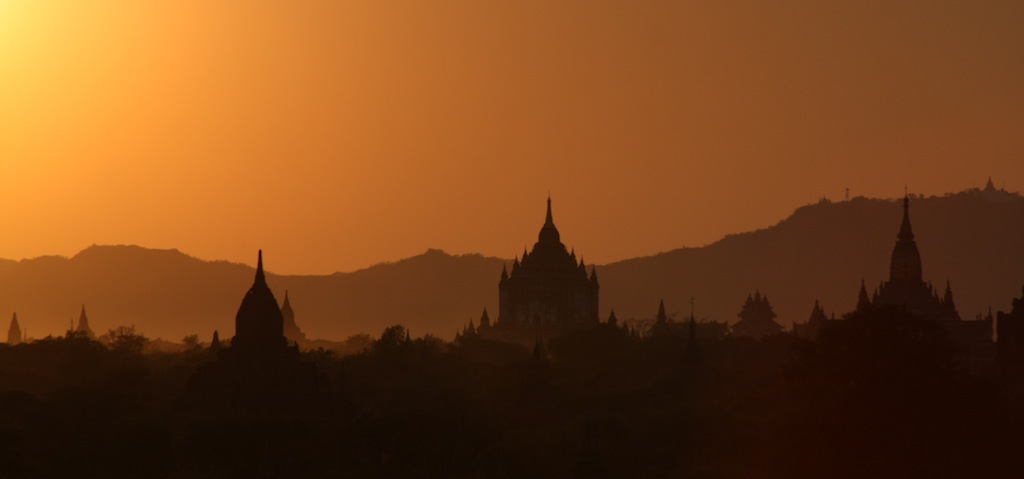
May is the bruise before the blow. Across the central plains it is the hottest stretch of the year, an inheritance from April that the calendar refuses to let go of — the laterite of Bagan's temples holds the heat like a kiln, and by mid-afternoon the air over the plain goes the colour of weak tea, dust and haze flattening the distance until the far pagodas dissolve.
Then, some afternoon in the middle of the month, the sky begins to build. You watch it happen: cumulus stacking into towers, the towers going anvil-flat at the top where the high winds shear them, the underside darkening from grey to a deep gunmetal that is almost violet. The first storms of the season are theatrical and brief — a wall of wind that carries the smell of wet dust, a quarter-hour of rain that does little more than write its name on the ground, and then it is gone and the light comes back raking and golden under the departing cloud. For a photographer, late May is one of the most charged skies of the year, precisely because the rain has not yet settled into routine.
June and July — The Rhythm Sets In
By June the monsoon has stopped auditioning and taken up residence. This is the wettest stretch of the calendar, July most of all, and yet the shape of a monsoon day is gentler than the rainfall totals suggest. The rain here is convective, not constant. Mornings frequently open clear and washed, the air scrubbed of its dry-season dust, the greens of the land suddenly saturated as though someone had turned a dial. The cloud builds through the day and breaks in the afternoon or evening, often in a single violent hour rather than a grey all-day drizzle.
That morning window is the gift of the wet season, and it is reliable enough to plan around. In June the sun comes up over the Bagan plain at around twenty to six, and the first hour of light arrives filtered through humidity rather than dust, which softens it into something diffuse and pearl-grey instead of the hard amber of the dry months. Sunset lands near half past six, and the storm clouds that have been gathering all afternoon make a backdrop the dry season simply cannot offer — they catch the low light on their flanks and turn the whole western sky into something you could not have invented.
The Two Myanmars of the Wet Season
Here is the thing most month-by-month guides flatten, and the single most useful fact for anyone choosing where to point a camera in the rains: Myanmar in the wet season is not one country but several, divided by a mountain range. The Rakhine Yoma — the Arakan mountains that run down the west of the country — stand between the sea and the interior and wring the monsoon dry as it crosses them.
West of that wall, the Rakhine coast and the Ayeyarwady delta are among the wettest places in all of Southeast Asia. Annual rainfall there can exceed five thousand millimetres, and a single monsoon month can drop more than twelve hundred. This is genuine, drenching, flood-bearing rain, and the coast in July or August is for those who actively want to photograph water and weather rather than escape it.
East of the wall, in the rain shadow, lies a different climate entirely. The central dry zone around Bagan and Mandalay receives only five hundred to a thousand millimetres in a whole year. Through the early monsoon and often clear to August, the dry zone stays comparatively dry — green now, where it was dust before, but interrupted only by the occasional heavy downpour rather than drowned by daily rain. This is why Bagan remains photographable straight through the wet season when the coast is unreachable. And higher again, on the Shan Plateau where Inle Lake sits, elevation makes its own weather: around nineteen hundred to two thousand millimetres a year, cooler temperatures, a subtropical air, mornings of mist lifting off the water that have no equal in the lowlands.
August and September — The Deep Water
If the monsoon has a centre of gravity, this is it. August and September bring the most sustained rain of the season, and the coast and the delta go fully under — rivers swollen brown and fast, paddy fields turned to mirrors, roads that vanish for days. The Ayeyarwady runs high and the colour of milky coffee, carrying the silt of the whole upper country down to the sea. This is the stretch to treat with respect: flooding is real, travel by road in the wet west can become genuinely difficult, and plans must be held loosely.
And yet the Shan hills in these months are at their most extraordinary. The terraced gardens around Inle stand impossibly green, the lake high and still at dawn, fishermen working their nets in a light that comes down silver through low cloud. The dry zone, too, is at its most generous now — the heat broken, the plain soft and verdant, the heavy showers passing through in the afternoon and leaving the evenings clear and the temples standing against skies that are doing real work. The photographer who accepts that two days in three will hand them a single perfect hour, rather than a perfect day, will be rewarded in these months as in no other.
October — The Light Returns
October is the long exhale. The monsoon withdraws from north to south through the first half of the month — the reverse of its coming — and as it lifts, the country is handed back its light. The air is at its clearest of the entire year, every particle of dust long since rained out of it, so that distances open up and the far edges of a scene come sharp again. The land is still wholly green from four months of water, but the skies are clearing to deep blue with the last of the season's clouds stacked in tall, sculptural masses on the horizon.
This is, to my eye, the finest fortnight to be in Myanmar with a camera. You are no longer fighting the rain but you have not lost the green, and the combination — saturated land, washed air, dramatic residual cloud, returning golden light — exists only in this brief transition. It is also when the country celebrates Thadingyut, the festival of lights that marks the end of Buddhist Lent and, not by coincidence, the end of the rains. The withdrawal of the monsoon and the lighting of ten thousand small flames are, in the local calendar, the same event.
Shooting Through the Wet
Practically, the wet season asks for a different discipline than the dry. Shoot the mornings — clear or pearl-grey, they are your most dependable light — and treat the afternoon storm as a subject rather than an obstacle. Carry more silica than you think you need; the humidity is the real enemy of a camera here, fogging lenses and creeping into bags, and a body brought from an air-conditioned room into the morning air will mist over for ten minutes before it clears. A simple rain cover and a microfibre cloth in every pocket will save more frames than any lens you own.
What you gain in return is what the dry season cannot give. The plains and the lakeshores are nearly empty of other travellers. The skies are genuinely dramatic in a way the cloudless months are not. And reflection becomes your collaborator — every flooded field, every wet flagstone, every still reach of the lake hands you a second copy of the sky to work with. A note that sits outside the weather but should not go unsaid: where it is safe and advisable to travel in Myanmar is a separate question from when the rain falls, one shaped by the security situation rather than the monsoon, and we treat that consideration elsewhere. Plan the weather here; weigh the rest with current, careful information.
What the Rain Is For
There is a habit in travel writing of treating the rains as the season to be survived, the months to apologise for, the asterisk on the recommendation to come in the dry. I have never seen it that way. The monsoon is not the absence of the good light; it is its own light, and a more difficult and more rewarding one.
Come in the dry season and you will have the easy frame, the cloudless balloon-dawn that everyone already owns. Come in the wet and you must work for the picture — you must read the sky, rise before it builds, and accept the mornings it refuses you. But the morning it grants, the one where the storm cloud catches the first sun and the wet plain throws it back, is a frame the dry season cannot make. The rain is what fills the rivers and greens the terraces and washes the air clear. It is, in every sense, what the country is for.
Italian travel photographer-writer. Architecture, landscape, the light. Slow, deliberate, image-led essays.
✦ More from Marco Rossi


✦ Keep reading
More from this region
More in Destinations
✦ Discussion
Start the discussion
No replies yet — yours could be the first.