
Do You Need a Visa for Singapore? A 2026 Entry Guide
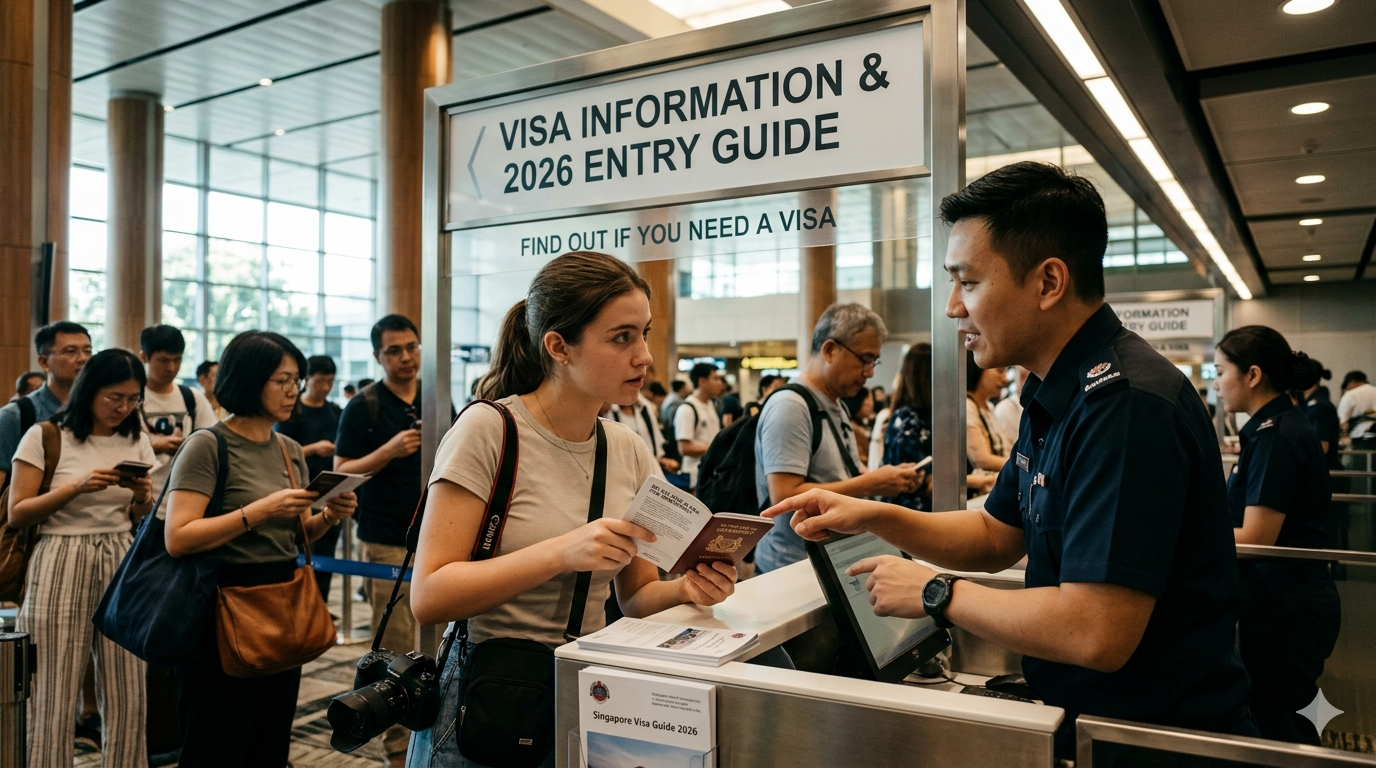
If you're flying into Singapore from the US, UK, EU, Australia, Canada or New Zealand for a holiday — with kids, with grandparents, or solo — the short answer to "do I need a visa" is almost certainly no. The longer answer, and the one that actually trips families up at the airport, is that there's a mandatory online step you must complete before you arrive, and you have to do it for every single member of your family, including the baby. I've taken my three kids through Changi more times than I can count, travelled it with my parents in tow, and watched plenty of families get caught out at the SG Arrival Card stage. This guide walks through every part of Singapore entry in 2026 so you arrive with nothing to worry about.
Do US, UK, EU, Australian and Canadian passport holders need a visa?
No — citizens of all of these countries can enter Singapore visa-free for tourism or business. You don't apply for anything at an embassy, you don't pay a visa fee, and you don't pre-arrange approval. You turn up with a valid passport and the SG Arrival Card already submitted (more on that below).
What does differ is how long you're allowed to stay, and this catches people out because they assume everyone gets the same window. Here's the 2026 breakdown for the main Western passports:
[Table — see source markdown]
Yes, you read that correctly — UK and Canadian passport holders get the shorter 30-day window, while Americans, Australians and EU citizens get 90 days. For a normal one-to-three-week family holiday this makes no practical difference. But if you're a UK family planning a longer Southeast Asia loop using Singapore as a base — popping in and out, or settling in for five or six weeks — that 30-day cap matters, and you should plan around it rather than assume you can stay as long as you like.
One important caveat: the number on the table is the maximum. The actual length of stay is set by the Immigration & Checkpoints Authority (ICA) officer at the checkpoint, and it's stamped (or, increasingly, recorded electronically) on entry. It's almost always the full allowance for a genuine tourist with a return ticket, but it is the officer's call, not an automatic entitlement. Check what you were actually granted before you leave the arrivals hall.
The SG Arrival Card — the step everyone forgets

This is the part of the article I'd most like you to read twice, because it's the single most common reason families have a stressful arrival.
The SG Arrival Card (SGAC) is a free, electronic form that every traveller must submit before entering Singapore. It is not a visa. It does not replace your passport. It's a separate, mandatory pre-arrival declaration — it includes a short electronic health declaration — and visa-free travellers are absolutely not exempt from it. Travellers who fail to submit it can be refused entry. There is no paper version any more; the old paper disembarkation card is gone.
Here's what you need to know to get it right:
When to submit: within three days before your arrival, including the day you arrive. So if you land on 30 June, you can file from 28 June onwards. You cannot do it weeks in advance, and you should not leave it until you're standing at immigration with no Wi-Fi.
Where to submit: only through the official ICA channels — the SG Arrival Card e-Service on the ICA website (
ica.gov.sg) or the MyICA mobile app. Both are free.Cost: zero. It is free of charge. This matters because the internet is full of copycat sites that will happily charge you US$15–60 per person to "process" a form that costs nothing and takes five minutes. If a website is asking for a card payment for an SG Arrival Card, you are on the wrong site. Go directly to
ica.gov.sg.Every traveller needs their own. This is the family-specific bit: there is no "family card." Your 2-year-old needs an SGAC. Your 13-year-old needs an SGAC. Grandma needs an SGAC. The ICA system does offer a group submission option for people travelling together on one trip, which lets a parent fill in the whole family in one session — use it, it's much faster than doing six separate forms — but each person still ends up with their own individual submission tied to their own passport.
My practical routine: I do the whole family's SGAC the evening before we fly, sitting at the kitchen table with all six passports in a pile, using the group submission to knock them out in one go. You'll need each person's passport details, your flight number, and your first night's accommodation address. Do it on home Wi-Fi, not in the airport queue. Screenshot or save the acknowledgement for each person — you don't strictly need to show it on arrival in most cases, because it's linked to the passport, but having proof on your phone removes any doubt if a question comes up.
Passport validity, onward travel and funds
Singapore's baseline entry requirements are straightforward, but each one is a genuine reason people get turned back, so don't wave them off.
Six months' passport validity. Your passport must be valid for at least six months beyond your date of entry into Singapore. This is the rule that catches families most often, because children's passports are issued for shorter periods (five years in most countries, versus ten for adults) and they expire when you're not looking. Before you book anything, line up every passport in the house and check the expiry date against your return date plus a six-month buffer. If a child's passport is inside that window, renew it now — children's passport renewals can take weeks, and it is miserable to discover the problem at check-in. Make this the first thing you do, not the last.
Proof of onward or return travel. Singapore expects visitors to have a confirmed ticket out — a flight or, if you're crossing into Malaysia, evidence of onward transport. For a normal return holiday this is just your return flight booking. If you're doing an open-ended trip, have something booked; an officer is entitled to ask, and "I'll figure it out later" is not a great answer at a checkpoint.
Sufficient funds. You may be asked to show you can support yourself and your family during the stay. In practice, for tourists staying in booked accommodation with a return ticket, this rarely comes up — but be ready to mention your hotel bookings and have a card on you. Singapore is an expensive city; nobody expects a family holiday there to be done on loose change.
Accommodation details. Have your first hotel or address ready. You'll need it for the SG Arrival Card anyway, so it's already to hand.
None of this requires paperwork printed out, but I keep a single screenshot folder on my phone — return flight, first hotel booking, SGAC acknowledgements — so that if anything is asked, I'm not scrolling through six months of email at the desk while three tired kids melt down behind me.
Transiting through Singapore with kids

Changi is one of the best airports in the world to be stuck in with children, so a transit through Singapore is rarely a hardship — but the rules depend on what you're doing.
Staying airside (not clearing immigration): If you're simply connecting from one flight to another and not leaving the transit area, you don't clear Singapore immigration and you don't need an SG Arrival Card. You stay within the terminals. With kids, this is genuinely fine — Changi has free play areas, a butterfly garden, kids' zones, the Jewel complex with its indoor waterfall and gardens, napping spots, and showers. A four-hour layover with primary-age kids can feel like an activity rather than a chore.
Leaving the airport during a layover: The moment you want to clear immigration and go into the city — to see Gardens by the Bay, eat hawker food, swim — you are entering Singapore. That means the normal rules apply: you need the SG Arrival Card submitted, and your visa-free entry allowance applies. For US/EU/Australian families this is easy and very much worth doing on a long layover; Singapore rewards even a six-hour visit. Just treat it as a real entry, file the SGAC for everyone the day before, and factor the immigration queue back into your connection time.
There is also a separate Visa-Free Transit Facility that allows certain nationalities who would normally need a visa to transit Singapore for up to 96 hours under specific conditions. If you hold a US, UK, EU, Australian, Canadian or New Zealand passport this doesn't concern you — you already have visa-free entry. It's relevant only if someone in your travelling group holds a passport that ordinarily requires a Singapore visa, in which case check the precise VFTF conditions on the ICA site, because they're strict about onward tickets and mode of departure.
Arriving smoothly — the family logistics
A few things that make the actual arrival painless, learned the hard way:
Automated clearance. Singapore has been steadily expanding passport-free, biometric immigration clearance at Changi. Eligibility and exact processes evolve, so I won't promise a specific lane setup, but the practical upshot for families is that queues move faster than you'd expect for an airport this size. Keep kids with you, keep passports accessible, and follow the signage on the day.
The health declaration. The SG Arrival Card folds in a short health declaration. It's quick, but answer it honestly. If a family member is genuinely unwell, that's a conversation to have, not a box to fudge.
Timing your SGAC around the date line. If you're flying long-haul and crossing time zones, "three days before arrival including arrival day" is calculated on the Singapore arrival date. Don't overthink it — just file it the day before you fly if your flight is short, or in the 72 hours before your landing date for long-haul. Filing too early is the only real error here, and the system simply won't let you.
SIM and connectivity. You don't need Singapore data to clear immigration, but having a working eSIM the moment you land makes everything downstream easier. Sort that before you fly.
Your Singapore entry checklist
Run through this once when you book, and again the week before you fly:
[ ] Passports — every traveller's passport valid for at least 6 months beyond your return date. Children's passports checked specifically.
[ ] Visa — none needed for US, UK, EU, Australian, Canadian, NZ tourists. Confirm your stay length: 90 days for US/EU/AU/NZ, 30 days for UK/Canada.
[ ] SG Arrival Card — submitted for every traveller, including infants and grandparents, within 3 days before arrival, via
ica.gov.sgor the MyICA app. Free. Use group submission for the whole family at once.[ ] Onward/return travel — confirmed ticket out of Singapore.
[ ] Accommodation — first night's address ready (needed for the SGAC).
[ ] Funds — a card and awareness that Singapore is pricey; rough sense of your budget.
[ ] Phone folder — screenshots of SGAC acknowledgements, return flight, first hotel.
[ ] Avoid scam sites — if anyone asks you to pay for the Arrival Card, you're on the wrong website.
The bottom line
Singapore is, genuinely, one of the easiest entries in Asia for a Western family. There's no visa to chase, the airport is a pleasure even with tired children, and the country is exceptionally well set up for family travel once you're through. The only thing standing between you and a smooth arrival is the SG Arrival Card — so do it the night before you fly, do it for everyone, do it on the official ICA site, and you've removed the one genuine snag. Everything else is just keeping your passports valid and your return ticket booked.
Entry rules do change, and the ICA is the only authority that matters here. Before you travel, do a final check at ica.gov.sg — it takes two minutes and it's the difference between confidence and guesswork at the checkpoint.
Australian family-travel writer based in Brisbane. Mother of three. Family-friendly SE Asia, multi-gen trips, the boring practical bits.
✦ More from Emma Wilson


✦ Keep reading
More from this region


More in Destinations
✦ Discussion
Start the discussion
No replies yet — yours could be the first.