
Cambodia, Month by Month: A Photographer's Calendar
The first thing to understand about Cambodia is that it does not have a best time to visit. It has three different countries, and they take turns. There is the cool, dry one of December — clear-skied, dust-gold, the one the brochures photograph. There is the hot one of April, when the air over the Angkor plain goes white and the stone holds the heat past midnight. And there is the green one of September, when the rice comes up the colour of new limes and the lake quietly swallows a province of forest. The question is not when is it good. The question is which Cambodia do you want to stand in, and at what hour of which day.
I tend to answer that question by light, because light is the only thing a photographer actually owns. So here is the year, read the way I read it through a viewfinder — by the angle of the sun, the weight of the air, and what the rains do to the reflections.
Cambodia does not have a best season. It has three different countries, and they take turns.
November to February — the cool, dry country
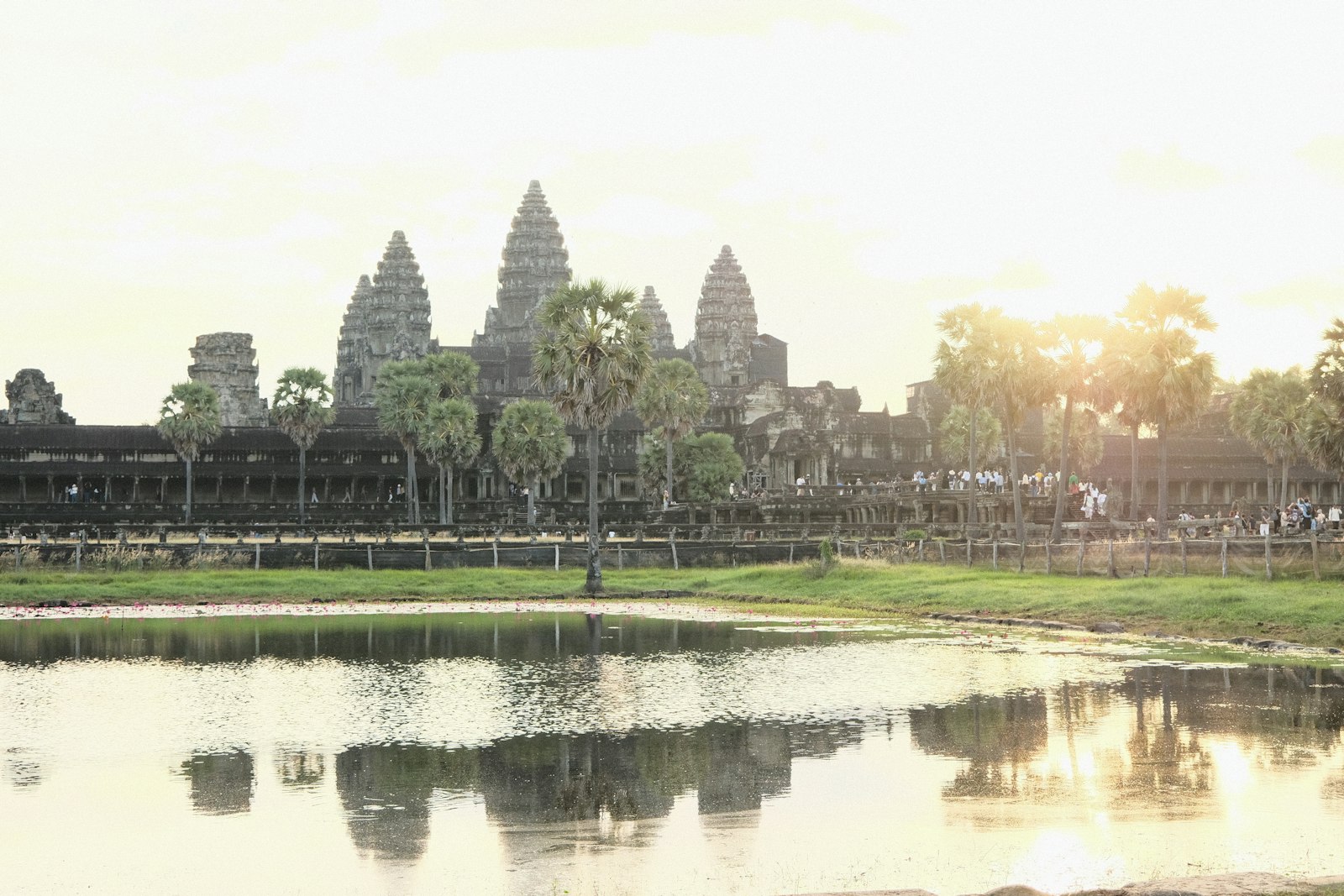
This is the season everyone means when they say "Cambodia." From early November the northeast monsoon settles in, the humidity drops, and the skies clear to a hard, even blue. Daytime highs in Siem Reap sit around 28°C in the depth of January — by Cambodian standards, almost cold; the early mornings can carry a genuine chill, and you will want a layer at the temples before dawn. The air is dry enough that distances sharpen. You can see the Kulen hills from the upper terrace of Angkor Wat without the usual haze softening them into a rumour.
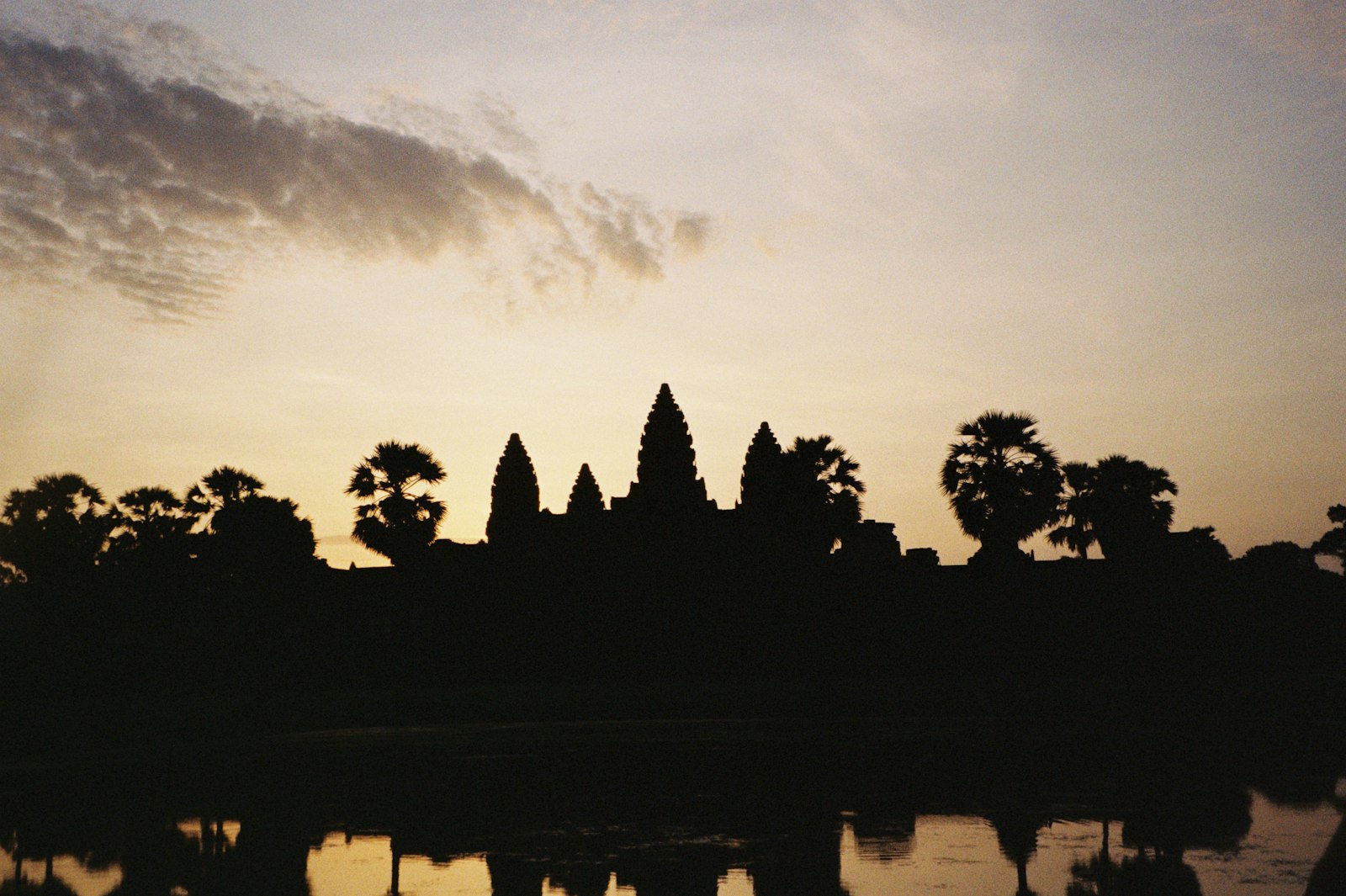
The trade-off is that everyone else has read the same memo. December and January are the high season, and the northern reflecting pool at Angkor Wat — that famous slot of water just inside the western gate — fills with tripods well before the sun comes up. In mid-January first light arrives around 6:28 and the sun clears the treeline shortly after; you want to be in position in the dark, by about 5:45, to claim a few feet of pool edge. The picture everyone is there for is the one the temple was, in a sense, built to refuse: Angkor Wat faces west, not east like almost every other Khmer temple, so at sunrise you are shooting the back of the towers against the dawn — a flat black cut-out, the five lotus spires and the sugar palms, all reduced to silhouette against an amber-grey sky. It is a picture about shape, not detail. Stop trying to recover the stone; let it go black and shoot the sky.
What the crowds miss is the second hour. By eight or nine the sunrise congregation has drifted off to breakfast, and the low, raking side-light of a clear morning is doing far more interesting work — picking out the apsara reliefs along the western gallery in grazing relief, every chisel-mark casting its own small shadow. The cool months are the season for the carving, not just the skyline.
Angkor Wat faces west, against every instinct of Khmer temple-building — so at sunrise you are photographing the back of it, and the stone has no choice but to go black.
There is one more reason to come now, and it is the best argument for early November of all. Bon Om Touk, the Water Festival, falls on the full moon of the Buddhist month of Kadeuk — in 2026, the 23rd to the 25th of November. It marks the moment the Tonle Sap river, which has spent the wet season flowing backwards, reverses again and begins to drain the swollen lake toward the sea. Phnom Penh is where to be: hundreds of long racing pirogues, forty rowers to a boat, drive up the riverfront under a sodium-lit crush of a million people, and the river at dusk goes the colour of wet brass. It is loud, it is devotional, it is the opposite of the silent dawn at the temples — and the two together are the truest portrait of the season.
March to May — the hot country, and the sun over the tower
Then the heat arrives. March is the hinge; by April the dry season has burned down to its embers and the Angkor plain becomes one of the hottest inhabited places in mainland Southeast Asia, with afternoon temperatures pushing 35 to 40°C and the stone radiating it back at you. The light goes hard and white at midday, the worst light there is — high, shadowless, contrast blown out. This is the season to invert your day completely: be out at first light, retreat by ten, sleep through the furnace, and come back for the last two hours before sunset, when the sun drops low enough to put some warmth and some shadow back into the laterite.
I will be honest that I love this season anyway, for one reason, and the reason has a date. Twice a year, at the equinoxes, the rising sun lines up exactly with the central tower of Angkor Wat and climbs the spire like a struck match. In 2026 the spring alignment runs from the 21st to the 23rd of March; stand at the western entrance from around five o'clock and, cloud permitting, by roughly 5:50 the disc sits balanced on the central lotus tower — the building's whole eight-hundred-year orientation resolving, for about ninety seconds, into a single photograph. The Khmer engineers who set the temple's axis under Suryavarman II, between about 1113 and 1150, almost certainly meant exactly this. It is the one morning the west-facing temple turns and faces the sun.
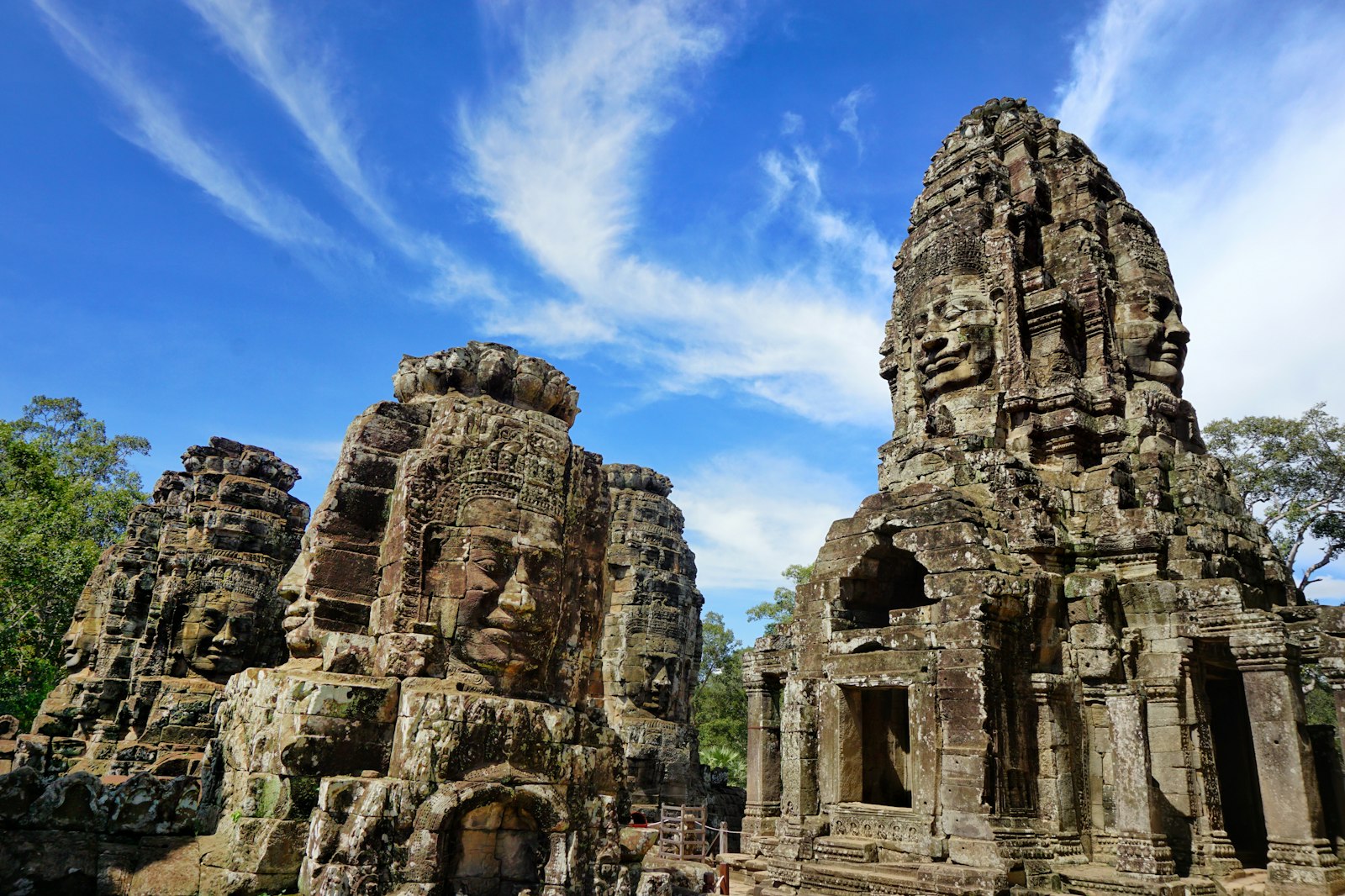
The hot months are also, paradoxically, the right light for Bayon. The face-towers of Jayavarman VII's great temple at the centre of Angkor Thom — those serene, four-faced sentinels in weathered grey sandstone — want hard, clear, directional light to read properly. The deep eye-sockets and the heavy lips need shadow to give them volume; the flat overcast of the wet season makes them go soft and dead. On a clear March afternoon, with the sun low and the sky a hard cobalt behind them, the faces lift off the towers. Get low, shoot up, let one face catch the side-light and let the rest fall into shade.
A note on the calendar: Khmer New Year, Chaul Chnam Thmey, falls on the 14th to 16th of April in 2026. It is the country's biggest holiday, the temples fill with Cambodian families making merit, and water gets thrown joyfully in the streets. Come for it, by all means — but understand that you are a guest at a domestic celebration, not the audience for a spectacle. Keep the camera quiet and ask before you point it at anyone.
June to October — the green country
And then, in the middle of May, the wind turns, the southwest monsoon arrives off the Gulf of Thailand, and the third Cambodia begins. This is the season the guidebooks warn you off, and the season I most want to send you to.
Start with what the rain is actually like, because the warning is overstated. The wet season here is not a grey week-long sulk; it is a daily event with a schedule. Roughly three-quarters of Cambodia's annual rain falls in these months, and September is the heaviest — Siem Reap takes on the order of 250 millimetres across the month — but it arrives mostly as a hard afternoon downpour, an hour or two of warm, vertical rain that clears as fast as it came. The mornings are frequently bright. The dawns are long: by the June solstice the sun is up around 5:38 and not down until past 6:30, the most generous daylight of the year. You simply learn to shoot early, shelter at lunch, and come back out for the washed, glittering light of a late afternoon after the storm has passed.
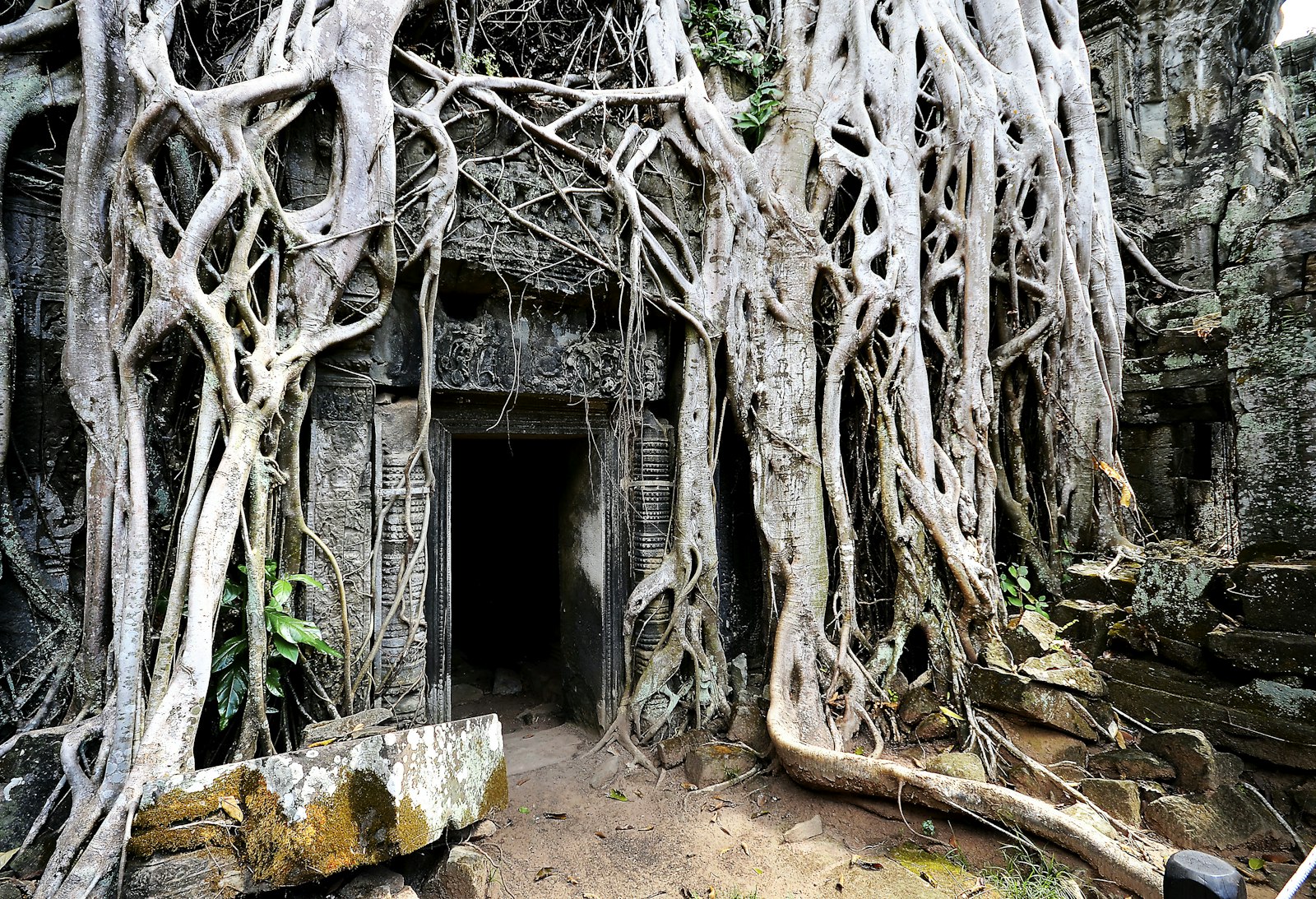
What you get in return is everything the dry season hasn't got. The plain turns green — not one green but a dozen, the acid-bright of new rice, the blackish jungle green of the temple canopy, the olive of the moats. The crowds thin to almost nothing; you can have a minor temple to yourself in a way that is unthinkable in January. And, crucially, you get water. Every flagstone causeway becomes a mirror after the rain; the moss comes up emerald on the laterite; and Ta Prohm — the temple the strangler figs and silk-cotton trees are slowly digesting — is at its most eloquent in the rains, the pale roots darkened and glistening over the stone, the whole ruin breathing damp. Skip the harsh direct sun here entirely. The soft, even, slightly under-lit overcast of a wet-season morning is the correct light for that tangle of root and ruin, and it is the one light the dry season can't give you.
The wet season is not a grey week-long sulk. It is a daily event with a schedule — an hour of warm vertical rain in the afternoon, and bright washed light on either side of it.
The lake that breathes — the Tonle Sap flood pulse
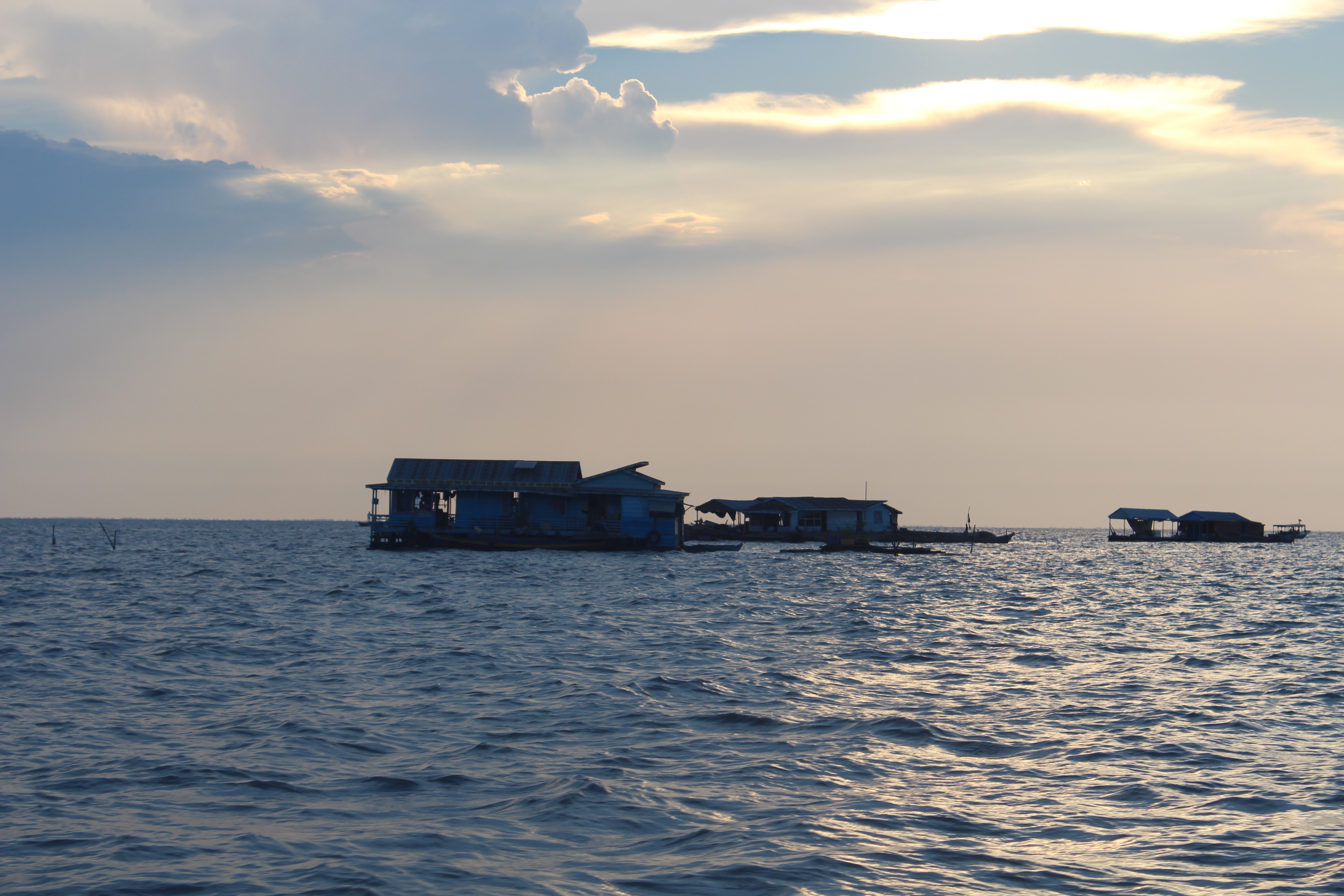
There is one phenomenon that overrides the whole calendar, and it is the reason the green season is worth the inconvenience. South of Siem Reap lies the Tonle Sap, the great lake at the heart of Cambodia, and it does something no other lake on earth quite does: it breathes once a year.
In the dry months it is a shallow plate of water, perhaps 2,700 square kilometres and barely a metre deep. Then the monsoon swells the Mekong so violently that the river backs up, forces the Tonle Sap's own outflow into reverse, and pumps water up into the lake until it has swollen to perhaps five times its dry-season size — drowning an entire belt of forest around its margins under metres of water. The fish breed in that flooded forest in numbers that feed the country. And the stilted and floating villages along the shore — Kampong Phluk, Kampong Khleang — spend half the year as dusty timber towns on impossibly tall legs and the other half as true water-worlds, the houses standing knee-deep, the boats tied to the verandahs.
The lake is at its fullest and most photographable from about September into November, at the tail of the rains. Go at the very end of the day. Hire a boat out past the last houses into open water, where the flooded village reads as a row of dark silhouettes strung along a horizon that is all water and sky, and wait for the sun to drop into the haze. The light over the Tonle Sap at that hour is a soft, smoke-gold wash, the water a pewter grey going to bronze. It is the quietest spectacle in Cambodia, and the one most people never see because they came in the wrong month.
A word that matters here: these are working villages, not a set. The people on those verandahs are fishing, cooking, doing homework, living a life that the flood pulse has shaped for centuries. Photograph the place with the respect you would want shown your own street, and buy your boat ride from someone local.
So, when?
If you want the postcard — clear skies, the dawn silhouette, the carving in raking light, the festival on the river — come in late November through February, and accept the crowds as the price of the light. If you want the temple to turn and face the sun, come for three days around the March equinox, and plan your whole day around the heat. And if you want the Cambodia that fewer people photograph — the green plain, the empty temples, the glistening roots of Ta Prohm, the breathing lake — come in the rains, between June and October, learn the rhythm of the afternoon downpour, and shoot the soft, generous light on either side of it.
There is no wrong month. There is only the question of which light you came for — and whether you are willing to get up in the dark to meet it.
Italian travel photographer-writer. Architecture, landscape, the light. Slow, deliberate, image-led essays.
✦ More from Marco Rossi


✦ Keep reading
More from this region

More in Destinations
✦ Discussion
Start the discussion
No replies yet — yours could be the first.