

Where to Stay in Singapore: A Design and Heritage Map
The first time I returned to Singapore as an adult — not as the kid being walked through Orchard Road by aunties with sharp opinions about my Cantonese — I made the mistake almost every visitor makes. I booked Marina Bay. The room was beautiful in the way that hotel rooms in finance districts are beautiful: silently, expensively, anywhere. I could have been in Shanghai. I could have been in Dubai. On the third morning, jet-lagged and bored, I walked to Tiong Bahru for coffee, turned a corner onto Eng Hoon Street, and looked up at a curved 1930s facade with porthole windows and horizontal banding, and understood I had been staying in the wrong city.
Singapore's design and heritage stock is concentrated in maybe six neighborhoods, and almost none of them are the ones on the postcard. The shophouses, the deco social housing, the godowns, the Peranakan terraces in their carnival colors — these are the rooms worth booking. Choosing where to stay here is less a question of star rating than of which century, which community, which architectural conversation you want to wake up inside.
Tiong Bahru: Streamline Moderne on a Sunday Morning
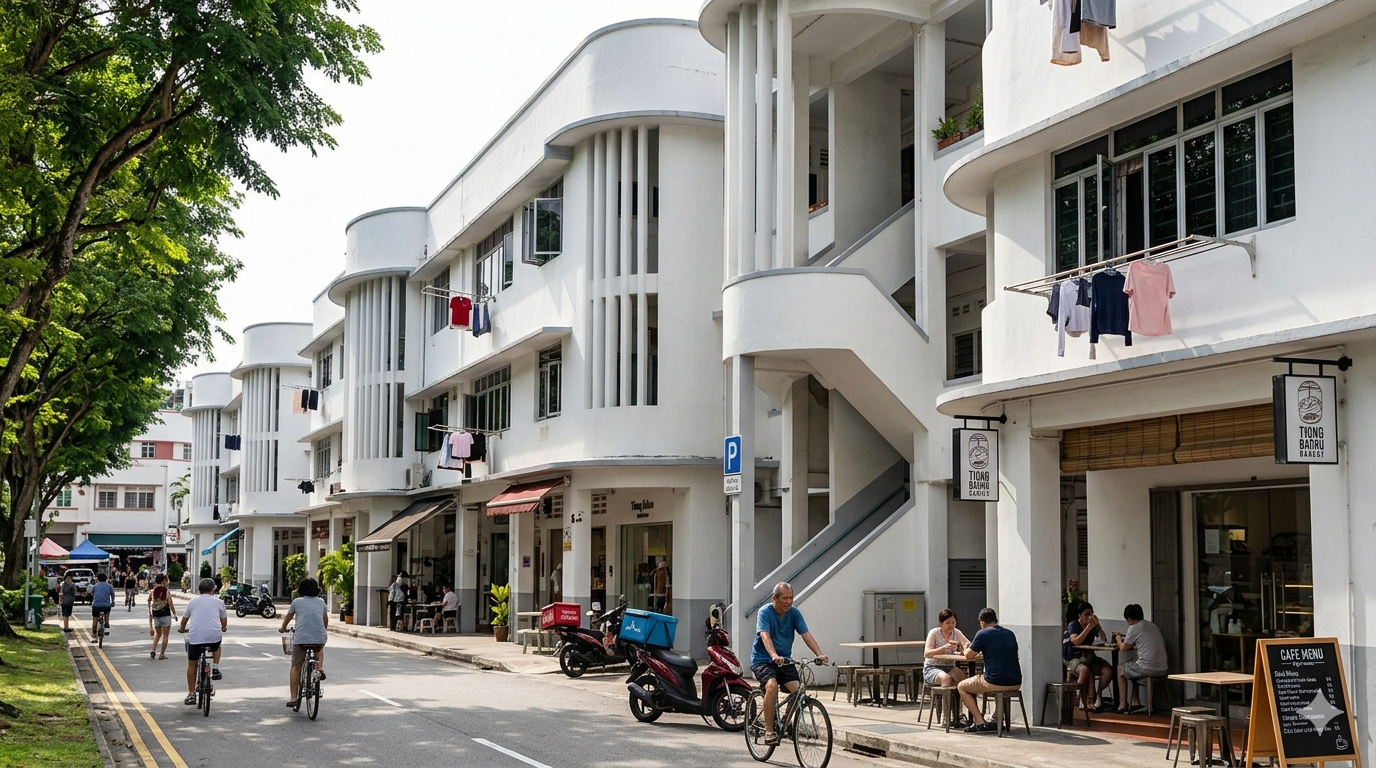
Tiong Bahru is the oldest housing estate in Singapore and, depending on how you count, one of the earliest experiments in modernist public housing anywhere in Asia. Between 1936 and 1941, the colonial-era Singapore Improvement Trust commissioned the architect Alfred G. Church to design what would become 784 flats, 54 tenements, and 33 shops in a vocabulary called Streamline Moderne — the late, stripped-down phase of Art Deco that took its cues from ocean liners and airplanes. Two blocks along Tiong Poh Road are still affectionately called the "aeroplane blocks" because their long horizontal wings really do look like something that might lift off.
Twenty of the pre-war blocks were gazetted for conservation by the Urban Redevelopment Authority in 2003, which is why a walk here at seven in the morning still delivers the strange pleasure of a 1930s streetscape with porthole windows, racing-stripe parapets, and curved corners — and, in the same frame, an old uncle in his singlet collecting the morning papers.
The neighborhood is now also where Singapore's indie-cafe class congregates: third-wave roasters, an independent bookshop, a wet market that still sells decent chwee kueh downstairs at six a.m. before the brunch crowd arrives. To stay in Tiong Bahru is to opt out of the tourist grid entirely.
The best room in the area is at Nostalgia Hotel, a 50-room boutique done in a self-aware mid-century palette that doesn't oversell the period drama. Across the river-bridge, D'Hotel Singapore sits in a Streamline Moderne building and leans, sensibly, on the bones of the architecture rather than fighting them; rooms are quiet, plant-heavy, with the kind of nature-inspired art that earns its wall space. If you want something stripped further down, Hotel Mono occupies six restored shophouses on the edge of Chinatown a few minutes away — strict monochrome interiors, no decorative shouting, all texture and proportion.
Choosing where to stay in Singapore is less a question of star rating than of which century, which community, which architectural conversation you want to wake up inside.
Joo Chiat and Katong: The Peranakan East
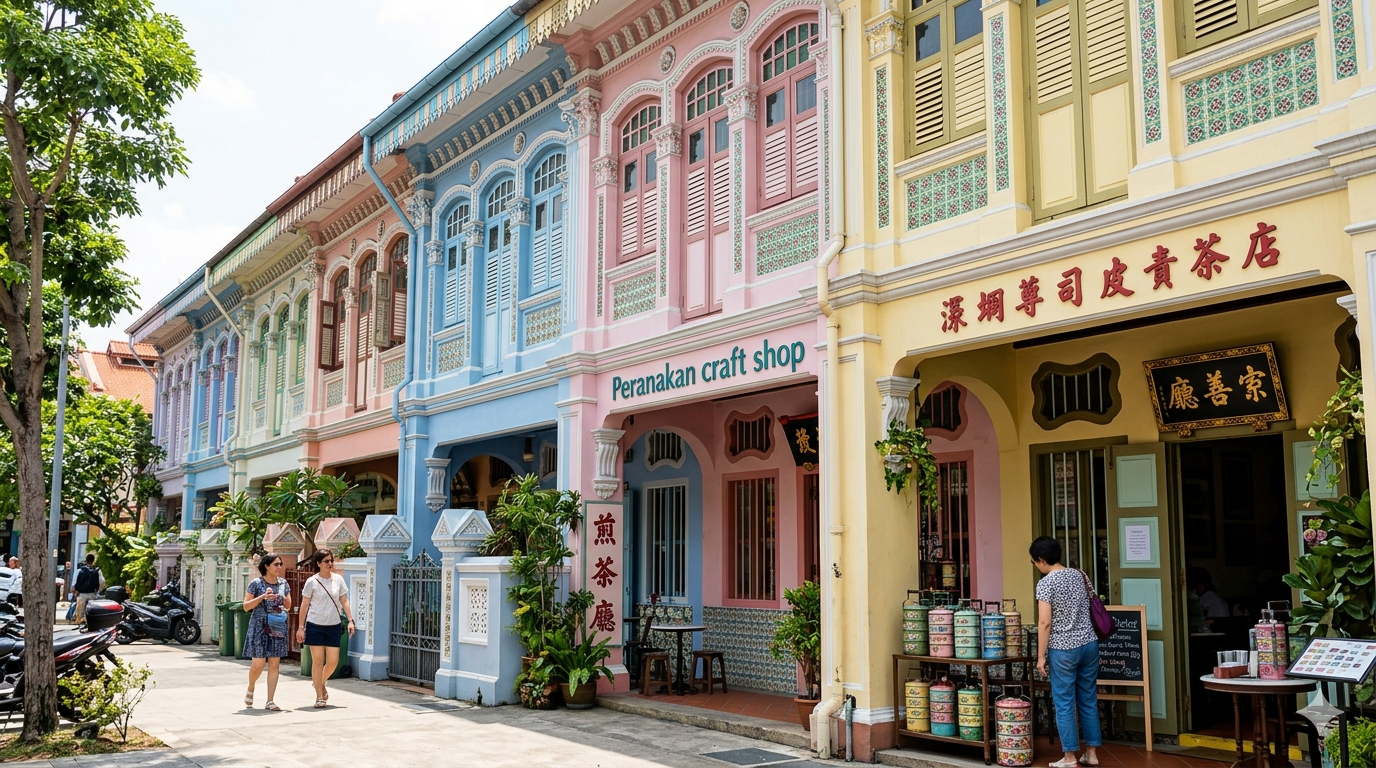
If Tiong Bahru is modernist Singapore, Joo Chiat and Katong are its Peranakan opposite — a 1920s and 30s streetscape painted, deliberately, like a box of glacé sweets. The Peranakans, descendants of intermarriage between early Chinese settlers and local Malays, treated bright color as a statement of prosperity. The famous row of shophouses on Koon Seng Road — turquoise next to lemon next to ash-pink — is, if anything, restrained compared to what these streets looked like at their height. The area was designated a national heritage conservation zone in 1993 and named Singapore's first Heritage Town in 2011, which means the facades and rooflines are now legally protected from anyone with too much money and too little taste.
Joo Chiat Road itself was named after Chew Joo Chiat, a Peranakan businessman who donated the land for it around 1917. The neighborhood is named after its own merchants, in other words, and that is the right frame. This is a community that built itself.
The place to stay is Hotel Indigo Singapore Katong, which has the unfair advantage of occupying the grounds of the former Joo Chiat Police Station — a 1928 colonial building whose architecture is preserved as the hotel's restaurant, Baba Chews. The interiors lean Peranakan in the smart way: tile motifs at the entrance, lantern fixtures, color drawn from the surrounding shophouse palette rather than dialed up to a tourist register. The rooftop pool looks west across the low Katong skyline, and Changi Airport is fifteen minutes by taxi, which matters more on a Sunday departure than you'd think.
If you want something smaller, A Hotel Joo Chiat is a more modest property a short walk away — Peranakan-coded interiors, walkable to 328 Katong Laksa and the kueh shops on East Coast Road. Neither of these rooms is the most expensive in Singapore. Both are among the most located.
Kampong Glam: Sultans, Shutters, and the Sound of Adhan
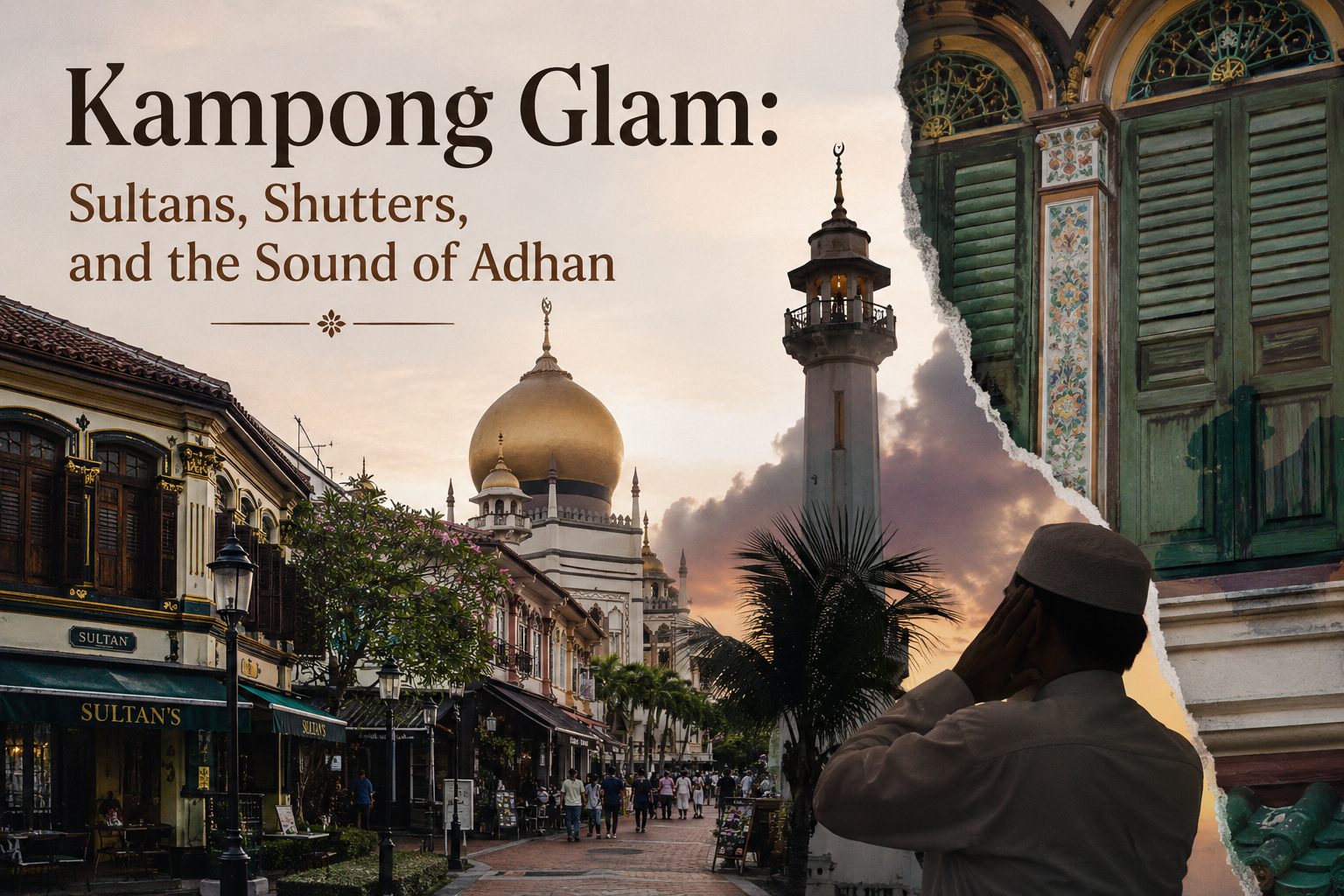
Kampong Glam was the seat of Malay royalty before it was anything else. In the early 1800s, the area formed part of the territory granted to Sultan Hussein Shah, and the Istana Kampong Glam — his royal compound — still anchors the neighborhood, now as the Malay Heritage Centre. The Sultan Mosque, with its gilded dome and column of black at the base (a band made from glass bottles donated by the poorer Muslims of the congregation in the 1920s, so they too could be part of the building) is the heart of the district. Arab Street runs alongside it, still trading in textiles and rugs in storefronts that have not been allowed to change their teakwood fronts in a hundred years.
The hotel here is The Sultan, a 64-room property assembled from ten meticulously restored Late and Second Transitional shophouses dating roughly from 1900 to the 1940s. The restoration, by Kay Ngee Tan Architects, won an Architectural Heritage Award from the Urban Redevelopment Authority in 2012, and the work shows — five-foot ways, full-length shuttered French windows, ornate cornices, columns kept intact rather than smoothed over. The rooms themselves are individually configured, which is the polite way of saying that booking is a small adventure: ask for one with the original tall windows over Jalan Sultan, not an interior unit.
A short walk inland toward Jalan Besar, The Vagabond Club — a 41-room Tribute Portfolio property in a 1950s deco building — does something stranger. The French designer Jacques Garcia, of Hôtel Costes fame, was brought in to gut the interiors into a kind of velvet-and-brass Parisian salon spliced with a golden monkey at the bar and a pair of life-sized golden elephants flanking the lift. It either lands or it doesn't, depending on your tolerance for theatricality. Personally, I think it earns its excess — Garcia treats the building like a stage, and the building can take it.
Chinatown's Quieter Pockets: Ann Siang, Bukit Pasoh, Carpenter Street
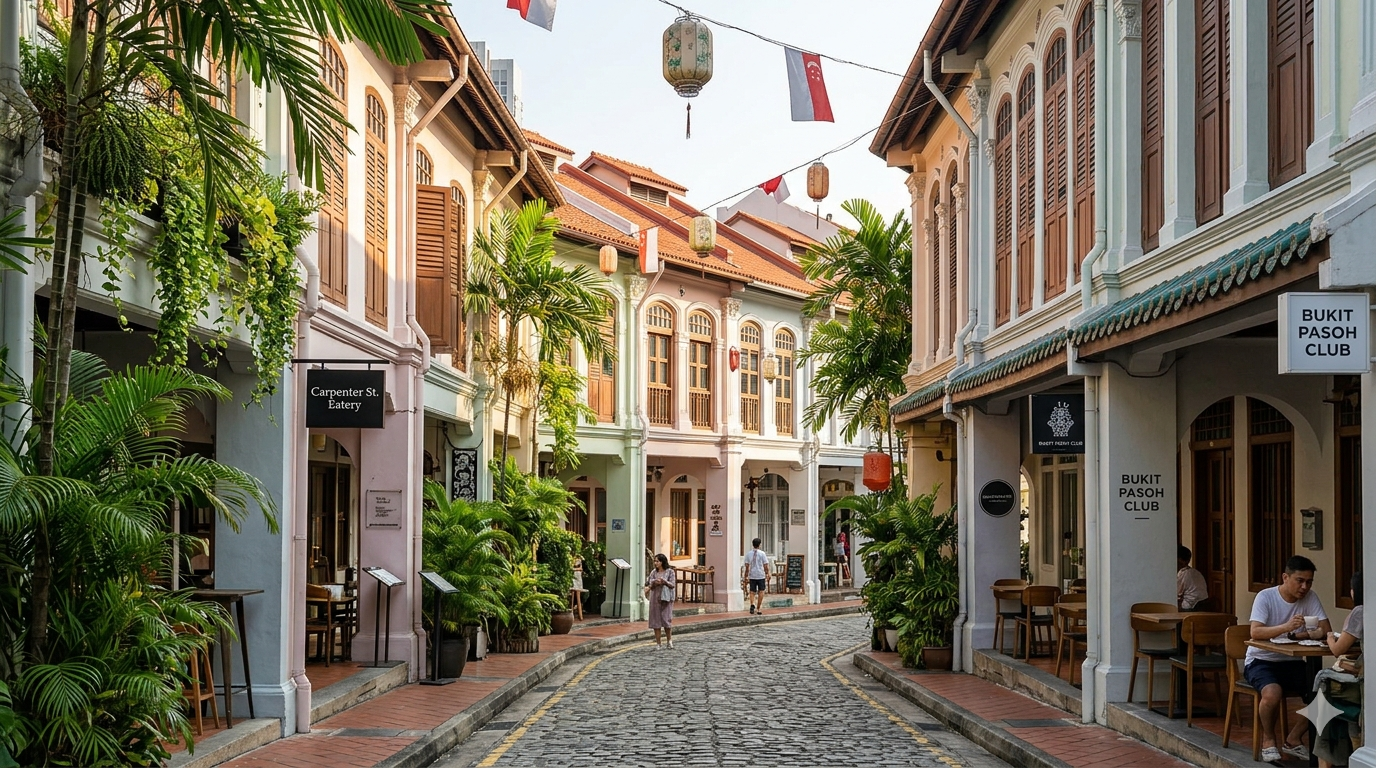
The headline parts of Chinatown — Pagoda Street, Smith Street, the food street with the red lanterns — are not where you want to sleep. The interesting Chinatown is two streets inland: Ann Siang Hill, Club Street, Bukit Pasoh, and the Carpenter Street stretch toward the river. These are the original shophouses of the merchant class, three and four stories tall, narrow as your shoulders, and now mostly converted into wine bars, omakase counters, and a small constellation of design hotels that punch well above their room count.
21 Carpenter is the architectural event of the past few years. Set in four conserved 1930s shophouses that once housed a remittance house called Chye Hua Seng Wee Kee — founded in 1936, where Singapore's earliest Chinese immigrants came to send money home to their villages — the property was reimagined by the architecture firm WOHA. The original four-story shophouse, now the Heritage Wing, has been preserved with its Shanghai plaster exterior, its original geometric windows, and its Chinese inscriptions intact. WOHA added a contemporary Urban Wing above it, with phrases pulled from archived remittance letters cut into the aluminum facade. The Art Deco interiors take their geometry from the original building. It is one of the rare hotels where the design genuinely deepens your understanding of the place rather than draping the place in a costume.
A few streets up the hill, Ann Siang House sits in one of Chinatown's most symbolic restored heritage buildings — twenty rooms, cool tones, gold fixtures, kitchenettes that suggest the property is comfortable with you staying a week. Rates start around USD $168 on the direct site, which is fair for the room and unfair to almost every chain hotel of the same price within a kilometer. Further out toward Outram, KēSa House, by the same group, occupies a conserved row of ten shophouses and works for longer stays.
21 Carpenter is one of the rare hotels where the design genuinely deepens your understanding of the place rather than draping the place in a costume.
Robertson Quay: The River, Restored
Robertson Quay is the quietest stretch of the Singapore River, upstream from the bachelor-party energy of Clarke Quay, and its defining property is The Warehouse Hotel — three adjoining godowns completed in 1895, restored in 2017, now a 37-room member of Design Hotels. The original buildings stored spices, rice, coffee, tin, and rubber. Less officially, this stretch of Havelock Road was the city's red-light district at the turn of the twentieth century, home to opium dens, secret societies, and so many varieties of illicit arrack that the Hokkien name for the road translates to "Spirits Shed Street." The hotel does not hide any of this; the lobby essentially tells you, here is what we were, and here is what we are now.
The restoration, by Zarch Collaboratives, earned the URA Architectural Heritage Award the year it opened. The pitched roofs, the brick, the iron pulleys at the eaves are all original. The pool is small and well-placed. The neighborhood around it is residential-quiet by ten p.m., which is the correct hour for it to be quiet.
For a larger room and a more conventional luxury hotel feel without giving up the riverside, the InterContinental Singapore Robertson Quay does the lifestyle-hotel thing competently — borrowed Tokyo Bikes, lap pool, river-facing balconies. A new DoubleTree by Hilton Robertson Quay is opening in 2026 with 344 rooms after a comprehensive renovation; worth tracking if you need scale.
How to Choose
If this is your first time in Singapore and you want to walk to hawker centers, temples, and a working mosque all before lunch, sleep in Kampong Glam or Chinatown's Ann Siang. If you want to feel like a resident in a Sunday-morning neighborhood that happens to be a piece of modernist architecture, Tiong Bahru. If you are here for the food east of the city center — and you should be — Joo Chiat or Katong, and accept the fifteen-minute taxi to anywhere else. If you want river quiet and a building with weight, Robertson Quay.
What I will say, having now spent enough time here to have favorites, is that none of these neighborhoods are hidden, and none of these hotels are secrets. The shophouses have been there for a century. The Streamline Moderne blocks have been there for nine decades. The only thing that has changed is whether visitors choose to notice. Choose to notice. The view from a porthole window on Eng Hoon Street, watching an old neighborhood wake up, is the view that ruined Marina Bay for me, and I have not been sorry once.
Asian-American travel writer + photographer based in SF. Luxury and culture, design-forward destinations, slow travel.
✦ More from Sarah Chen

✦ Keep reading
More from this region

More in Destinations
✦ Discussion
Start the discussion
No replies yet — yours could be the first.