
The short answer: $25 a day if you grind, $50-80 if you breathe
Let me give it to you straight before the breakdown. If you stay in family guesthouses, eat where the trishaw drivers eat, and take buses instead of planes, you can do Myanmar on about $25 USD a day. That is the broke-but-happy number, and it is real.
Most people I crossed paths with in 2026 were sitting closer to $40-80 a day. That is the comfortable backpacker zone: a private fan room, three proper meals, a couple of beers, entrance tickets, and the odd shared taxi. Add a domestic flight or a balloon ride and a single day spikes hard.
So a two-week trip lands somewhere between $350 on the bone and $1,100 if you live a little, before your international flight. Myanmar is cheap. But here is the part nobody tells you up front: it is cheap and complicated, and the complicated part costs you if you wing it.
The cash trap nobody warns you about properly
Myanmar runs on cash. Hard cash. USD cash, specifically. This is the single biggest thing that separates a smooth trip from a stranded-and-broke one, so read this twice.
ATMs exist in Yangon, Mandalay, Bagan and a few other hubs, but they are unreliable, they often eat foreign cards, and they slap a fee of at least 5,000 kyat per withdrawal on top of whatever your home bank charges. Card payment is basically dead outside a handful of fancy hotels. Assume you cannot rely on plastic for anything. Assume it.
So you bring USD and change it on arrival. But your dollars have to be flawless. I mean crisp, new-series notes with no folds, no pen marks, no tiny tear, no coffee stain, nothing. A creased $100 either gets refused outright or changed at a worse rate. Money changers here are pickier than a Hanoi auntie inspecting a durian. Bring big clean bills too: $50s and $100s get a better rate than tens and twenties.
The move is to bring more USD than you think you need, $300-500 minimum as untouchable backup even on a budget trip, and keep it in a ziplock so it stays pristine. Run out of clean cash in a region with no working ATM and you have a genuine problem, not an inconvenience.
The exchange rate is two different numbers, and that matters
Here is where Myanmar gets weird. There is an official rate and a parallel market rate, and they are nowhere near each other. In mid-2026 the official central-bank rate sat around 2,100 kyat to the dollar, while the real street and money-changer rate was wildly higher, in the rough ballpark of 4,000-5,000 kyat per dollar depending on the day and who you ask.
What this means in plain terms: if you withdraw kyat from an ATM, you are often getting hammered at something close to the unfavorable official rate, so your dollar buys far less. Changing physical USD cash with a reputable money changer usually gets you dramatically more kyat for the same bill.
Treat any single quoted rate as approximate and volatile — it genuinely moves week to week and the gap between official and market is the whole reason cash-USD is king here. Don't change everything at once, and never change money with a random guy on the street who flags you down. That is a classic short-change setup.
The $50 eVisa and the costs before you even land
The tourist eVisa is $50 USD, paid online when you apply. It is valid for a 28-day stay and you must enter within 90 days of approval. Business eVisas are $70, but you want the tourist one.
Apply at the official government eVisa portal, not a third-party site that tacks on a service fee. You will need a passport with at least six months validity, a passport photo, and they may ask for a return ticket and a hotel booking. Approval usually comes in 24-72 hours. Print the approval letter — they want the physical printout at check-in and at immigration.
Your other big pre-trip cost is the flight in. Myanmar is not a budget-flight hub, so international fares run higher than the rest of the region; expect to pay more to fly into Yangon than you would into Bangkok or Hanoi. Many backpackers fly into Bangkok cheap and hop over from there.
Beds, food and beer: the day-to-day numbers
Accommodation is where Myanmar stays kind to your wallet. A simple family guesthouse or basic room starts around $5-8 USD a night, often with breakfast and sometimes a shared bathroom. Step up to a clean private room with aircon and you are looking at $15-30. Bagan and Inle run a touch higher than Yangon backstreets.
Food is the real joy and it is dirt cheap if you eat local. Street food, a plate of noodles or a samosa or a bowl of mohinga, the fish-noodle soup that is basically the national breakfast, runs roughly 400-1,300 kyat, call it 30 cents to a dollar. A proper sit-down local meal of rice, curry and the little free side dishes they pile on is around 2,000-6,000 kyat, so $1.50-4. A Myanmar beer is cheap, a dollar or two.
Eat at a tourist-facing restaurant with an English menu and prices jump three or four times. Not a scam, just the tourist tax. My rule everywhere in this region holds here: if the menu has photos and a guy outside waving you in, walk one more block to where the locals are hunched over plastic stools.
Getting around: buses are cheap, flights cost you
Overland is the budget option. Long-distance buses between the big tourist cities are comfortable enough and cheap, usually in the single-digit to low-teens dollar range for an overnight haul like Yangon to Bagan or Bagan to Inle. Local pickups and shared taxis fill the gaps for a few dollars.
Domestic flights are the budget-killer. A one-way hop like Mandalay to Yangon runs north of $100 USD, and routes around the country sit in that $90-150 zone. One flight can equal four or five days of your entire ground budget, so think hard before booking one.
But here is the catch that pushes people onto planes anyway, and it is not about comfort. It is about safety.
The caveat that decides where your money goes at all
You cannot talk about the cost of a Myanmar trip in 2026 without talking about the conflict, because it dictates where you are allowed to spend money in the first place. The country is in an ongoing armed conflict between the military and various resistance groups, and large parts of it are flatly off-limits.
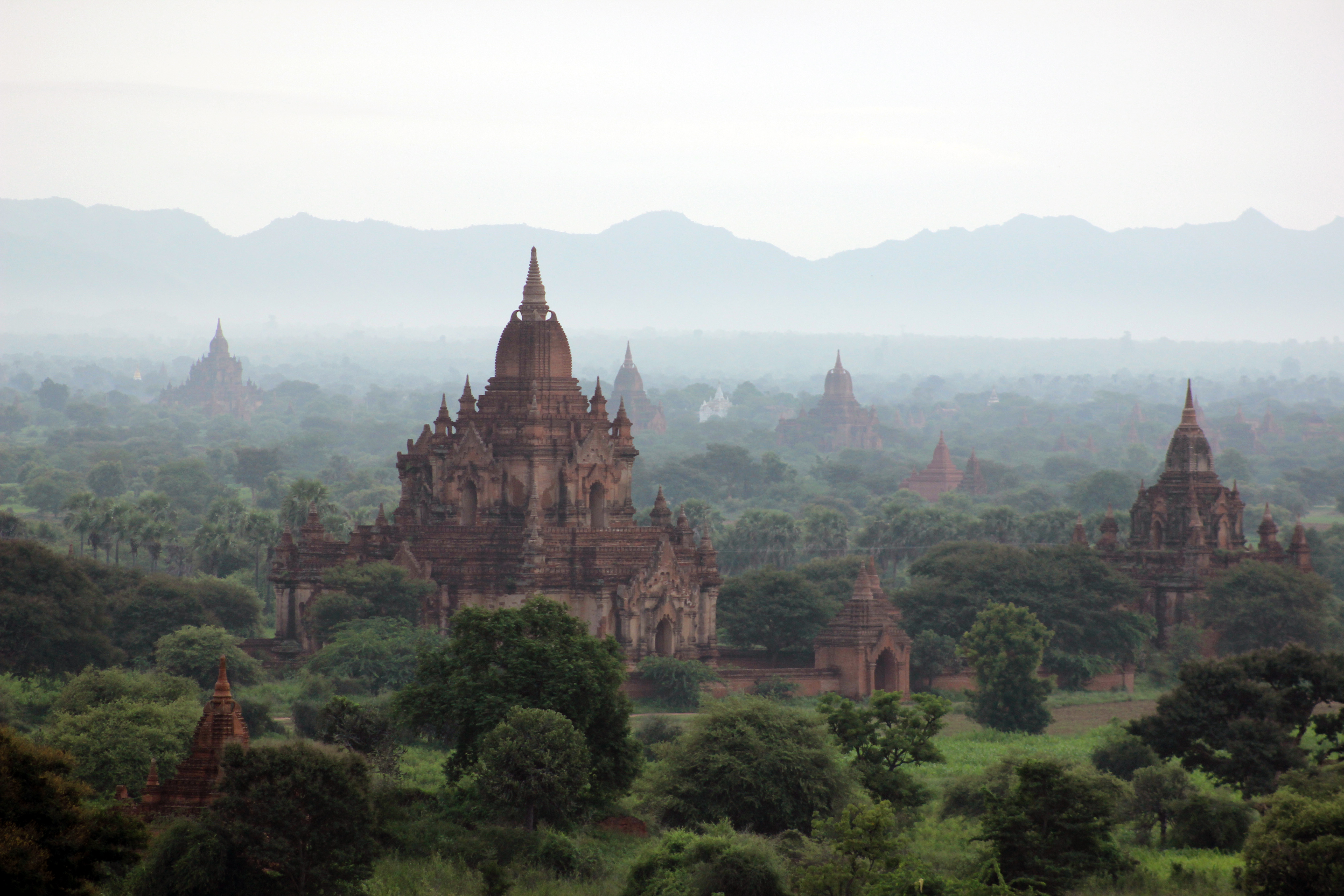
What is realistically open is the classic loop, the so-called Tourist Kite: Yangon, Bagan, Mandalay and Inle Lake. Yangon is the calmest and is generally treated as a green zone. Bagan and Inle are doing tourism with balloons going up over the temples and boats out on the lake. That core is where nearly all foreign travel happens right now.
Everything outside it — Rakhine, Kachin, northern Shan, Sagaing, Kayah, Kayin, Mon — is a hard no. Overland routes between cities pass through military checkpoints and the security picture can flip fast, which is exactly why some travelers eat the cost of a domestic flight to skip a sketchy road. Check your government's current advisory and very current on-the-ground accounts before you go. This is not a destination to improvise across.
I am framing all of this as approximate and as of mid-2026 on purpose. Prices, rates and the safety map all move here faster than almost anywhere else I write about.
Bottom line: what I'd actually budget
For two weeks on the Tourist Kite, eating local, sleeping in guesthouses, moving by bus, I'd carry the $50 eVisa, my international flight, and then plan on roughly $40 a day on the ground, so around $550-600 in-country. Add one domestic flight if a road looks dodgy and bump that by $100-150.
Then I'd bring an extra $300-500 in pristine USD I do not plan to touch, in a ziplock, in big clean bills. Not because the trip costs that much more, but because the day an ATM fails in a town with no working backup is the day that cash stops the trip from falling apart.
Myanmar is one of the cheapest places left in Southeast Asia to actually travel. The money math is easy. The cash logistics and the safety map are the hard part — get those right and you are golden. Get them wrong and cheap stops mattering real quick.
Vietnamese backpacker, 5 years zigzagging across SE Asia on a shoestring. Budget travel, street food, hidden gems — the honest version.
✦ More from Alex Nguyen


✦ Keep reading
More from this region


More in Destinations
✦ Discussion
Start the discussion
No replies yet — yours could be the first.