
Start with the sleeper train — it's the move
If you do one overland leg in Thailand, make it the night train from Bangkok to Chiang Mai. A second-class air-con sleeper runs about 940–1,040 THB ($28–31), and that buys you a flat bed, a curtain, and 12 hours that would've cost you a guesthouse night anyway. The famous one is train #9: leaves Krung Thep Aphiwat station around 18:40, rolls into Chiang Mai by ~07:15.
Book ahead. Beds genuinely sell out, especially Nov–Feb. Since April 2026 you can reserve a max of 90 days out on the State Railway site — do it 60+ days early in high season. Lower berths cost a touch more than uppers and are worth it: bigger window, easier to climb into after a Chang.
First class (a private two-bunk cabin) exists from roughly 1,650 THB ($50) if you want a door that locks. Honestly the second-class car is sociable and fine. Bring a hoodie — they crank the aircon to meat-locker.
Buses and minivans: cheap, everywhere, occasionally sketchy
Buses go where trains don't. A VIP overnight Bangkok–Phuket (about 850 km, ~12 hours) runs 1,000–1,200 THB ($30–36), reclining seat, blanket, a meal-stop voucher. 'VIP' means fewer, wider seats — pay the extra over the standard express, your spine will thank you.
Book government buses (Transport Co.) or established operators from the real terminal — in Bangkok that's mostly Mo Chit (north/northeast) and the Southern Terminal (Sai Tai Mai). Skip the cheap 'tourist buses' sold from Khao San Road travel agents. That's where the classic move happens: your bag gets quietly gone through in the luggage hold while you sleep. Keep your passport, cash, and phone on your body, not in the bin.
Minivans (rot tu) cover short hops — Bangkok to Ayutthaya or Kanchanaburi, island piers, town-to-town. Fast and cheap (a few hundred baht), but the drivers treat the road like a Mario Kart map. Sit toward the front, wear the belt, and don't take the very back row over the wheel arch unless you enjoy being airborne.
Domestic flights are dumb-cheap — use them on long hauls
Thailand's budget carriers are some of the best value in the region. Bangkok–Chiang Mai on Nok Air, AirAsia, Thai Lion or Thai Vietjet starts around 1,000–1,400 THB ($30–42) one-way if you book a week or two out. That's barely more than the train and saves you a full day.
The catch is the usual budget-airline tax: base fare gets you a seat and a small bag only. Add checked luggage and a seat assignment online — buying bags at the airport counter is where they reaming you, sometimes double. Domestic flights mostly use Don Mueang (DMK), not Suvarnabhumi (BKK), so check which airport before you book a 4am taxi to the wrong one.
My rule: train or bus for anything under ~6 hours and overnight; fly the long diagonals (Bangkok to Chiang Rai, Krabi, Phuket) when a sleeper would eat two travel days.
Ferries to the islands: know your pier
Gulf islands (Koh Samui, Koh Phangan, Koh Tao) connect through Surat Thani. The high-speed Lomprayah/Seatran catamarans run about 550 THB ($17) Surat Thani–Samui, ~1h15; the slower car ferries are cheaper and take ~3 hours. Most agents sell a combo train-or-bus + ferry ticket from Bangkok, which is genuinely convenient here.
Andaman side (Phuket, Phi Phi, Krabi, Koh Lanta) runs out of Phuket's Rassada Pier and Krabi. Phuket–Phi Phi is roughly 400–650 THB ($12–20) depending on speedboat vs big ferry.
Two honest warnings. Seas get rough and boats get cancelled May–October on both coasts — don't book a same-day flight connection off the last ferry. And the combo-ticket agents love overselling speedboat transfers; the standard ferry is slower but steadier and you keep more baht.
In Bangkok: BTS, MRT, and skip the metered-taxi drama
Bangkok traffic is a war crime, so the BTS Skytrain and MRT subway are your best friends. Since November 2025 both moved to distance-based fares: BTS runs about 17–65 THB ($0.50–2), MRT roughly 17–45 THB. Grab a stored-value Rabbit card (BTS) if you're staying a while — no fumbling for coins at rush hour.
For door-to-door, use Grab. It shows the price up front, so there's no haggle and no 'meter broken, 300 baht' nonsense. Street taxis are fine if they actually use the meter (starts 35 THB, ~150 THB for 5 km) — if the driver quotes a flat fare, wave them off and get the next one.
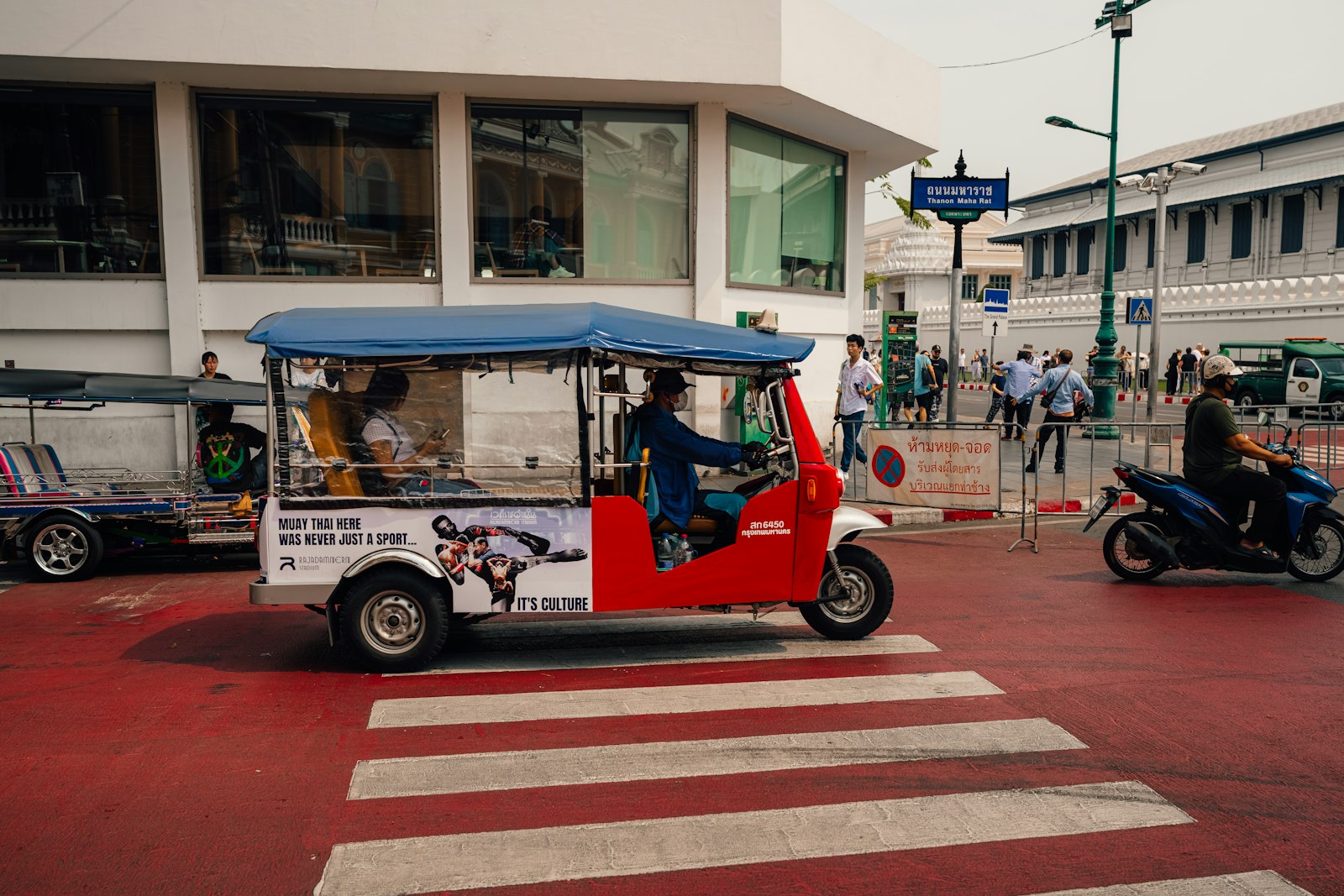
Tuk-tuks are a vibe, not transport. They're often pricier than a metered cab and the 10-baht 'temple tour' is a gem-shop scam pipeline. Take one once for the photo, agree the price first, then default back to Grab and the trains.
Renting a motorbike without getting scammed
On the islands and in Chiang Mai/Pai, a scooter is freedom — usually 200–300 THB ($6–9) a day. But read this twice: never hand over your physical passport as deposit. A cash deposit or a passport photocopy is normal; the original is the leverage scammers use to invent a 'scratch' and hold you hostage until you pay.
Before you ride off, film a slow video of the whole bike — every scratch, mirror, panel, under the seat — with the staff watching you do it. The damage scam (charging you for old dents, sometimes hidden under touch-up paint) is the most common rip-off in Thailand, full stop. If a shop refuses a copy-only deposit, walk; there's another rental 50 metres down.
Legally you need an International Driving Permit with a motorcycle endorsement, and police do run checks (a ~500 THB 'fine' at a checkpoint is common). No helmet is a guaranteed stop. And know your insurance won't cover a crash if you weren't licensed — that's how a 300-baht rental becomes a 300,000-baht hospital bill. If you've never ridden, learn somewhere that isn't a cliff road in the rain.
Bottom line
Sleeper train for the long classic legs, budget flights for the far corners, government buses over Khao San tourist buses, Grab and the BTS to beat Bangkok traffic, and ferries with a buffer day built in. Keep your valuables on your body, keep your passport in your pocket, and film the rental bike. Do that and Thailand is about the easiest country in Southeast Asia to move around — and one of the cheapest.
Note on prices: fares are mid-2026 and I've used roughly 33 THB to the dollar. FX and fuel surcharges drift, so treat these as ballpark, not gospel — check the operator before you book.
Vietnamese backpacker, 5 years zigzagging across SE Asia on a shoestring. Budget travel, street food, hidden gems — the honest version.
✦ More from Alex Nguyen


✦ Keep reading
More from this region

More in Destinations
✦ Discussion
Start the discussion
No replies yet — yours could be the first.