
Why go
If Hanoi is the north's careful, herb-forward conservatism, Ho Chi Minh City — still Saigon to most of the people who live and cook here — is the south's open hand: sweeter, richer, more willing to borrow. It is the most generous eating city in Vietnam, and arguably in mainland Southeast Asia. The reason is history sitting on a plate. Saigon absorbed the Mekong Delta's abundance, French colonial bread and coffee, and a deep, century-old Chinese diaspora in Cholon, and it never bothered to keep them separate. The result is cơm tấm built on broken rice the French export trade once discarded, bánh mì that out-engineers any sandwich in the region, and hủ tiếu that exists in a dozen contested versions because Cantonese, Teochew, and Khmer cooks all claim it. You come here to understand that Vietnamese food is not one cuisine but a negotiation. Beyond the table, this is the country's commercial engine — louder, hotter, and more forward-looking than the capital, with a rooftop-bar skyline that didn't exist a decade ago. The War Remnants Museum and the Cu Chi tunnels give the trip its necessary weight. But the honest reason to come is that few cities reward an appetite this completely, this cheaply.
When to go
The single most useful fact: Saigon has two seasons, not four. The dry season runs roughly December to April and is the easy window — warm, bright, low humidity, and the stretch most worth planning around. December to February is the sweet spot, with daytime highs in the low 30s°C and cooler evenings that make street-side eating a pleasure rather than an endurance test. March and April heat up sharply; by April the city is genuinely punishing at midday. The wet season (May to November) brings near-daily afternoon downpours — intense, theatrical, and usually over within an hour. Don't write it off: rain comes in predictable bursts, prices soften, and the food never stops. The real scheduling trap is Tết, the Lunar New Year (late January or February). For three to five days, much of the city — including a large share of the family-run stalls you came for — shuts entirely as staff return to home provinces. The streets empty in a way that is eerie and beautiful, but if your trip is built around eating, Tết will gut your itinerary. Aim for the week before for the markets at full tilt, or avoid the holiday window altogether.
How to get there
You land at Tan Son Nhat (SGN), unusually close to the center — about 7km from District 1, which sounds trivial and isn't, because Saigon traffic bends time. Book a Grab (the regional ride app, far cheaper and less stressful than the airport taxi touts): a GrabCar to District 1 runs roughly 150,000–220,000 VND ($6–9) and takes 25 minutes off-peak or close to an hour in the evening crush. For solo travelers with a small bag, GrabBike — a motorbike taxi — is half the price and twice the fun, though weave-through-traffic energy is not for everyone. Inside the city, Grab is your default for both cars and bikes; you almost never need to negotiate or carry exact change. The metro's first line finally opened and is useful along its corridor, but it doesn't yet reach most of where you'll eat. Be realistic about the traffic: this is a city of millions of motorbikes moving as one organism, and crossing the street is a learned skill — walk slowly, predictably, don't stop, and let the bikes flow around you. They will. Distances that look walkable on a map are often best done by bike given the heat. Budget more transit time than seems reasonable, especially 5–7pm.
Where to stay
Three honest options. District 1 (Đồng Khởi and Bến Thành) is the polished center — colonial landmarks, the best restaurants, rooftop bars, and walkable access to the major sights. You pay for it: mid-range hotels run $50–110, and the smarter boutiques and the Park Hyatt climb well past that. It's the right base for a first trip and for anyone whose itinerary is food-and-sights dense. Pham Ngu Lao (the backpacker quarter around Bùi Viện) is loud, cheap, and divisive — hostels and budget rooms from $10–30, a beer-soaked walking-street circus at night, and unbeatable proximity to cheap eats and tour pickups. Stay here if you want energy and a thin wallet; avoid it if you want to sleep. My quiet pick is District 3, just northwest of the center: leafier, more residential, genuinely local, and home to some of the city's best old-guard eating (Phở Hòa Pasteur, Bánh Mì Hòa Mã, the sock-filter coffee at Cheo Leo). Rooms run $30–70, and you trade ten minutes of Grab time for a neighborhood that feels like the real city. For a food-led trip, District 3 is where I book.
What to eat
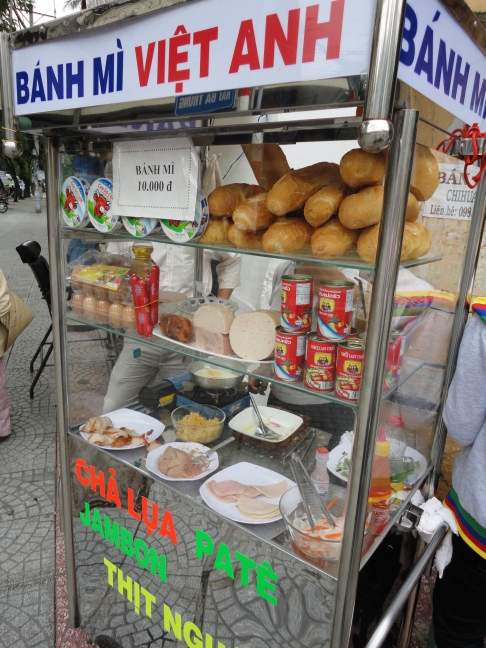
Start with cơm tấm — broken-rice with a grilled pork chop, the dish that defines southern comfort eating. Cơm Tấm Ba Ghiền (84 Đặng Văn Ngữ, Phú Nhuận) plates a pork chop the size of your hand for around 60,000–90,000 VND ($2.40–3.60); the char and the nước mắm dressing are the point. For bánh mì, the famous answer is Huỳnh Hoa (26 Lê Thị Riêng, D1), an overstuffed cold-cut monster at about 58,000–65,000 VND ($2.30–2.60) — genuinely excellent, often a queue. But don't miss Bánh Mì Hòa Mã (53 Cao Thắng, D3), the pan-served original where the fillings arrive in a skillet beside the bread, around 50,000 VND. Hủ tiếu — the south's signature noodle soup, drier and sweeter than phở — is best chased in Cholon (District 5): hủ tiếu Nam Vang (the Phnom Penh style, pork-and-shrimp) is the one to order, 50,000–70,000 VND. For phở, Phở Hòa Pasteur and Phở Lệ in Cholon both hold up at 75,000–95,000 VND. And cà phê sữa đá — strong robusta over sweet condensed milk and ice — costs 15,000–30,000 VND at any cart; for ritual, drink it at Cheo Leo, the city's last sock-filter holdout in D3.
Things to do
Anchor the trip with the War Remnants Museum (40,000 VND, ~$1.60) — unsentimental, hard, and essential; give it a clear-headed morning. Pair it with the Reunification Palace (65,000 VND), the eerily preserved former presidential seat where the war ended. Bến Thành Market is the obvious central landmark and worth a walk-through, but go in with eyes open: the dry-goods and souvenir stalls run heavy tourist markup, so treat it as a sight and do your real eating at the market's back food stalls or, better, the night market that sets up around it after dark. Cholon (District 5) deserves a half-day on its own — Bình Tây Market, the incense-curtained Thiên Hậu Temple, and the best Chinese-Vietnamese food in the country. The Cu Chi tunnels make the standard day trip (about 1.5–2 hours each way; the tunnels themselves are claustrophobic and sobering — choose the less-touristed Ben Duoc section if you can). End on a rooftop: the city's bar-in-the-sky scene is real, from the budget-friendly heights of the Bitexco tower's observation deck to proper cocktails on the upper floors of the Đồng Khởi corridor.
Food journalist based in Seoul. Restaurant criticism, regional cuisines, comparative analysis. Hawker stalls and tasting menus, same standards.
✦ More from David Park


✦ Discussion
Start the discussion
No replies yet — yours could be the first.