
Why go
Hanoi is the most serious eating city in Vietnam, and it earns that claim through restraint rather than abundance. Where Saigon's food is loud and sweet and endlessly remixed, Hanoi cooks in a narrower, older register — clean broths, herbal precision, a near-religious respect for the single-dish specialist. This is the city that gave the world phở (phở) and bún chả (bún chả), and it still treats both as crafts, not commodities. A shop here often sells one thing, has sold it for three generations, and closes when the day's pot runs out. That single-mindedness is the point. Beyond the bowl, Hanoi is a living French-colonial streetscape laid over a thousand-year-old grid: ochre villas with shuttered balconies, plane trees, Hoan Kiem Lake (Hồ Hoàn Kiếm) glassy at dawn while tai chi practitioners move through the mist. It is the gateway to the north — Halong Bay, the rice terraces of Sapa, the motorbike loops of Ha Giang all begin here. But the strongest reason to come is the table. Few cities reward a hungry, curious traveler with this density of genuinely great, genuinely cheap food packed into walking distance.
When to go
Hanoi has four real seasons, which sets it apart from the year-round swelter of the south, and the shoulder months are decisively the best. Autumn — late September through November — is the city at its finest: dry, mild, golden afternoons, low 20s°C, the season Hanoians themselves write poems about. Spring (March–April) is also lovely but carries a damp drizzle locals call mưa phùn, a fine mist that can hang for days. Winter (December–February) genuinely chills; expect 10–17°C, gray skies, and a damp cold that cuts harder than the thermometer suggests — pack a real jacket, because nothing is heated. The upside: a steaming bowl of phở or a clay-pot of chả cá tastes transcendent when you're cold. Summer (May–August) is the season to avoid if you can: 35°C-plus, brutal humidity, and the heaviest rains, including the occasional typhoon tail-end that floods Old Quarter lanes. If you're chaining onward to Sapa or Ha Giang, aim for September–November when the rice terraces turn gold and mountain roads are dry.
How to get there
You'll land at Noi Bai International (HAN), about 27km north of the center — a 35–50 minute drive. Skip the freelance taxi touts at arrivals. Use the Grab app (the regional Uber equivalent; a car runs roughly 280,000–400,000 VND / $11–16 to the Old Quarter) or a fixed-price airport counter; metered Mai Linh and G7 are the trustworthy taxi brands. Avoid unbranded cabs and anyone quoting a flat fare without the meter. The new Airport-City express bus (86) is a cheap, comfortable alternative at around 45,000 VND. Once you're in the Old Quarter, walk — the 36 ancient guild streets are tangled, motorbike-clogged, and best explored on foot, though crossing traffic is a learned skill (move slowly and predictably; the scooters flow around you). For day trips, Grab bikes and cars work well inside the city. Hanoi is the launchpad for the north: overnight trains and sleeper buses run to Sapa and Lao Cai, cruises depart for Halong and the quieter Lan Ha and Bai Tu Long bays, and the Ha Giang loop begins with a night bus from My Dinh station.
Where to stay
Three neighborhoods, three trade-offs. The Old Quarter (Hoàn Kiếm district) is where most travelers stay and for good reason — you're inside the food, the chaos, and the history, steps from Hoan Kiem Lake and the night market. The cost is noise: scooter horns from 5am, karaoke, and the relentless energy of Tạ Hiện's beer corner. Light sleepers, choose a room off the lane. The French Quarter, just south and east of the lake, is the elegant counterweight: wide boulevards, the Opera House, the storied Sofitel Metropole, and grand colonial architecture. It's calmer, more expensive, and a short walk from the Old Quarter's grit — a smart base if you want both worlds. Tay Ho (West Lake / Hồ Tây) is the expat and slow-travel pick: leafy, lakeside, full of specialty cafés, brunch spots, and boutique stays, about 15–20 minutes by Grab from the center. You trade immediacy for breathing room. My call: first-timers stay Old Quarter for the immersion; return visitors or anyone over a week move to Tay Ho and commute in for dinner.
What to eat
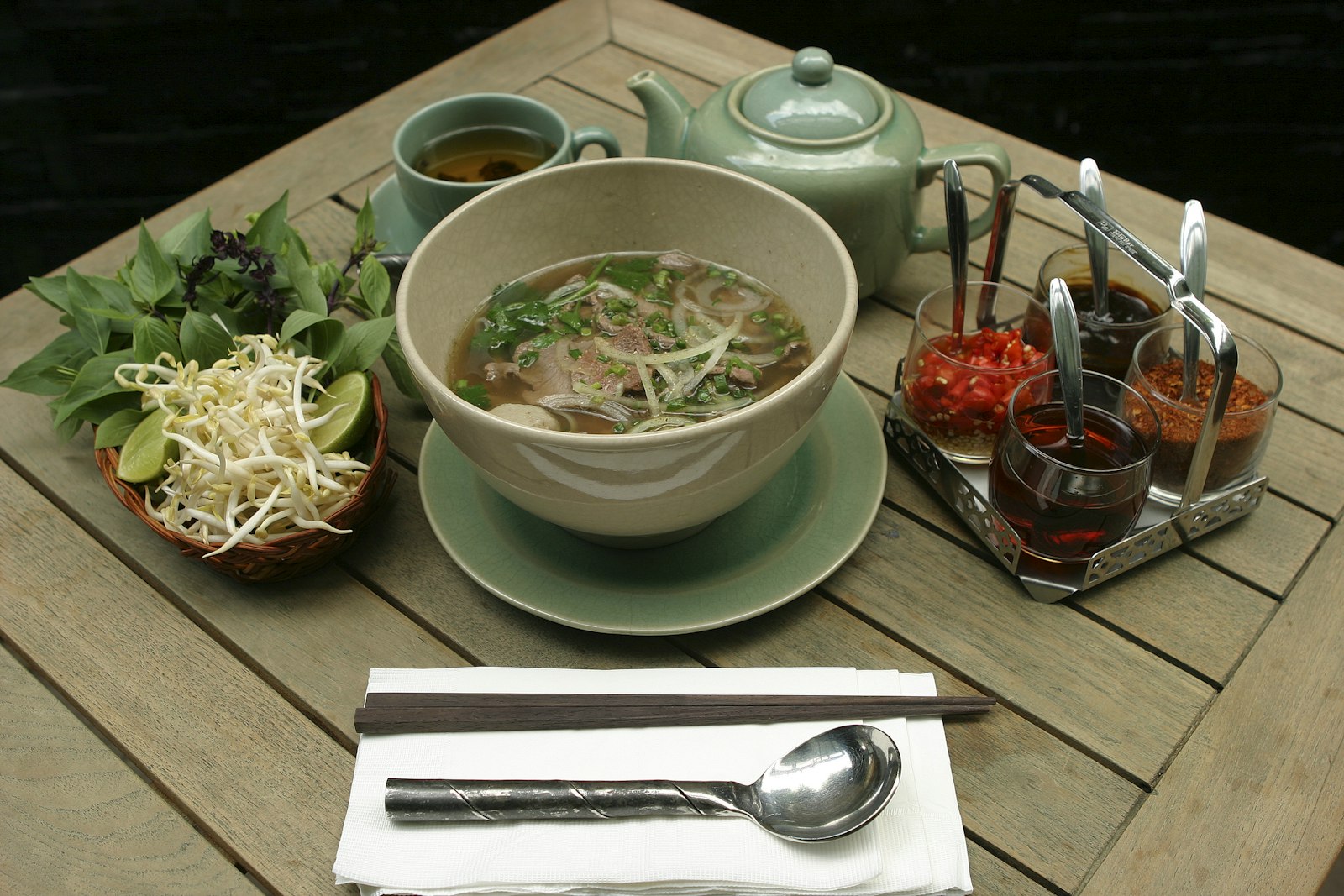
This is why you came. Start with phở at Phở Gia Truyền Bát Đàn (49 Bát Đàn) — a no-frills queue-and-pay institution; the bò chín broth is deep, clean, beef-forward, around 50,000 VND ($2). For bún chả — grilled pork patties and belly in a warm sweet-sour fish-sauce broth with cold vermicelli — the famous stop is Bún Chả Hương Liên (24 Lê Văn Hưu), now branded 'Bún chả Obama' since the 2016 Obama–Bourdain visit. The 'Combo Obama' (bún chả, a crab spring roll, a Bia Hà Nội) runs 130,000 VND (~$5). Honest note: it's good but touristy and pricier than the neighborhood norm; for a quieter, equally fine bowl try Bún Chả Đắc Kim or any smoke-wreathed lunch stall. Don't miss bánh cuốn — gossamer steamed rice crêpes filled with pork and wood-ear mushroom — at Bánh Cuốn Bà Hoành (66 Tô Hiến Thành). For chả cá, turmeric-and-dill fried fish sizzled tableside, go to Chả Cá Thăng Long (19–21 Đường Thành), ~170,000 VND/person. Finish with the original egg coffee (cà phê trứng) at Giảng Café (39 Nguyễn Hữu Huân), 30,000–45,000 VND — a meringue-like whipped yolk custard over strong coffee. And at dusk, pull up a plastic stool for bia hơi, the fresh draft beer brewed daily, at the Tạ Hiện corner for around 10,000–15,000 VND a glass.
Things to do
Anchor your days on Hoan Kiem Lake (Hồ Hoàn Kiếm), the city's beating heart — cross the scarlet Huc Bridge to Ngoc Son Temple, and come at dawn to watch Hanoi exercise before the heat. The surrounding Old Quarter is the main event: wander the 36 guild streets, each historically dedicated to a trade (Hàng Bạc for silver, Hàng Mã for paper goods), and time a visit for the weekend night market. For history, the Temple of Literature (Văn Miếu) — Vietnam's first university, founded 1070 — is genuinely worth the ticket, its courtyards and stelae a calm counterpoint to the streets. The Vietnamese Women's Museum and the Ho Chi Minh Mausoleum complex round out the serious sightseeing. A real-talk caution on Train Street: as of 2026 the famous Phùng Hưng track lane is heavily restricted — group tours were banned in March 2025, and access comes only through licensed trackside cafés, with checkpoints that open and close without notice. It's atmospheric but no longer the easy photo op Instagram promises, and authorities have floated removing the line entirely. For an evening, the Thang Long Water Puppet Theatre delivers a charming, distinctly Vietnamese art form.
Food journalist based in Seoul. Restaurant criticism, regional cuisines, comparative analysis. Hawker stalls and tasting menus, same standards.
✦ More from David Park


✦ Discussion
Start the discussion
No replies yet — yours could be the first.