
Best and Worst Months to Visit Thailand
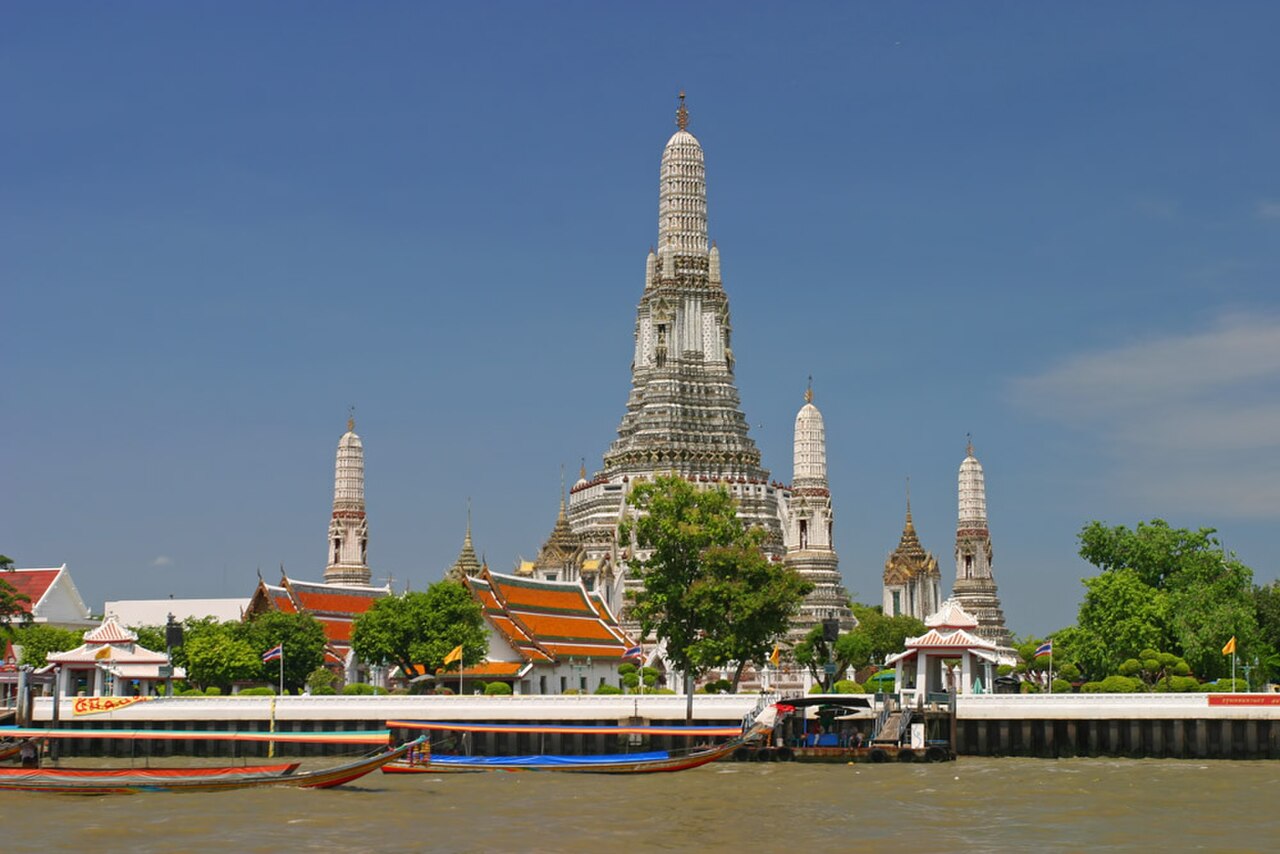
The light tells you which Thailand you have arrived in before the calendar does. In the third week of January, the sun comes off the Chao Phraya at a low, clean angle — a raking light, the kind that finds every ridge of porcelain on the spire of Wat Arun and throws the orange tile of the riverside roofs into relief. By the third week of April that same light has gone vertical and white, a flat overhead glare with no mercy in it, and the river itself seems to give off heat. By July the sky has lowered to a soft monsoon grey, a diffuse light that erases shadows and saturates every green it touches.
Three skies. One country. The trick to timing Thailand is knowing which of the three you want — and knowing that the islands quietly keep a different calendar from the mainland.
Three skies, one country. The art of timing Thailand is knowing which of the three you came for.
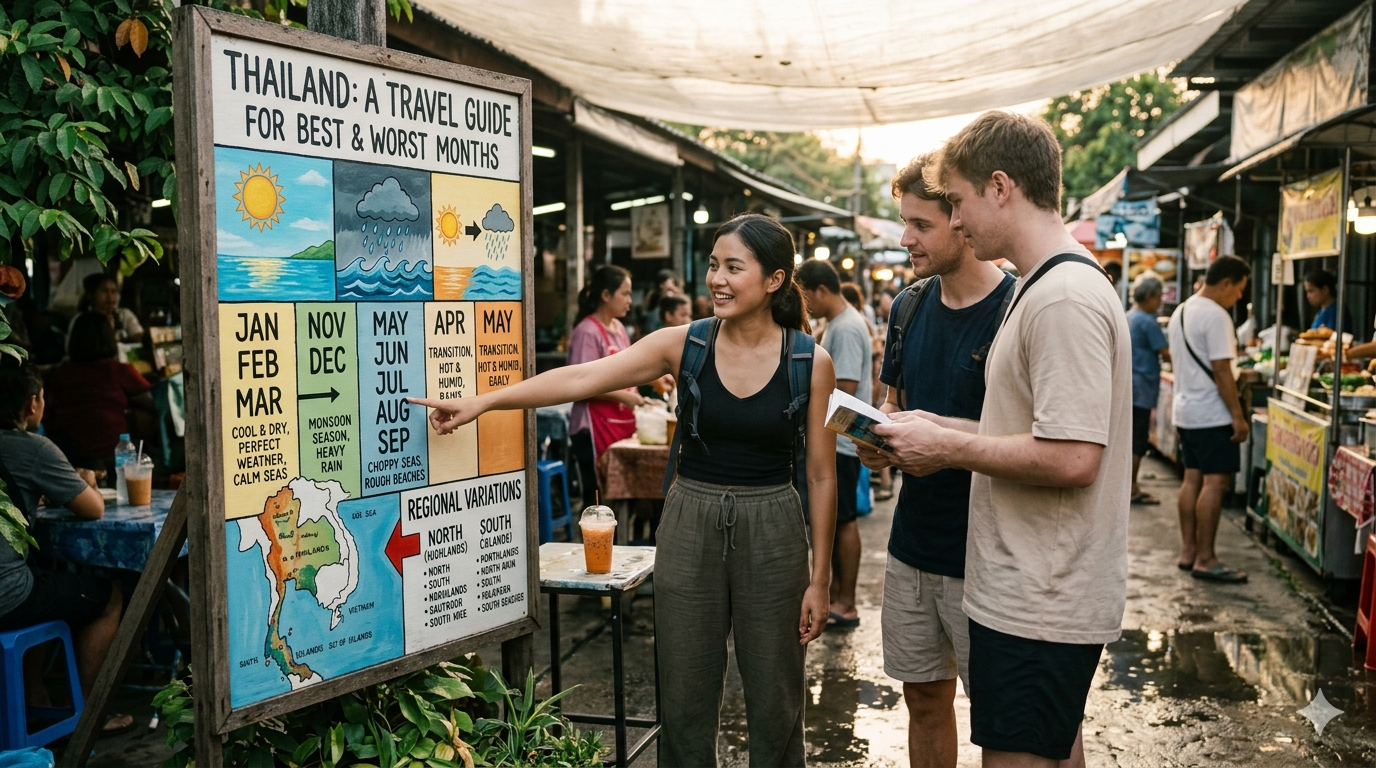
This is a guide for the traveller who reads weather the way a photographer does — not as a column of average temperatures but as a quality of air, an angle of sun, a probability of cloud. Thailand runs three seasons: the cool-dry months from November to February, the hot months of March to May, and the green or monsoon months from June to October. Each trades something for something else. None of them is wrong. But one of them is almost certainly right for you, and the worst month for one traveller is another's quiet, half-priced reward.
November to February — the Cool-Dry Season, and Why Everyone Is Right
This is the window the whole region agrees on, and the agreement is earned. From November through February, the northeast brings down dry continental air, the humidity drops, and the sky clears to a hard, dependable blue. Daytime temperatures across central Thailand sit around a comfortable 27°C, falling to the low twenties at night. In the northern hills around Chiang Mai and Chiang Rai, dawn can drop below 15°C — cold enough that you will want a layer for the early start, cold enough that the valleys hold mist until the sun burns it off around eight.
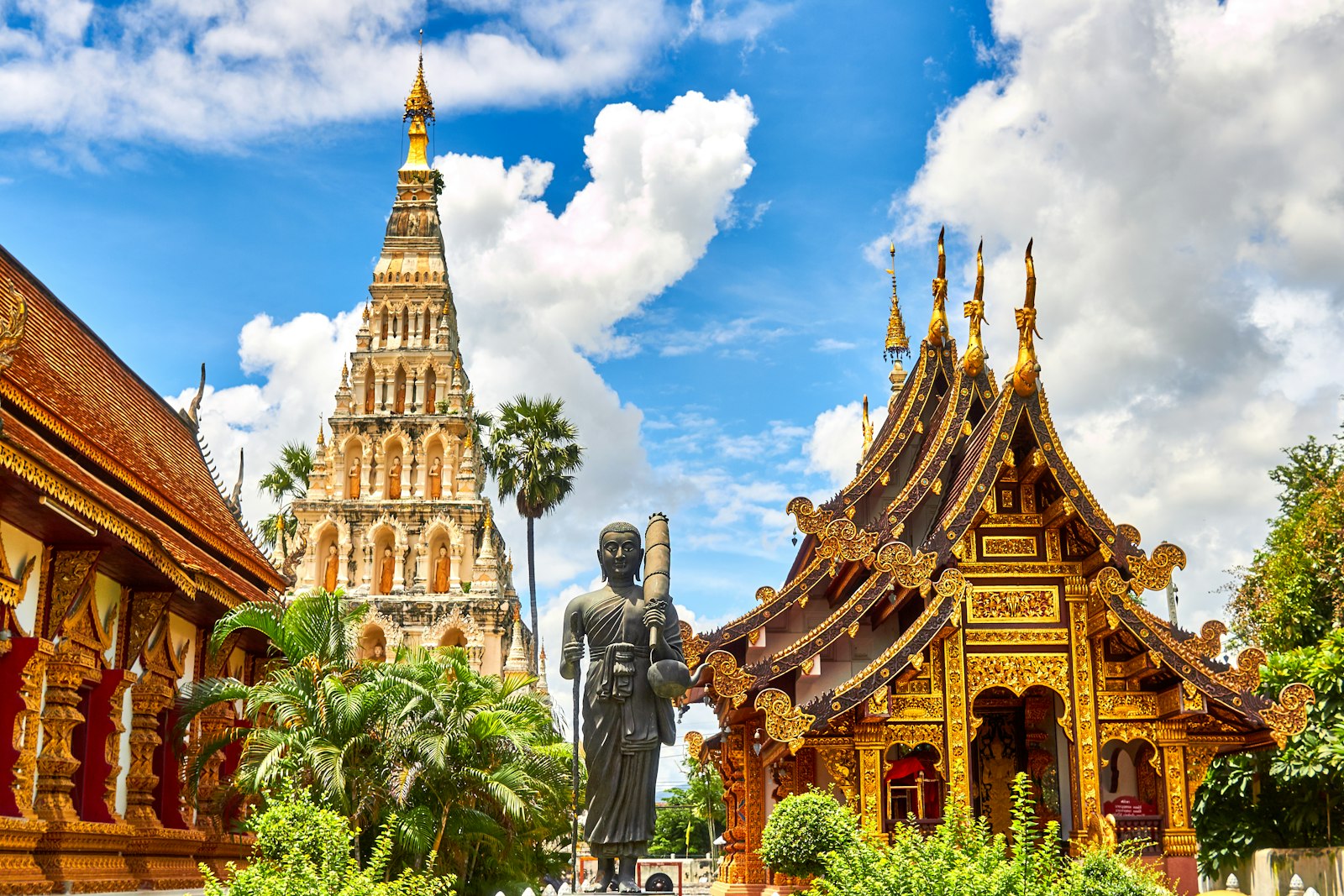
For a photographer this is the generous season. The air is clear, so distance reads cleanly — ridgelines stack into the haze instead of dissolving into it. Sunrise is genuinely worth the alarm: in December, the sun comes up over Bangkok at roughly 6:40am and sets near 6:00pm, which gives you a short, well-defined golden hour at each end and a long usable middle. Temple gold against that cool blue is one of the most reliable frames in the country — the gilded chofa, the horn-like finial at the roof's gable, catches the first light like a struck match.
The cost is other people, and money. This is high season, and the prices know it. Beach resorts and the better hotels run their peak rates from roughly mid-November through February, and the fortnight around Christmas and New Year is the most expensive and most crowded stretch of the entire Thai year — book it months ahead or skip it entirely. The popular temples of Bangkok and Ayutthaya, and the marquee viewpoints of the north, fill early. If you want the cool season without the crush, aim for the first half of November or the back end of January, and start your days before the tour buses do.
One regional warning earns its place here. By late February the burning season can begin in the north. Farmers clear fields with fire, forest fires follow, and Chiang Mai — which sits in a mountain basin that traps smoke — can slide from clean air into genuine haze. In 2026 the city repeatedly ranked among the most polluted in the world through March, with PM2.5 readings climbing into hazardous territory. The cool season is the right season for the north — but lean toward November, December and January, and treat late February as the edge of a closing door.
March to May — the Hot Season, and the White Light of April
Then the heat arrives, and it does not negotiate. From March the temperature climbs week on week; April is the furnace, with central and northern Thailand routinely pushing past 35°C and the air thick enough to feel like a held breath. This is the season most guides label "worst," and for the midday hours of April they are not wrong.
But the hot season is also the answer to a specific question — when is Thailand at its hottest, most reliably rainless? — and for some travellers that is exactly the brief. If you want beach weather with the lowest chance of an afternoon storm and you can tolerate real heat, March is excellent and early April still holds. The Gulf and the Andaman are both warm and largely dry. The light, though, changes character entirely: gone is the raking gold of January, replaced by a high, white, near-shadowless glare. As a photographer I treat April as a discipline. Shoot the first ninety minutes after sunrise and the last ninety before sunset; surrender the middle of the day to shade, to interiors, to a slow lunch. The compensation is the heat-haze itself — shimmer rising off laterite and asphalt, distance softening into a pale wash, a particular dreamlike compression when you reach for a long lens.
And April carries the country's defining event. Songkran, the Thai New Year, runs nationally on 13–15 April 2026, with Chiang Mai stretching its official celebrations across a far longer span — the city has confirmed festivities from 6 to 17 April. Strip away the city-wide water fight the cameras love and Songkran is, at root, a gesture of cleansing: water poured over Buddha images and over the hands of elders, a washing-away of the old year. It is photographically extraordinary and logistically demanding — transport books out, prices firm up, and your camera will want serious protection from the water. Go for it deliberately, or plan firmly around it. There is no middle path with Songkran.
The Two Coasts — Why Phuket and Koh Samui Refuse to Agree
Here is the single fact that undoes more Thai itineraries than any other: the two coasts run opposite rain seasons. Treat "Thailand's beaches" as one weather system and you will, sooner or later, fly straight into the wrong one.
The Andaman coast on the west — Phuket, Krabi, Koh Lanta, the Phi Phi and Similan islands — takes the southwest monsoon. Its wet season runs roughly May to October, bringing heavier showers, grey skies and a swell that closes some of the smaller dive and snorkel operations. Its dry, brilliant window is November to April.
The Gulf coast on the east — Koh Samui, Koh Phangan, Koh Tao — answers to a different wind. The Gulf's wettest stretch falls later: October through December, with November the soggiest month of all. Which means that in November, when Phuket is drying out into its finest light, Samui is finishing its monsoon under cloud.
Treat "Thailand's beaches" as one weather system and you will, sooner or later, fly straight into the wrong one.
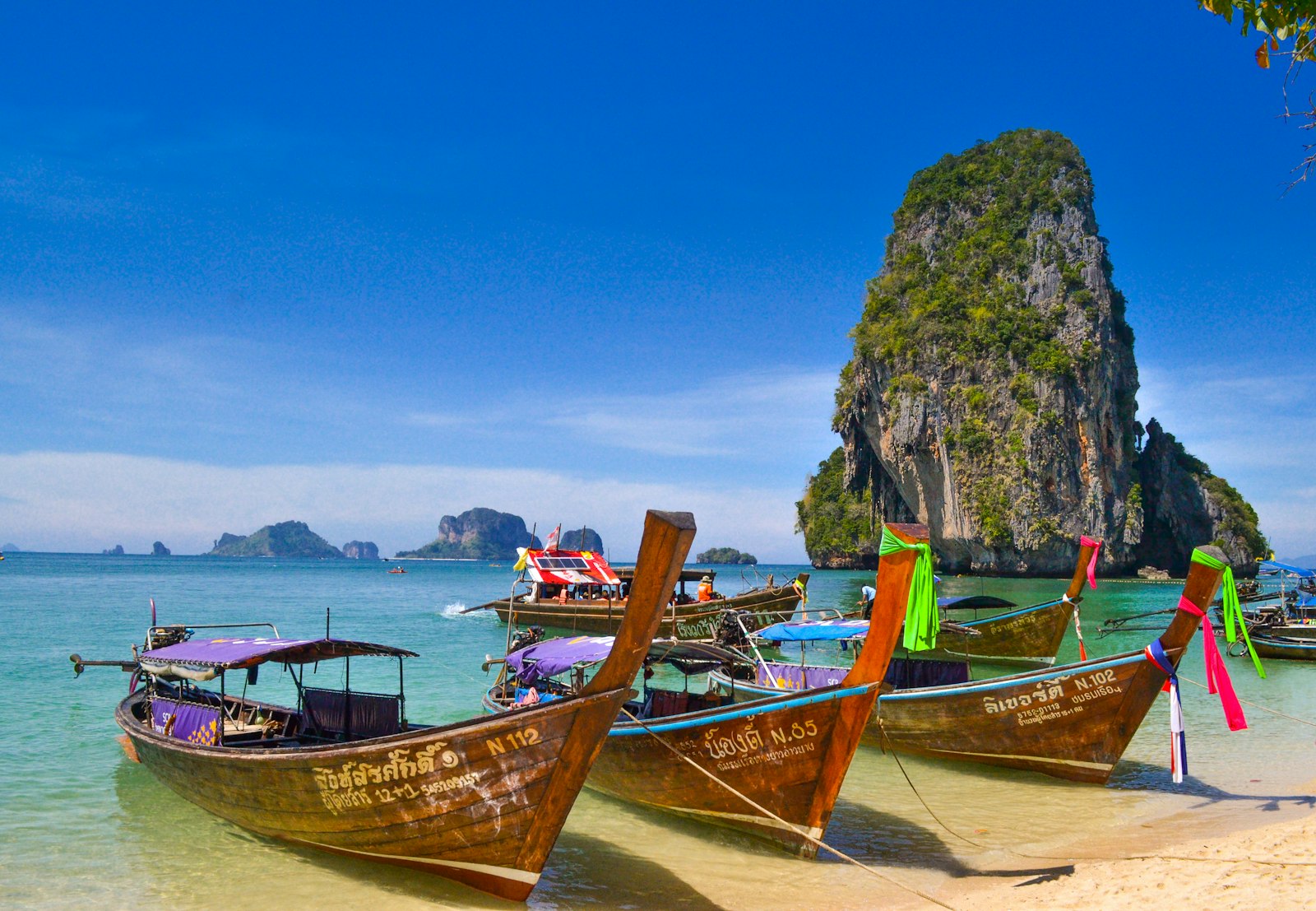
The practical reading is liberating once you have it. Travelling in July or August — the European and Australian summer holidays, deep in the Andaman's wet season — do not write off the islands. Cross to the Gulf. Koh Samui, Koh Phangan and Koh Tao are typically sunny and dry then, their shallows running that green-tinted teal over pale sand, the colour of oxidised copper held up to light. Travelling in November or December, do the reverse: choose the Andaman, where Railay's limestone towers stand crisp against a cloudless sky and the longtails lie beached on dry sand in hard, clean morning light. The shoulder months — April, and again September into October — are the genuine sweet spots, when neither coast is at its worst and prices have not yet hardened.
June to October — the Green Season, and What "Worst" Actually Trades

Now the season the brochures undersell. From June the southwest monsoon settles in across most of the country, and the marketing language turns cautious. But "rainy season" is doing a lot of unfair work in that sentence.
June through August is the early green season, and its weather is more predictable than its reputation. The pattern is a short, heavy, theatrical downpour — often in the late afternoon — that clears within an hour and leaves the air rinsed and cool. Many days stay mostly dry. September and October are the heavier, less predictable end, when storms can settle in for longer and the Gulf coast begins its own monsoon. This is the stretch that genuinely earns caution, and the stretch I would not build a tight island itinerary around.
What "worst" actually trades is this: you give up the guarantee of an unbroken blue sky, and in exchange you get the country at its most alive and least expensive. Low-season room rates fall hard — discounts of up to 50% are routine on the islands and in beach towns like Krabi, and a hotel that lists near 8,600 baht (roughly USD 240) in peak season can drop toward 2,800 baht (about USD 80) in the green months. Flights soften too. October in particular tends to stay cheap because the crowds have not yet returned — one of the most underrated months in the Thai calendar.
For a photographer the green season is not a compromise; it is a different and arguably richer commission. The light goes soft and diffuse, a flat overcast that behaves like a vast natural softbox — no blown highlights, no crushed shadows, every surface evenly described. The rice terraces of the north run an electric, saturated green you simply cannot find in the dry months. Storm light is its own gift: the bruised indigo of an advancing squall behind a gilded temple roof, the brief, low, gold-shafted clearing the moment a downpour breaks. Bring a rain cover, build slack into your plans, and accept that the weather is now a collaborator rather than a backdrop.
So — Best and Worst, Honestly
If you want one verdict: the best all-round months to visit Thailand are November, December and January — clear air, comfortable heat, the cleanest light, the whole country open. If that is your window, book early and start your mornings ahead of the crowds.
The hardest month to love is April — peak heat nationwide, Songkran congestion, and in the north a haze that in 2026 turned dangerous. But "hardest" is not "avoid." April is the right month if you specifically want hot, dry beach weather, or if Songkran is the reason you are coming at all.
The genuinely underrated months are the green ones — June through August especially, and October for the value. You trade certainty for low prices, soft light and a landscape at its most saturated.
And whatever month the calendar gives you, let the coasts decide your beach. Andaman for the November-to-April dry season; Gulf for the June-to-September window when the west is under cloud.
A last thought, the one I keep coming back to. Thailand photographs differently in every season, but it is never not worth photographing. The cool months give you clarity; the hot months give you that strange white shimmer; the green months give you saturation and storm and a country half-empty of other travellers. There is no wrong door. There is only the question of which light you came for — and the quiet discipline of being awake when it arrives.
Italian travel photographer-writer. Architecture, landscape, the light. Slow, deliberate, image-led essays.
✦ More from Marco Rossi


✦ Keep reading
More from this region

More in Destinations
✦ Discussion
Start the discussion
No replies yet — yours could be the first.