
Start with the question that actually matters
People agonise over which Thai island is "the best," and it's the wrong question. There isn't a best one. There's the right one for the kind of trip you're taking, at the time of year you can actually go. Get those two things straight and the choice almost makes itself.
Thailand's beaches split across two coasts that sit on opposite weather clocks. The Andaman side, west, is the postcard one: limestone karsts, Phuket, Krabi, Phi Phi, Koh Lanta. The Gulf side, east, is the backpacker-to-honeymoon archipelago of Koh Samui, Koh Phangan and Koh Tao. The two coasts are wet at different times, which is the single most useful fact in this whole article. Pick the coast that's dry when you're travelling first; pick the island second.
Monsoon timing: get this right and everything else is easy
The Andaman coast (Phuket, Krabi, Phi Phi, Koh Lanta) is reliably dry and calm roughly December to April. Its wet season runs May to October, with the heaviest rain and rough seas around September. The Gulf coast (Samui, Phangan, Tao) is offset: its driest, calmest stretch is broadly January to April and again July to September, while its wettest, windiest months are October to December, peaking in November.
This is genuinely useful, not trivia. If you can only travel in November, the Andaman is the safer bet because the Gulf is at its soggiest. If you're going in July or August, both coasts are workable, but the Gulf often stays calmer for ferries while the Andaman gets the odd heavy downpour. "Wet season" rarely means rained-out all day, by the way; it usually means a dramatic afternoon deluge that clears. The real cost of low season isn't the rain, it's the sea state, choppier water, cancelled boats, and murkier visibility for snorkelling.
Prices and crowds follow the same clock in reverse. December through February is peak everywhere on the Andaman, beautiful weather, highest prices, busiest beaches. If you want the karst scenery without the December crush, aim for late April or early November shoulder weeks and accept a gamble on a few wet days.
The Andaman coast: karsts, snorkelling, and easy family bases
Phuket is where most first-timers land, and it earns the reputation despite being the island people love to look down on. It has the international airport, the hospitals, the family resorts, the supermarkets and the pharmacies, which matters enormously if you're travelling with kids or older parents. Base yourself in Kata, Karon or Bang Tao for calmer family beaches and skip Patong unless you specifically want nightlife and neon. Phuket is the lowest-stress entry point to the region, full stop.
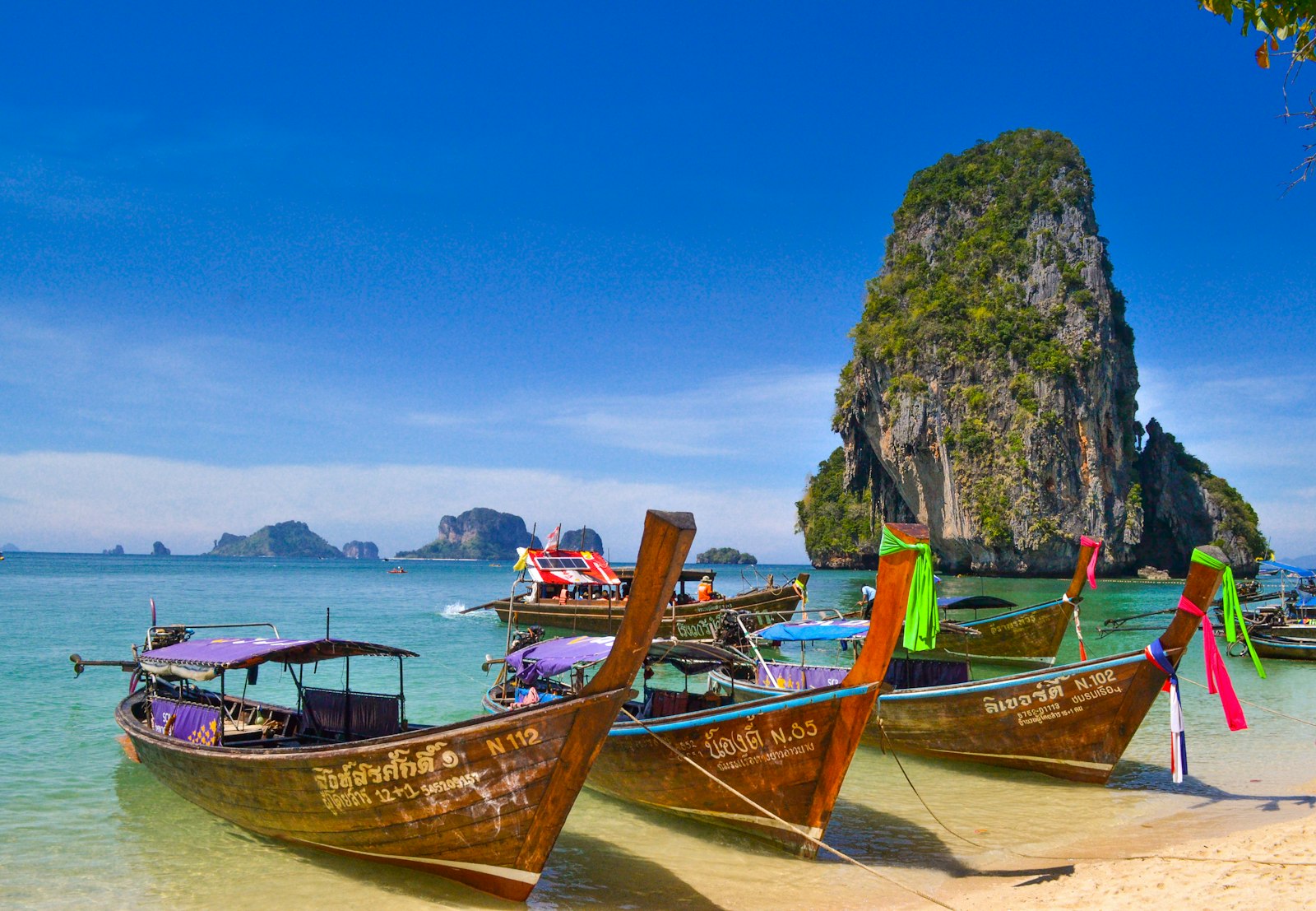
Krabi (Ao Nang and Railay) gives you the dramatic limestone scenery with a more low-key feel. Railay is cut off by headlands, so you arrive by longtail boat, no roads, which is half its charm and the reason it feels like an escape ten minutes from town. Ao Nang is the practical mainland base for island-hopping day trips.
Koh Lanta is the one I steer families and quiet-seekers towards. It's long, flat, easy to get around by scooter or taxi, with a string of west-facing beaches that get gentler and emptier the further south you go. It has restaurants and conveniences without the sensory overload of Phuket. Phi Phi, by contrast, is gorgeous and knows it, day-trip boats descend en masse on Maya Bay, and Phi Phi Don's main village is a compact party hub. Stunning for a night or a day tour; not where I'd park young kids for a week.
The Gulf coast: Samui's comfort, Phangan's parties, Tao's diving
Koh Samui is the Gulf's all-rounder and the family-friendly anchor of the three. It has its own airport (handy, but Bangkok Airways' near-monopoly makes flights pricey), proper hospitals, big resorts and calm beaches like Choeng Mon and the quieter end of Chaweng. It's the Gulf equivalent of Phuket: developed, convenient, easy with kids.
Koh Phangan is two islands in one mood. Most of the year it's a laid-back, yoga-and-hammock kind of place with lovely quiet north and east coast beaches. Then, around each full moon, the south at Haad Rin transforms into the Full Moon Party, tens of thousands of people, buckets of spirits, an all-night beach rave. Families and quiet-seekers can absolutely enjoy Phangan; just stay well north of Haad Rin and check the full-moon calendar before you book, because accommodation and ferries go haywire that week.
Koh Tao is small, and it's the diving and snorkelling capital of the Gulf, one of the cheapest and most popular places in the world to get your open-water certification. It skews young, active and budget. There's no airport, so you arrive by boat, and it's the least suited of the three to non-swimmers, toddlers or anyone wanting resort polish. For teens learning to dive, though, it's hard to beat.
Ferries and getting around: the part nobody warns you about
Island time is real, and it starts with the boats. Inter-island ferries get cancelled in rough seas, run late, and often involve a transfer onto a smaller speedboat or longtail where you wade the last few metres carrying your bag, and your toddler, over your head. Pack a dry bag for phones and documents, and don't book a tight onward connection on a ferry day. Build a buffer night near the airport before any flight home rather than gambling on a same-day boat-plus-flight.
Crucially, you cannot easily hop between the two coasts. Andaman to Gulf is not a quick boat ride; it's a long combination of ferry, bus and/or a domestic flight via Bangkok or Surat Thani. So don't plan to mix Phi Phi and Koh Phangan in one short trip, pick a coast and explore within it. Within a coast, hopping is easy: Phuket–Phi Phi–Lanta on the Andaman, or Samui–Phangan–Tao on the Gulf, are all comfortable ferry triangles.
On the islands themselves, scooters are everywhere and cheap, but rentals come with under-insured risks and unfamiliar roads, so factor in metered taxis, songthaews (shared pickups) or a private driver for the day if you've got kids or aren't a confident rider.
So which one? A cheat sheet by traveller
Families with young kids: Phuket (Kata/Karon/Bang Tao) or Koh Lanta on the Andaman; Koh Samui on the Gulf. All three have hospitals, pharmacies, calm beaches and resorts with pools and kids' facilities, the safety net you want when someone's three and has a fever at 2am.
Couples and honeymooners wanting beauty with comfort: Krabi/Railay or a quiet Koh Lanta resort on the Andaman; the north of Koh Phangan or a Samui boutique on the Gulf.
Partiers and young backpackers: Koh Phangan for the Full Moon Party, Koh Tao for diving and a younger scene, or Phuket's Patong if you want it loud and easy to reach. Quiet-seekers wanting to disappear: southern Koh Lanta, the Andaman's smaller islands like Koh Yao Noi, or Phangan's east coast, all deliver genuine calm if you go in the right season and avoid the headline beaches.
The bottom line
Choose your coast by the calendar, then choose your island by your tribe. Travelling November to April? The Andaman is the safe, sunny default, Phuket or Lanta for families, Krabi for scenery, Phi Phi for a day trip not a base. Stuck with the shoulder months or going mid-year? Look hard at the Gulf, Samui for comfort, Phangan for the party (or the peace, depending where you stay), Tao for diving.
Whatever you pick, don't try to do both coasts in a week, don't book a same-day ferry-and-flight, and don't let anyone tell you Phuket is "too touristy" to enjoy with kids. The infrastructure that makes it busy is exactly what makes it easy. Get the coast and the season right, and there genuinely isn't a wrong island left to choose.
Australian family-travel writer based in Brisbane. Mother of three. Family-friendly SE Asia, multi-gen trips, the boring practical bits.
✦ More from Emma Wilson


✦ Keep reading
More from this region


More in Destinations
✦ Discussion
Start the discussion
No replies yet — yours could be the first.